The Ten Commandments, How Deep Our Debt



No matter where they stand on Alabama Chief Justice Roy Moore's fight to keep his Ten Commandments monument on display at the Alabama Judicial Building, Americans agree that it is symbolic. But symbolic of what?
I will not try to prove Moore's claim that the Decalogue is "the moral foundation of law in this nation." But, without question, it is central to Jewish and Christian morality. And, also without question, it is deeply embedded in Western—especially Anglo-American—culture.
We've all heard these ten commands many times. As familiarity may breed contempt, it's worth hearing them once more, a little differently. The following is a summary of the version that appears in Deuteronomy 5 (the other, slightly different version is found in Exodus 20):
God identifies himself by what he has done. He brought his people out of Egypt. They are to have no other gods. He is invisible. They must not try to make an image of God or express him in terms of heavenly bodies or earthly creatures. Any idol of God would be pitifully inadequate and dangerously misleading. Instead, God wishes to be known by his passion for his people: his jealousy for their love, his hatred of their wickedness and his lasting commitment to their well being.
God's name is utterly holy. It sums up his personality and purpose. It is a serious thing to abuse God's name, by taking it lightly or using it to endorse empty promises.
The Sabbath day is to be kept holy. It is a day when the whole community—including servants, animals, visitors and strangers—has time and space to rest and reflect.
Children are to honor their parents. Families are to be bonded by obedience as well as affection. Elderly parents are to be provided for by their children. Soundly built families make a strong and stable society.
Human life, marriage, possessions and reputations are all to be respected. In particular, jealousy is to be tackled at source—in the heart. A neighbor is any fellow human being—not just a person who lives nearby. Another person's partner and possessions are not negotiable. Don't even think it! (Andrew Knowles, The Bible Guide: An All-in-one Introduction to the Book of Books [Augsburg: 2001], 95-96.)
These are, above all, the commandments of a God who loves his people. He makes a covenant with them, freely, on his own initiative. To live by these commandments is to respond rightly to God's prior grace. It is to live as part of a covenant community with that loving God.
Long before it became, through the mediation of Christianity, the moral property of Gentiles, the Decalogue was the law code and constitutional center of a theocratic state—the Hebrew nation formed at Sinai. Long before Christian theologians grappled with its relationship, as the "old covenant," with the "new covenant" in Christ, the rabbis treasured, interpreted, and applied it in a kaleidoscope of ways.
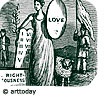
Because it represents the responsibilities of a covenant, the Decalogue was probably not divided (as some imagine) into two tablets, each containing five commandments. Rather, there would have been one complete record for each partner in the covenant—symbolizing that this is a mutual relationship. Not only did the commandments come from a loving God, they enjoined love in return. Jesus made this clear when, faced by the Pharisees' question, he summarized all the commandments in two: Love to God and love to neighbor (Matt 22:34-40).
Not that Christians have somehow risen above the need to keep the Ten Commandments. This is clear from Jesus' response to another questioner—the rich young ruler (Matt. 19:17). "Because of His advent in the flesh," as the second-century teacher Irenaeus said, the Ten Commandments "have received extension and increase, but not abrogation." In plain language, they have been amplified, in the Sermon on the Mount and others of Jesus' teaching; they have not been set aside.
Though the Ten Commandments may not be popular with everyone in pluralist America, few would go so far in their criticism as the ancient Manicheans, who believed them to be the work of an evil principle. In part because of such extreme views, the church had, by Augustine's day, placed the Decalogue at the heart of the instruction received by catechumens preparing for baptism.
The commandments were always taught in the church, but they took on a weightier authority at several points in history.
The "Ten Reminders"
for example, in the thirteenth century, the "schoolmen" or scholastics—including the great Thomas Aquinas—picked up the argument of Irenaeus's younger contemporary, Tertullian, that the commandments had been engraved on the hearts of all humanity before they were ever engraved on stone. They treated the Decalogue part of the "natural law"—part of the very nature of things, accessible to the reason of all people. For such teachers (and for most Christians ever since), God gave this central pillar of the Law not as a news flash, but as a reminder of what would be common knowledge, were it not for sin's obscuring influence.
At the sixteenth-century Council of Trent, the Roman Catholic Church made the Decalogue one of the "four pillars of catechesis," (that is, of the church's teaching office) along with the Creed, the liturgy, and the Lord's Prayer. Today's Catechism of the Catholic Church reaffirms its centrality, adding a reaffirmation of Augustine's words: "Every commandment concerns charity [that is, love]."
Among the sixteenth-century Reformers, Luther commented on the commandments fully in his Catechisms. Calvin prescribed their regular reading in worship, in order to "bring our consciences into subjection to his Law." He also insisted, as had few before him, that the fourth commandment—to keep the Sabbath holy—be strictly observed.
It was this heightened Reformation attention to the commandments that influenced Queen Elizabeth to order that the Decalogue be painted over the communion table in all the land's churches—often over existing altar paintings. During her time, the official sermons appointed to be read from Church of England pulpits included messages on the second, third, seventh, eight, ninth, and tenth commandments.
England soon found itself divided over how much Christians, living in Christ's grace, needed to observe literally all the law's requirements. The Puritans tended to take Calvin's stronger view (though some wondered, in light of their well-known successes in the world of business, whether the Puritans took the eighth commandment as seriously as some of the others).
The accomplished but troubled Calvinist poet William Cowper (making a cameo appearance in our Winter 2004 issue on John Newton) saw the Decalogue as a code handed down in a way calculated to arouse fear, which still held fearful power over hapless humanity:
Marshalling all his terrors as he came;
Thunder, and earthquake, and devouring flame;
From Sinai's top Jehovah gave the law—
Life for obedience—death for ev'ry flaw.
When the great Sov'rein would his will express,
He gives a perfect rule; what can he less? ('Truth,' 547-52)
Cowper wrote that those who persisted in breaking commandments, such as that to keep the Sabbath, would find "mercy cast away" (Bill of Mortality, 1793). John Bunyan's Pilgrim's Progress reflects the same stern vision: when Moses finds Christian, he treats him harshly on account of his sins, saying, "I know not how to show mercy."
The Ten Commandments were central to English law from the beginning. King Alfred the Great (849-99), King of Wessex from 871, a deeply pious promoter of Christian learning and ecclesiastical reform, placed the Decalogue as a prefix to his own legal code. This was no mere nod in God's direction, as at that time the moral and the civil law stood together as one. Hundreds of years later, William Tyndale (c. 1494-1536) would argue that the "law of the kynge is Gods lawe" (Obedience of a Christian Man, 79).
It should not surprise us, then, to find at the roots of America a concern to govern the new nation according to the dictates of the Decalogue. The most radical example of this concern was the theocratic state of the Massachusetts Bay Colony, which wove into its laws much of the Old Testament law.
The jury is still out on the question of to what degree this concern animated the founding fathers. But the older tradition of English and American legal and moral thought was undergirded by these commandments. Are we that much smarter than our forebears? Time will tell.
Chris Armstrong is managing editor of Christian History magazine. This article is indebted to David Lyle Jeffrey's excellent essay on the Ten Commandments in his Dictionary of Biblical Tradition in English Literature (Eerdmans, 1992).
Copyright © 2003 Christianity Today. Click for reprint information.

Support Our Work
Subscribe to CT for less than $4.25/month