Holy America, Phoebe!



America's modernized, industrialized, consumerized, urbanized, television-ized culture doesn't make it easy for its Christian believers to live consistently holy lives. Today we will meet a group of people who took up this challenge and changed America forever. We will also meet the extraordinary woman who led their movement: a middle-class matron named Phoebe Palmer.
Even in the whirl of a swiftly secularizing society, Americans have always found ways to pursue holiness. Some—like the Old Order Amish and Benedictine monastics—have entered enclaves and taken countercultural vows of abstinence and obedience. They would tell you that America is simply too easy to love, and that the only way to lead a God-honoring life surrounded by the secularized masses is to "come out from among them" (2 Corinthians 6:17).
Others, though equally wary of the many traps American culture sets for the feet of the disciple, have dedicated themselves to seeking holiness in the thick of things. Executives, laborers, soldiers, teachers, stay-at-home parents … these intrepid souls have tried to live holy lives right out in the marketplace—pursuing John the Disciple's fine art of "being in but not of the world" (John 17:14-16).
Of course, the problem of living holy in an unholy world is not uniquely American—or uniquely modern. Yet, at certain times and places, the Christian battle for personal and public holiness has become more intense.
One such time and place was the mid-1700s on the teeming, industrializing landscape of England. There, amidst a close circle of Oxford friends derisively labeled "the Holy Club" by less spiritually earnest undergraduates, John Wesley caught his namesake John the Disciple's vision of an engaged holiness. He began to gather non-Christians and nominal Christians—anyone who could honestly say that they were "fleeing the wrath to come"—into small groups and catch them up in the quest to "become blameless and pure, children of God without fault in a crooked and depraved generation, in which you shine like stars in the universe" (Philippians 2:15).
Soon Wesley's first, small constellation of "Methodist" believers grew into a galaxy of thousands—launching the transatlantic evangelical revival of the eighteenth century.
During Wesley's day, thousands of Americans were also experiencing Christian salvation and beginning to learn what it means to live for heaven in an often-unsympathetic world. These were the converts of the Great Awakening, swept into the faith by such preaching stars as the Connecticut pastor and theologian Jonathan Edwards and the Englishman George Whitefield (a member of Wesley's Oxford "Holy Club").
Soon after the heyday of the 1740s, the glow of revival receded for a time. Then, in the first decades of the nineteenth century, it re-kindled on the American frontier, drawing new strength through the camp meetings and circuit riders of that brawling, sprawling age. More often than not, the Methodists led the way.
Nothing seems to douse revival like prosperity, however. By the mid-1800s the Victorian era was in full swing, and churches founded in the white heat of frontier enthusiasm were building lavish faux-gothic facades and enjoying the refined preaching of educated, citified ministers.
In reaction, many Victorian American Methodists yearned to experience again the fiery devotion of their parents and grandparents. It was no lukewarm, respectable "churchianity," they insisted, that had propelled John Wesley's movement for salvation and holy living across the Atlantic and into the groves and cabins of the American frontier—breaking down human hearts and building them up again.
No, the Methodists of the mid-nineteenth century's "new middle class" kept alive the stories of their parents and grandparents. They knew that Wesley and the early American Methodists had really experienced God's "incomparably great power for us who believe" (Ephesians 1:19). They knew it was this electric, motivating spiritual power that had propelled those earlier Methodists to preach the Gospel everywhere and to live holy lives. Now, felt many Victorian Methodists, it was time to go before God in prayer and recover that power for a new generation.
Out of this Methodist impulse to recapture the "old-time religion" emerged the single most influential American religious movement of the nineteenth and possibly the twentieth century: the "holiness movement."
At this new movement's helm sat (or rather, to mix metaphors but more nearly capture her personality, marched) a person who today is virtually unknown. In 1840, a middle-class Methodist matron named Phoebe Palmer (1807-1874) began leading "Tuesday Meetings for the Promotion of Holiness" in the parlor of her New York City home. A woman of extraordinary gifts, within a decade she became the leading voice in a growing chorus of American Christian voices discontented with church-as-usual. Tireless in her religious activism, she managed over the years that followed to launch a transatlantic revival, lay the theological framework for the denominations that would emerge from it (for example, the Church of God [Anderson, IN)] and the Church of the Nazarene), and create a new model for Christian social ministry in America.
This last fact may surprise us. We may have a hazy image of holiness folk as "holy-rollers": a bunch of experience-seekers content to revel in the presence and power of their Lord. The truth is far different. The holiness believers' pursuit of a "higher Christian life" led them onward into a dynamic practice of social holiness. As the late Dr. Timothy Smith argued some 50 years ago in his book Revivalism and Social Reform (indeed, argued so persuasively that he is not seriously doubted even today), the holiness movement was in fact the seedbed of the "social gospel" in America.
Out of the fervor of camp meetings and mid-week prayer meetings where they heard personal testimonies and experienced God's power in direct, personal, even physical ways, people from Methodist, Presbyterian, Congregationalist, and many other churches emerged to act on their newfound convictions. They preached, certainly—and thousands were converted. But more than this, they established urban missions—and inner-city churches—to provide for the physical and spiritual needs of America's most destitute and depraved.
Palmer also pioneered in another sphere—encouraging the churches to recognize and encourage the gifting of women for ministry. Though few in the religious mainstream listened to her, Palmer's teachings on this matter were formative for holiness denominations. It was Palmer's closely argued Biblical case for women in ministry that inspired England's Catherine Booth to co-found with her husband William England's first Wesleyan holiness denomination, the Salvation Army—today the only major Western denomination in which more than half of ordained ministers are women. And by the end of the 1800s, when several holiness denominations had emerged from the movement in America, these groups, too, were ordaining women—long before mainline Methodism and most other mainline churches.
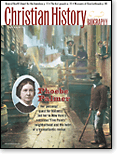
There is so much more to tell, and it has been a delight to tell it in our issue mailing next week: Issue 82: Phoebe Palmer and the Holiness Revival. In this issue, we introduce Palmer and follow her from the tragic loss of her infant daughter in a crib fire; to the fires of the revival meetings she preached in the U.S., Canada, and abroad; and into the darkest neighborhoods of New York's "Five Points" district (the scene of the movie Gangs of New York), where she helped found the seminal Five Points Mission. We also meet many other extraordinary people who spread that movement across every denominational boundary. And we see how their work changed the landscape of America. If this brief introduction has caught your interest, I encourage you to watch this page each week for a new article from this issue in the "From the Current Issue" section of our homepage, www.christianhistory.net.
Copyright © 2004 Christianity Today.Click for reprint information.

Support Our Work
Subscribe to CT for less than $4.25/month