

When Theology Comes Alive


An earlier version of this essay was given by Dr. Chris Armstrong (associate professor of church history, Bethel Seminary, St. Paul, and senior editor,Christian History & Biography) as a talk to the trustees of Bethel University on May 5, 2005.
Dorothy Sayers, a 20th-century, Oxford-educated dramatist, novelist, and lay theologian, wrote to wake up her sleeping Anglican church. She saw people inside and outside of the churches of her day completely unaware of how radical and powerful the gospel really is. And so she wrote essays, stories, and dramas that made the gospel come alive for people. She had a phrase she liked to use when she encountered people who thought church doctrine—"dogma" as it is still sometimes called—was dull and irrelevant. She would say, "The dogma is the drama!"
I love that. The dogma is the drama. What Sayers was reminding us was that if we are falling asleep in church, it is because we have no idea what dynamite we are sitting on.
And as I always remind my students, a wonderful place to go to see what happens when the Gospel's dynamite blows up in people's lives is Christian history. I'll put this idea in less violent form: Christian history is where theology comes to life.
As a historian working in a seminary, I have asked myself, who decided to make Christian history a part of Protestant seminary curriculums? Bible courses I understand. Theology is obvious. Preaching, counseling, Christian education all make immediate sense. But why Christian history?
To find the answer, we need to step into a time machine and travel to 17th-century Germany.
Quickly, we will see that theology was everything to Protestants of that time and place. Everywhere we find folks arguing heatedly over doctrine, sometimes to the point of violence. We find folks writing long confessional documents for other folks to sign. We find folks enforcing social barriers between their churches and other folks' churches, to make sure that their own pure theology is not contaminated.
Then along comes Philip Jakob Spener and his "Pietists." Spener—a universally respected Lutheran pastor—is appalled by the deadness and dryness and division and nastiness in the major Protestant confessions. He mourns over the age's theologia spinosa—"prickly theology." Christianity, Spener insists, is not just the memorization of catechisms and forms. Theology must be lived. It must be embodied in life. But too many Christian leaders are more concerned about being right than about being righteous.
Doing church differently
In pursuit of a living orthodoxy, Spener's Pietists created new practices. These innovations seem commonplace today—because they worked so well that they changed Protestant religion forever! Small-group Bible studies, spiritual formation programs at seminaries, ecumenical initiatives, lay engagement in spiritual disciplines … all came from the Pietists.
Unlike many modern conservative Protestants, the Pietists also modeled a heart religion with a social conscience. Their works of mercy, including inner-city ministries, orphanages, and hospitals, gave public form to their devotion.
I have said the Pietists changed theological studies. Every theological student, professor, and administrator needs to read Philip Jakob Spener's wise prescription for seminary reform in his brief book Pia Desideria. Centuries before today's trendy initiatives in "holistic" or "integrative" ministerial training, Spener insisted that spiritual formation stands with careful biblical scholarship as the twin pillars of a seminary education.
Seeking in this way to absorb and teach a living faith, the Pietists added a new discipline to the theological curriculum. In a real sense, they invented Christian history. Not that histories of the church hadn't been written before—but they were the first to give history and biography status as theological disciplines.
Why did the Pietists do this? Quite simply, they discovered that when you turn from theological treatises to church history, you begin to see how theory has become practice in the lives of real people. Then when you return to do theology, you have gained a new angle on the task.
The saints came marching [back] in
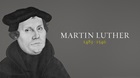
You see, a radical surgery had been performed on church practice a century before the Pietists arrived on the scene: Luther and his fellow Reformers had thrown out the celebration of Saints' Days—and therefore the study and emulation of the saints' lives. This had solved some real abuses: beseeching saints to intercede as mediators between the believer and Christ, drawing on their supposed "bank" of accumulated merits, nearly worshiping them.
But so many exemplary figures were lost to the generations of Protestants that followed: St. Francis of Assisi, St. Clare—hundreds and thousands of others.
Were these people plaster saints—super-Christians who lived their whole lives surfing the clouds, drop-kicking demons, and laughing at temptation? No, they were just human beings.
And that's exactly what had made them such powerful lessons for the medieval Christians: ordinary believers could look at the saints' lives and see people who had their own flaws—who made mistakes, got cranky, had bad days. … And yet by God's grace these saints did remarkable things—they lived their theology in remarkable ways.
So, looking at their stories, any person, however lowly, would know that it is possible to be changed by grace and be used in great ways in the kingdom. You would know that the kind of life you are currently living is not the only possible kind—that there is this luminous possibility of Christlikeness available to all.
By making church history a respected theological discipline, the Pietists recaptured this tradition of learning about and being inspired by the "great cloud of witnesses" who have gone before us.
So if we take the Pietists' cue and read church history to learn lessons about living theology, what will we find?
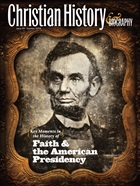
Before I came to Bethel, I spent most of three years as managing editor of Christian History & Biography magazine. For me, every new issue was a revelation of what happens when theology comes alive.
Some saints I've met
When I started working on my very first issue, Issue 76: The Christian Face of the Scientific Revolution, I had a vague sense that Christianity and science had always been at odds with each other. "Everyone knew," for example, that the church had stomped on Galileo Galilei when he took Copernicus's theory and ran with it. But I soon discovered that this "warfare model" of the relationship between theology and science was anything but true. I learned from scientists like Galileo Galilei and Isaac Newton that when we let God guide us in our secular vocations, amazing things happen.
During the scientific revolution of the 17th and 18th centuries, countless scientists both famous and unknown had engaged in the passionate pursuit of scientific knowledge precisely out of theological motives. They believed God is the creator and lover of the world. And they wanted to know more about this wondrous, beloved creation. The warfare of science and theology? Hardly. One Christian scientific innovator after another* made theology come alive as they pursued their scientific vocations. And the results have changed the world.
Working on Issue 80: The First Bible Teachers, I learned from Augustine of Hippo that when we let Scripture "read us," then theology comes to life in us.
This was the church fathers' idea of how you should read the Bible: You read constantly, at intervals throughout every day. And you read with an openness to being changed as you read. Indeed, this idea of the fathers was the whole basis of Western monasticism: A monastery or a convent is a place where you practice "Scripture saturation"—continually reading, continually seeking to be transformed by what you read.
While working on Issue 82: Phoebe Palmer and the American Holiness Movement, I saw that when theology comes to life, it inflames us to do useful work in God's kingdom, regardless of personal cost.
Palmer led middle-class Victorian Protestants out of their captivity to material comforts and social status and back into the vibrant Christianity of the frontier era. She urged Christians to lay all their time, talents, and wealth on the "altar" of Christ and consecrate themselves to wholehearted service of him; to pursue holiness in every area of their lives; to stand up publicly at every opportunity and tell what God was doing in their lives; and to forge the urban missions and inner-city churches that became the holiness and Pentecostal movements' most precious legacies.
I could go on, for a very long time. But I'll just conclude by blessing the Pietists for bringing Christian history into the curriculum of western seminaries—and thereby to pastors and laypeople everywhere. Without their bold innovation, I would not have the joyous privilege of standing before students and communicating to them how theology has come alive in people of every time and place. And without them, this tremendous magazine, Christian History & Biography, would not be telling the stories of these living models to a growing group of readers.
May we allow the Pietists' example, and those of a thousand other saints, to bring theology alive in us, too.
* * *
*Many of the innovators during the scientific revolution seem to have been—though such things are notoriously difficult to determine—more than nominal Christians. Consider these "fathers" featured in our Issue 76: The Christian Face of the Scientific Revolution:
Andreas Vesalius (1514-1564) "Father of modern anatomy"
Galileo Galilei (1564-1642) "Father of modern astronomy"
William Harvey (1578-1630) "Father of modern medicine"
Robert Boyle (1627-1691) "Father of modern chemistry"
Antony van Leeuwenhoek (1632-1723) "Father of microbiology"
Isaac Newton (1642-1727) "Father of modern mechanistic physics" (and, with Leibnitz, of calculus).
Copyright © 2005 Christianity Today.Click for reprint information.

Support Our Work
Subscribe to CT for less than $4.25/month