When Billy Graham Went to New York City


This piece was originally published in 2005.
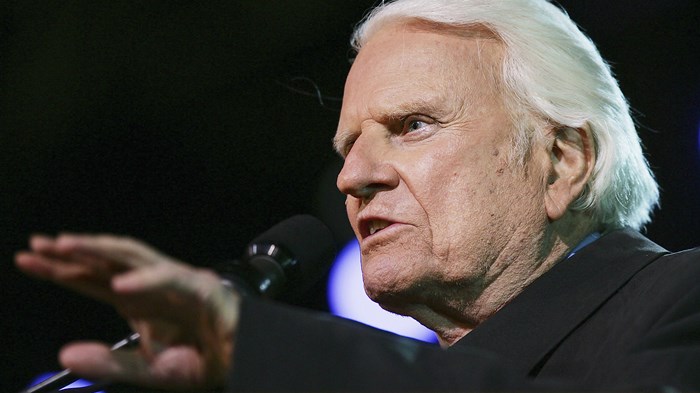
His body racked by age and infirmities, Billy Graham will depend heavily on the Holy Spirit to endure his speaking schedule for the New York City crusade later this month. The 86-year-old evangelist is determined not to let even hearing loss, prostate cancer, and Parkinson's disease stop him from delivering the gospel message of salvation through Jesus Christ.
Nearly 50 years ago, during his first major Gotham crusade, Graham faced different—yet similarly daunting—impediments to his ministry. Instead of disease, Graham warded off withering attacks from Reinhold Niebuhr, fundamentalists, and segregationists. The remarkable response to Graham's preaching effectively marginalized the extreme ends of the theological spectrum and helped carve out a prosperous middle ground for the burgeoning civil rights and evangelical movements.
Confronting the Mainline Establishment
Granting a rare interview, Graham this week told The New York Times that sentiment prompted him to choose New York City for what could be his last crusade. Given the significance of his 1957 crusade, the symbolism is obvious. Only eight years earlier, Graham burst onto the American scene in Los Angeles, and his 1954 visit to London marked Graham as a global figure. But New York City had yet to embrace the dynamic young evangelist.
Leading the charge against Graham was none other than Reinhold Niebuhr, the venerable professor at Union Theological Seminary in New York City. In an article for Life magazine, Niebuhr vigorously denounced Graham for presenting Jesus as the all-sufficient answer for man's ills. "Perhaps because these solutions are rather too simple in any age, but particularly so in a nuclear one with its great moral perplexities, such a message is not very convincing to anyone—Christian or not—who is aware of the continuing possibilities of good and evil in every advance of civilization, every discipline of culture, and every religious convention," Niebuhr wrote. "Graham offers Christian evangelism even less complicated answers than it has ever before provided."
Despite repeated requests by Graham, Niebuhr refused to meet with him. So Graham simply complimented Niebuhr and explained away their differences. "I have read nearly everything Mr. Niebuhr has written and I feel inadequate before his brilliant mind and learning," Graham told reporters. "Occasionally I get a glimmer of what he is talking about. . . . If I tried to preach as he writes, people would be so bewildered they would walk out."
This charitable yet honest response was a common leadership tactic for Graham, as shown by Harold Myra and Marshall Shelley in their forthcoming book, The Leadership Secrets of Billy Graham. He did not prolong the controversy, and with the crowds exceeding all expectations, Niebuhr's critique lost credibility. During 16 weeks of preaching at Madison Square Garden, Yankee Stadium, the Polo Grounds, Ebbetts Field, and elsewhere, more than 2 million people attended crusade events, and more than 61,000 indicated decisions for Christ.
Retired Sen. Mark Hatfield turned out for the crusade's closing event, held in Times Square, to see Graham for the first time. "As those streets angled off of Times Square, and he was standing in the center and they had the platform and microphones and a PA system down those streets—it was just a mass of people in every direction and all funneled into the center of the square," Hatfield recalled for Christian History & Biography.
"What impressed me is Billy came with a message, and he took the theater marquees—for instance, Love from a Stranger—as his key and launched off. I wish I could remember the others. He built his message, obviously the same simple gospel message, out of the environment of those marquees. People listened to Billy because he had something to say and he put it in a familiar context."
Fundamentalism's Enemy No. 1
Though Niebuhr and other liberals didn't listen to Graham, at least he expected their opposition. But the New York City crusade also solidified his final break with fundamentalists, who distanced themselves from Graham in their sharp denunciations of ecumenism.
Graham declined invitations in 1951 and 1954 to preach in New York City, because he judged those invitations not representative of the city's diverse Christian makeup. But in 1957 he accepted the call of the Protestant Council of the City of New York, which was the local arm of the liberal National Council of Churches.
Fundamentalists viewed Graham's decision as a slap in the face and quickly pronounced their displeasure. John R. Rice, one of Graham's last fundamentalist supporters, recognized the historical significance of Graham's New York City crusade. "Dr. Graham is one of the spokesmen, and perhaps the principal spark plug of a great drift away from strict Bible fundamentalism and strict defense of the faith," Rice wrote in his publication, The Sword of the Lord. Since this break, Graham and the evangelical movement have been targets of criticism by fundamentalists, despite their many shared theological commitments.
Harlem and Beyond
Graham further irked some Southern fundamentalists by inviting Martin Luther King Jr. to give an opening prayer at the crusade. "A great social revolution is going on in the United States today," Graham said as he introduced King. "Dr. King is one of its leaders, and we appreciate his taking time out of his busy schedule to come and share this service with us tonight."
This show of solidarity was lost on no one. Fundamentalist patriarch Bob Jones Sr.—already wary of Graham's theology—defended segregation against King and warned Graham of the consequences of associating with the civil-rights leader. "Dr. Graham has declared emphatically that he would not hold a meeting anywhere, North or South, where the colored people and the white people would be segregated in the auditorium," Jones said, "and I do not think any time in the foreseeable future the good Christian colored people and the good Christian white people would want to set aside an old established social and religious custom."
Even though Graham's New York City meetings obviously weren't segregated, during the first few nights of the crusade, critics and supporters alike noticed that the audiences looked more like a cross-section of Middle America than the city's diverse streets. Lamenting the absence of African Americans, Graham decided to preach where the blacks lived—Harlem. Later, at a similar event in Brooklyn, Graham for the first time voiced his support for civil rights legislation. Though Graham focused his efforts on spiritual change and emphasized the necessity of inward transformation, he also lobbied for institutional reform.
Graham's foray into Harlem accomplished the goal of attracting blacks to hear the evangelist's message. It also sparked the beginning of a historic collaboration. Two Harlem rally organizers were close friends and advisers to King. Together with King, they huddled with Graham in private strategy meetings and even swapped dreams of conducting joint evangelistic crusades. The union was not to be. King's approach was too political for Graham's taste, and they agreed to seek change in separate spheres.
The paths of Graham's and King's aides crossed again in 1962 while Graham conducted a crusade in Chicago. Graham's media adviser, Walter Bennett, offered advice to a couple of King's senior aides. Bennett deconstructed their entire approach to event organization and media relations. He warned that King would burn out if the minister continued his break-neck pace of speaking at small churches before modest audiences. Bennett suggested that King should bide his time and gear up for fewer, more spectacular events. At least some of the advice must have stuck. One year later King exhibited exceptional media savvy and organizational acumen during his defining moment, the March on Washington.
Historians will continue to debate the degree of direct influence Graham's 1957 New York City crusade had on discrediting liberal theology, marginalizing fundamentalism, and broadening the appeal of King's civil rights message. But there is no doubt the crusade witnessed a historic confluence of these significant trends that shaped contemporary evangelicalism and 20th-century American culture.
Copyright © 2005 Christianity Today. Click for reprint information.

Support Our Work
Subscribe to CT for less than $4.25/month