


An Early Christian Eucharist
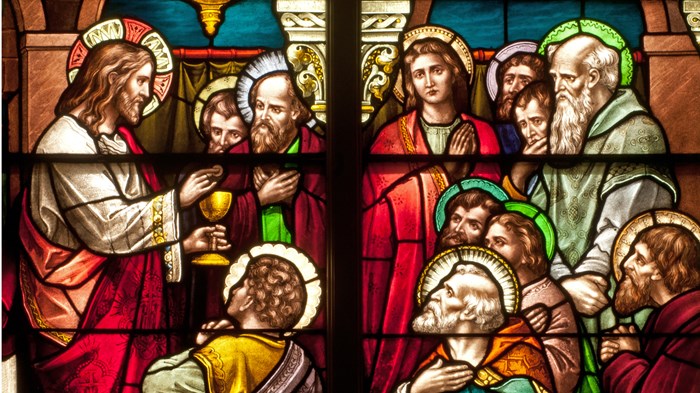


In the early church, the celebration of the Eucharist was an essential part of the Christian life. In continuation of last week's tremendously popular feature article, Divided by Communion, we are featuring selections from early Christian writings that shed light on how Christians in the first two centuries celebrated Communion.
Note: We appreciated the many responses we received to last week's newsletter and have made a selection of them available for all our readers on the website.
Justin Martyr (100-165): Christian philosopher and apologist
First Apology(155 A.D), chapter 66
And this food is called among us the Eucharist of which no one is allowed to partake but the man who believes that the things which we teach are true, and who has been washed with the washing that is for the remission of sins, and unto regeneration, and who is so living as Christ has enjoined. For not as common bread and common drink do we receive these; but in like manner as Jesus Christ our Savior, having been made flesh by the Word of God, had both flesh and blood for our salvation, so likewise have we been taught that the food which is blessed by the prayer of His word, and from which our blood and flesh by transmutation are nourished, is the flesh and blood of that Jesus who was made flesh. For the apostles, in the memoirs composed by them, which are called Gospels, have thus delivered unto us what was enjoined upon them; that Jesus took bread, and when He had given thanks, said, "This do ye in remembrance of Me, this is My body;" and that, after the same manner, having taken the cup and given thanks, He said, "This is My blood;" and gave it to them alone.
Read all of chapter 66 Christian Classics Ethereal Library
First Apology, chapter 65
There is then brought to the president of the brethren bread and a cup of wine mixed with water; and he taking them, gives praise and glory to the Father of the universe, through the name of the Son and of the Holy Ghost, and offers thanks at considerable length for our being counted worthy to receive these things at His hands. And when he has concluded the prayers and thanksgivings, all the people present express their assent by saying Amen. And when the president has given thanks, and all the people have expressed their assent, those who are called by us deacons give to each of those present to partake of the bread and wine mixed with water over which the thanksgiving was pronounced, and to those who are absent they carry away a portion.
Read all of chapter 65 at Christian Classics Ethereal Library
Ignatius of Antioch (35-107): Early Christian bishop and martyr
Epistle to the Ephesians, chapter 20
Stand fast, brethren, in the faith of Jesus Christ, and in His love, in His passion, and in His resurrection. Do ye all come together in common, and individually, through grace, in one faith of God the Father, and of Jesus Christ His only-begotten Son, and "the first-born of every creature," but of the seed of David according to the flesh, being under the guidance of the Comforter, in obedience to the bishop and the presbytery with an undivided mind, breaking one and the same bread, which is the medicine of immortality, and the antidote which prevents us from dying, but a cleansing remedy driving away evil, [which causes] that we should live in God through Jesus Christ.
Read more of Ignatius' Epistle to the Ephesians at Christian Classics Ethereal Library
Irenaeus (c.130-c.200): Bishop of Lyons and opponent of Gnosticism
Fragments from the lost writings of Irenaeus, chapter 37
Then again, Paul exhorts us "to present our bodies a living sacrifice, holy, acceptable unto God, which is your reasonable service." And again, "Let us offer the sacrifice of praise, that is, the fruit of the lips." Now those oblations are not according to the law, the handwriting of which the Lord took away from the midst by canceling it; but they are according to the Spirit, for we must worship God "in spirit and in truth." And therefore the oblation of the Eucharist is not a carnal one, but a spiritual; and in this respect it is pure. For we make an oblation to God of the bread and the cup of blessing, giving Him thanks in that He has commanded the earth to bring forth these fruits for our nourishment. And then, when we have perfected the oblation, we invoke the Holy Spirit, that He may exhibit this sacrifice, both the bread the body of Christ, and the cup the blood of Christ, in order that the receivers of these may obtain remission of sins and life eternal. Those persons, then, who perform these oblations in remembrance of the Lord, do not fall in with Jewish views, but, performing the service after a spiritual manner, they shall be called sons of wisdom.
Read all of chapter 37 at Christian Classics Ethereal Library
Irenaeus
Against Heresies, chapter 18
But our opinion is in accordance with the Eucharist, and the Eucharist in turn establishes our opinion. For we offer to Him His own, announcing consistently the fellowship and union of the flesh and Spirit. For as the bread, which is produced from the earth, when it receives the invocation of God is no longer common bread, but the Eucharist, consisting of two realities, earthly and heavenly; so also our bodies, when they receive the Eucharist, are no longer corruptible, having the hope of the resurrection to eternity.
Read all of chapter 18 at Christian Classics Ethereal Library
Origen (185-254): Biblical scholar and philosopher
Against Celsus, chapter 57
We are much more concerned lest we should be ungrateful to God, who has loaded us with His benefits, whose workmanship we are, who cares for us in whatever condition we may be, and who has given us hopes of things beyond this present life. And we have a symbol of gratitude to God in the bread which we call the Eucharist.
Read all of chapter 57 at Christian Classics Ethereal Library
Didache (date uncertain—possibly late first or early second century, authorship unknown)
The document describes a code of morals for the Christian life and a manual of church order, and includes this Eucharistic liturgy:
Now about the Eucharist: This is how to give thanks: First in connection with the cup: "We thank you, our Father, for the holy vine of David, your child, which you have revealed through Jesus, your child. To you be glory forever."
Then in connection with the piece [broken off the loaf]:
"We thank you, our Father, for the life and knowledge which you have revealed through Jesus, your child. To you be glory forever.
"As this piece [of bread] was scattered over the hills and then was brought together and made one, so let your Church be brought together from the ends of the earth into your Kingdom. For yours is the glory and the power through Jesus Christ forever."
You must not let anyone eat or drink of your Eucharist except those baptized in the Lord's name. For in reference to this the Lord said, "Do not give what is sacred to dogs." After you have finished your meal, say in this way:
"We thank you, holy Father, for your sacred name which you have in our hearts, and for the knowledge and faith and immortality which you have revealed through Jesus, your child. To you be glory forever.
"Almighty Master, 'you have created everything' for the sake of your name, and have given men food and drink to enjoy that they may thank you. But to us you have given spiritual food and drink and eternal life through Jesus, your child.
"Above all, we thank you that you are mighty. To you be glory forever.
"Remember, Lord, your Church, to save it from all evil and to make it perfect by your love. Make it holy, 'and gather' it 'together from the four winds' into your Kingdom which you have made ready for it. For yours is the power and the glory forever."
"Let grace come and let this world pass away."
"Hosanna to the God of David!"
"If anyone is holy, let him come. If not, let him repent."
"Our Lord, come!"
"Amen."
Read more of the Didache at Christian Classics Ethereal Library
We'd like to know what you think about this article. Please send your response to history@christianitytoday.com.
One good collection including this and many other early Christian writings isEarly Christian Fathers, edited by Cyril C. Richardson.
Christian History Issue #37, Worship in the Early Church, is currently out of print, but the content is available in electronic form at Christian History.
Copyright © 2006 by the author or Christianity Today/Christian History magazine.
Click here for reprint information on Christian History.

Support Our Work
Subscribe to CT for less than $4.25/month