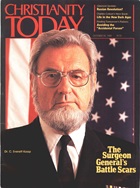
Former Surgeon General C. Everett Koop—known for his medical advocacy and his evangelical Christian faith—died today at age 96. This profile, originally published in CT's October 20, 1989, issue, was published shortly after Koop resigned from the Department of Health and Human Services.
* * *
In the first of a two-part series, CT's editor at large recounts the setbacks and triumphs of C. Everett Koop's eight-year term as U .S. Surgeon General. Part 2, an interview to appear in the next issue, will present Koop's own words about his concerns as he returns to private life.
In three decades of surgery at Philadelphia's Children's Hospital, C. Everett Koop pioneered techniques that saved the lives of premature and malformed babies. Meanwhile, in another wing of the hospital an abortion clinic opened, capable of eliminating 10 to 15 lives in the time it took Koop to save 1 or 2. Abortion increasingly became for Koop a simple, black-and-white issue. When he finally spoke out on abortion, he spoke with conviction, calling the Roe v. Wade ruling "the most important event in American history since the Civil War."
For a time Koop even suspended his brilliant career in pediatric surgery to go on the stump with L'Abri founder Francis Schaeffer. In a dramatic scene from the Schaeffer-produced film series Whatever Happened to the Human Race? Koop looked out on a thousand naked dolls strewn across the salt wastes of the Dead Sea and proclaimed, "I am standing on the site of Sodom, the place of evil and death."
Koop tends to see faith, too, in shades of black and white. He became a committed Christian as an adult while attending Donald Grey Barnhouse's Tenth Presbyterian Church in Philadelphia, and the doctrine of the sovereignty of God is central to his beliefs. A man who respects chain-of-command authority, Koop seems virtually immune to Kierekegaardian bouts of angst. If God is all powerful, then naturally everything that happens—everything—is under his complete control at all times.
Stumbling into a war zone
The aftermath of a momentous telephone call in August of 1980 put to the test this bedrock belief in God's sovereignty. Ronald Reagan, who had read two of Koop's books, wanted him to serve as the nation's surgeon general. The appointment would help cement Reagan's support among prolife constituents and especially evangelicals, the group who knew Koop best.
Shortly after his inauguration, Reagan named Koop deputy assistant secretary of health and nominated him as surgeon general. That nomination, however, needed congressional action, because the 64-year-old Koop exceeded the age limit for the office by a hundred days. What Reagan and nearly everyone in the administration thought would be a pro forma legislative procedure turned into a political firestorm.
Koop's black-and-white views came back to haunt him. Planned Parenthood, the National Organization for Women (NOW), and other prochoice groups led the cavalry charge, brandishing every extreme statement Koop had ever made on abortion, women's rights, and homosexuality. In a case of reverse McCarthyism, they questioned not only his beliefs, but also his competence as a physician, his emotional stability, and even his sanity. The staid New York Times ran an editorial entitled "Dr. Unqualified," and the Washington press coined the even more unflattering nickname "Dr. Kook." Congressman Henry Waxman branded him "scary" and "intolerant." Others called him a right-wing crank, a mean-spirited nut, a religious zealot. For the first time in its hundred-year history, the American Public Health Association went on record against a nominee. "We'd be better off with no surgeon general than with Koop," said their executive director.
The Koops arrived in Washington like innocent tourists who had accidentally wandered into a war zone. In Philadelphia, Koop's surgical triumphs—separating Siamese twins, repairing facial deformities, repositioning a child's external heart—had attracted much publicity. The recipient of many awards, including France's Légion d'honneur, he was often identified in newspapers as Philadelphia's "best-known" favorite son.
But now the hometown press joined in the chorus against him, printing a cruel cartoon of Koop as a two-headed monster. Each morning Koop's son, working in another city, would find a newspaper under his office door with the articles defaming his father circled in red grease pencil.
Koop and his wife, Betty, were living in temporary quarters, surrounded by boxes still unpacked. Each day Koop would report to a spacious office from which, if he leaned back in his chair, he could view the dome of the Capitol and its huge American flag. Though near the seat of power, he had no power; he had only the city's scorn. After four decades of 12-hour, frenetic workdays, he now faced an empty "in" box, a silent telephone, and a blank calendar. Hand surgeon Paul Brand, who visited him then, recalls, "I had the impression of a caged lion, full of enormous power; he paced the room with literally nothing to do. And I also had the impression of a wounded man, a man in need of comfort, in need of the body of Christ."
Article continues below
Koop himself reflects, "I couldn't understand why God would disrupt such a peaceful, quiet, productive life and bring me down into that mess. The worst day was when I went home one afternoon—the sun was coming in through the half-drawn Venetian blinds in our little one-room apartment in Georgetown—and I opened the door with my key and saw Betty there reading the Washington Post with tears falling down her cheeks."
"I don't need this!" Koop fumed. "I've never been treated this way before, and it's wrong to put my family through it." This time it was Betty who reminded him that a sovereign God must somehow have a purpose behind the disruption of their lives. "If you quit now," she said, "you'd always wonder." She added with a wry smile, "And don't forget—you no longer have a job in Philadelphia."
No cardboard-cutout ideologue
As anyone who has watched television, read newspapers, or listened to radio in the last several years knows, C. Everett Koop finally got the job of surgeon general (thanks mainly to the dogged forts of Sen. Jesse Helms), and against all odds emerged as one of the most visible, colorful, and admired public servants in the nation. When he announced his resignation last spring, his former critics fell over one another heaping fulsome praise on the man they had once vilified. Dan Rather pronounced him "the best surgeon general in history." Representative Waxman, now one of Koop's biggest fans, readily agreed: "He's a man of tremendous integrity. He's done everything a surgeon general can do, and more." The American Public Health Association, the same group that had fought his nomination, honored him with their highest award for excellence. Nearly everyone except, strangely, Koop's original allies joined in the applause.
What caused the turnabout in C. Everett Koop's public image? The answer lies partly in the mass media's fundamental misperception of Koop, partly in Koop's skillful molding of an office to fit his strengths, and partly in what happened during the hellish nine months when he sat in a vacuous office with nothing to do.
Article continues below
If Koop's critics had looked more closely at his background, they would have seen he was no cardboard-cutout ideologue. His firm convictions were tempered by, and in fact formed by, human compassion. One of his closest aides explains, "What people didn't understand about Doctor Koop is that he is prolife in the purest sense of the word: not antideath, but prolife. I have seen him with thousands of people—malnourished children, Washington socialites, dying AIDS patients, abused wives, abortion-rights activists—and he treats every one of them as if he truly believes, which he does, that they are created in the image of God. He'll interrupt his busy schedule to meet with some disturbed person who insists on talking to 'the top doc.' He truly does respect the value of all human life."
Koop's strong stand on abortion had come about, after all, because of his experience with over 100,000 pediatric patients, many of them small enough to hold in one hand, many so deformed that no other surgeon would touch them. Over the years Koop had seen these babies grow into fully functioning adults with names, personalities, and individual histories: Paul, Koop's patient through 37 facial and abdominal surgeries, now a graduate of West Chester University; Chris, who required 15 operations to get his external heart in place and his lungs functioning adequately; Maria, for whom Koop fashioned an esophagus out of a section of colon and who went on to earn a Ph.D. and become a pediatric surgeon herself.
Something about the helplessness of tiny human beings had attracted Koop to the underdeveloped field of pediatric surgery. He had a soft spot for the weak and disenfranchised. And as he sat in his Washington office during the nomination hearings, for the first time he too felt weak and disenfranchised.
One by one, the various special-interest groups paid a call. Most knew little about him other than the hysterical reports they had read in the newspapers. But the prospective surgeon general who had no power and little hope had one commodity in plentiful supply: time-time to listen and to plan.
During that nine-month period, Koop heard diverse voices from all over the country. Some, such as the gay-rights advocates and the prochoicers, fiercely opposed his positions. But they too were part of the nation whose medical needs he would oversee. Koop now looks back on that period as a wonderful gift: "I had a chance to look at the health problems of the nation and wonder what I could do about them when I was finally let loose. I decided I would use the office to espouse the cause of the disenfranchised: handicapped children, the elderly, people in need of organ transplantation, women and children who were being battered and abused. During that nine months I developed a detailed agenda, something no surgeon general has ever had before. In the end, that period of acute frustration made possible every single thing I was able to accomplish in office. Now that's the sovereignty of God at work!"
Article continues below
In short, Koop used the time to dream about what difference a surgeon general could make. And his very notoriety ensured that after his installation everything he said or wrote attracted a swarm of media attention. His detractors, who meant to do him harm, paradoxically helped deliver to him the platform he would need to accomplish his goals.
But Koop soon found that he had the rank of three-star admiral but no ship to command. He set to work to change that. The office of surgeon general, vaguely defined to begin with, had been sorely neglected (President Nixon never even got around to appointing one).
Koop had little decision-making power, no budget authority, and a minuscule staff to carry out his will. Reagan's budget cuts had just closed hospitals and slashed 2,600 Public Health Service jobs, and PHS's Commissioned Corps morale was at an all-time low.
In an attempt to bolster that morale, Koop urged the corps to wear the uniform that had long since fallen out of vogue. He set a personal example, dressing in a starched uniform bedecked with bars, epaulets, ribbons, and gold braid. The practice took a while to catch on. More than once airplane passengers mistook Koop for a steward and asked for help with their luggage. And the Washington press, most notably political cartoonists, now had a visual focus for their derision. Who was this strange M.D. with a Captain Ahab beard and a cruise-ship uniform, this man who in a city of designer briefcases carried a canvas tote bag?
Yet the very distinctiveness of Koop's style kept the media's attention. At 6'1", 210 pounds, he made an imposing uniformed figure, and as he began delivering pronouncements on the nation's health in his strong Brooklyn voice, fascination soon replaced derision. As one reporter put it, "On television, the steely beard and gold shoulder boards of the PHS uniform project a stern Dutch uncle inveighing against the evils of indulgence."
Article continues below
But in person, those same reporters came away impressed with the cordiality and openness of the new surgeon general. Before long, he was the hottest interview in town. Magazines put his stern visage on their covers, Johnny Carson wrote him into monologues, Elizabeth Taylor blew him on-air kisses, and "The Golden Girls" proposed a cameo appearance.
"Where there's Koop, there's controversy," became a Washington slogan. He lashed out against drunk drivers, convened task forces on child abuse and spouse abuse, criticized American eating habits. And then there were the Big Three controversies of his term: the Baby Doe case, the AIDS report, and the effects-of-abortion letter. Koop became even bigger news.
Koop's employers didn't know what to think, especially when he broke ranks to challenge their policies. For example, Ronald Reagan had promised southern senators such as Jesse Helms that he would not use his administration as a bully pulpit against smoking.
But here was Reagan's surgeon general calling the tobacco lobbyists "sleazy" and "flat-footed liars," and accusing them of exporting death to the Third World. The administration was embarrassed; North Carolina's Jesse Helms, once Koop's strongest supporter, was appalled.
Despite enormous pressure, Koop would not back down. One thousand Americans a day were dying of tobacco-related illnesses, and as the nation's top doctor he felt obligated to speak out. (He now points to the decline in cigarette smoking-almost 20 million Americans quit during his term-as his greatest accomplishment.) On cigarette smoking, sex education, free needle distribution for addicts, and many other issues, Koop traveled his own path.
To a jaded public hungry for integrity in their leaders, Koop became a genuine folk hero. And what had looked like a cul-de-sac job gradually developed into a central arena for moral suasion. "I have a sense of right and wrong," he says. "A lot of other people in this town don't have that."
In essence, Koop managed to meet the American expectations of a family doctor. You know your doctor may deliver grim news, and may lecture you about your bad habits, but still you want a doctor who will tell it straight and not mince words, whose only concern is your health. That image, Koop fulfilled on a grand scale.
Article continues below
A bad report card
Another, even more startling reversal took place during Koop's eight years in Washington. As former critics learned to respect his independence and integrity, and the public at large came to revere him as an avuncular folk hero, Koop's original constituency looked on in shock and dismay at what they saw as a betrayal of their cause. Here is Koop's report card as graded by the conservatives:
"Koop has been one of the major disappointments of the Reagan Administration." —National Review "Koop should have kept his lip buttoned."—Phyllis Schlafly "I think the guy's a disgrace. … He sold out the very principles that made him surgeon general." —Michael Schwartz, Free Congress Foundation "If he couldn't act on what he believed to be correct, he should have resigned. He has revealed himself to be a man who prized the public spotlight rather than his conscience." —Howard Phillips, Chairman of Conservative Caucus
Some evangelical Christians, who once lionized Koop, share the sense of dismay. "Long-time supporters of Doctor Koop are bitter and depressed," says commentator Cal Thomas, who grouses, "An atheist would have performed just as effectively for the Left."
Theologian Harold O. J. Brown typifies the concern of evangelicals, It was he who, more than a decade before, had convinced Koop that abortion was always wrong, even in the "hard" cases. In 1975, he and Koop had helped found the Protestant prolife lobby. He openly admires Koop: "Not since William Jennings Bryan has another evangelical Christian of Doctor Koop's degree of clarity, forthrightness, and determination to bring spiritual values into play in public life been appointed to similarly high office."
And yet Brown, too, now wonders aloud whether Koop set back the prolife cause.
Conservatives' complaints center on the major crises: Baby Doe, AIDS, and the effects-of-abortion letter. The Baby Doe controversy came early on (1982-83) and involved two separate instances in which a doctor and family agreed to withhold nourishment from a birth-defective child. No issue was closer to Koop's heart. To him, the deed was infanticide, plain and simple. After Baby Doe died, and the government's stiff regulations to prevent future occurrences were repeatedly overturned in court, Koop met with both sides (the medical establishment vigorously opposed the regulations) and came up with a compromise based on "patient-care review committees" within local hospitals.
Article continues below
The Supreme Court eventually struck down Koop's agreement as well, mooting the entire issue. But the process of compromise had opened a crack between the surgeon general and radical prolifers, who viewed Koop's acceptance of the review committees as "caving in" to the medical establishment. If the prolife lobbyists came away slightly disillusioned with Koop, he came away frustrated by their all-or-nothing mentality. Despite his ironclad personal views on the issues, he could see occasion for legislative compromise.
Heat from the Baby Doe issue dissipated quickly after the court decisions, and Koop retained his stature with most political and religious conservatives. But in 1986 a new crisis fell into Koop's lap, like a live grenade. As early as 1981 administration officials had detected the rumblings of a major health epidemic concentrated in groups practicing "high-risk behaviors," notably, homosexuals and intravenous drug users. Ignoring outcries from the gay community, the President avoided discussing; the disease that became known as AIDS. Not until 1986, with 10,000 cases confirmed, did he ask the surgeon general to prepare a report on the topic.
According to one HHS staff member, at the time 5,000 letters a week were pouring in from conservatives pleading against research and education funds: "God's judgment," they argued, should be allowed to run its course. Given the climate, nearly everyone expected a reproachful, moralistic report. Gay-rights leaders were openly cynical.
But Koop took his assignment seriously. He scheduled two-hour interviews, off the record, with 25 different groups, ranging from the National Lesbian and Gay Task Force to the Southern Baptists. He asked for authority to prepare the report himself, avoiding the normal bureaucratic channels that might weaken it. Working at home at a stand-up desk, he went through 27 drafts. These words set the tone of the report: "At the beginning of the AIDS epidemic many Americans had little sympathy for people with AIDS. The feeling was that somehow people from certain groups 'deserved' their illness. Let us put those feelings behind us. We are fighting a disease, not people."
Article continues below
The AIDS report was remarkably blunt, spelling out the dangers in anatomical detail, and calling for sex education "beginning at the lowest grade possible." Although prescribing abstinence and sex within monogamous marriage as the safest course, it also recommended condoms for anyone who had multiple sex partners or engaged in homosexual acts. "The silence must end," Koop declared.
The silence did end. Voices within the Reagan administration denounced Koop's stances on compulsory AIDS testing (against) and early sex education (for). But liberal politicians, such as Ted Kennedy and Henry Waxman, commended the report for its candidness and its emphasis on the health aspects of the disease. Gay-rights activists declared Koop a "certifiable AIDS hero." Congress stood behind Koop, mandating something unprecedented: that an educational booklet on the disease be mailed to every household in America.
Some political conservatives were outraged. Paul Weyrich (a founder of the Religious Right) and ERA nemesis Phyllis Schlafly mobilized against Koop, calling for a boycott of a Washington dinner scheduled in his honor. Their letter read, in part, "His report on AIDS issued last November reads as though it were edited by the National Gay Task Force. … Dr. Koop's proposals for stopping AIDS represent the homosexuals' views, not those of the profamily movement."
To complicate matters, in the midst of the furor over the AIDS report, Koop awoke from a nap one afternoon to find himself essentially quadriplegic-he could move neither hands nor feet, due to a damaged vertebra, aggravated by years of bending over while operating on infants. Surgeons repaired most of the damage, but recuperation kept him in bed for the next several weeks.
Surprising friends and foes
Koop now looks back on that time of enforced inactivity—like the nine-month nomination process—as a providential gift. He began to see that AIDS was one disease in which the moralist and the scientist could work, indeed, needed to work, hand in hand to contain the epidemic. "For seven weeks I watched the impact of what had been done as reported in the press. I made up my mind that I had an obligation and a chore, and so I decided to do something that probably nobody else ever has done in public office. For the first seven weeks in 1987 I addressed only religious groups. I started with Jerry Falwell's church and the chapel at Liberty University, went to the National Religious Broadcasters' convention, talked to conservative people in Judaism, and to Roman Catholics, and ended up with a series of radio shows for Moody Broadcasting Network."
Article continues below
In those addresses, delivered in full uniform and a neck brace, Koop affirmed the need for abstinence and monogamous marriage. But he added, "Total abstinence for everyone is not realistic, and I'm not ready to give up on the human race quite yet. … I am the surgeon general of the heterosexuals and the homosexuals, of the young and the old, of the moral and the immoral." He admonished, "You may hate the sin, but you are to love the sinner." While Koop expressed his personal abhorrence of sexual promiscuity—consistently he has used the word sodomy when referring to homosexual acts—he also insisted, "I'm the surgeon general, not the chaplain general."
To explain his position, he often used the analogy of an emergency-room physician. If an ambulance pulls up and unloads two wounded men, a bank robber who shot a guard and the bank guard who returned fire, which man does the doctor treat first? He must go to the man with the most urgent wounds, not the most moral one. Koop had seen enough homosexual AIDS patients, their bodies gaunt, emaciated, and covered with purplish sores, to know who needed the most urgent treatment. He had vowed to look out for the weak and disenfranchised—and there was no group more weak or disenfranchised in the nation. Regardless of the political cost, he would defend their right to treatment, and work to educate them on preventing this deadly disease.
The surgeon general lost much support among political conservatives over the AIDS issue. But he now looks back with pride on the attitude of the roots church. "I really think we turned people around on this issue," he says. Surveys revealed a public more open to sex education in the schools. Koop saw denominations design their own sex-education curricula, and form programs to minister to the AIDS patients.
But those conservatives who had stood by Koop during the Baby Doe and AIDS controversies were rocked yet again in early 1989 when the press reported on a letter from Koop to President Reagan regarding abortion. The previous fall, one of Reagan's prolife advisers had convinced him that the surgeon general should research the health effects of abortion on women. "The findings would be so devastating," he predicted, "that they would reverse Roe v. Wade."
Article continues below
Prochoice activists, knowing Koop's views on abortion, braced for the worst. But in January of 1989, Koop submitted his findings to the President in a letter that concluded, "I regret, Mr. President, in spite of a diligent review on the part of many in the PHS and in the private sector, the scientific studies do not provide conclusive data about the health effects of abortion on women." Instantly, leaders of the prochoice movement trumpeted the message, slightly distorted, "Koop says abortion does not harm women."
"Koop's Stand on Abortion's Effect Surprises Friends and Foes Alike," read a New York Times headline the next day, a headline that could win a Pulitzer Prize for understatement. For some evangelicals, Koop's letter was the last straw, for it appeared that Koop had abandoned the very principles that had gotten him nominated. The controversy left a permanent stain on Koop's career, and may have contributed to his retirement from public service.
Koop himself feels personally betrayed over the issue. He had reviewed 255 reports on the health effects of abortion. Some "proved" abortion was harmful, some "proved" it was harmless. Taken together, they all seemed flawed methodologically. Although Koop had much anecdotal evidence of the harmful psychological effects of abortion, he had no rigorous scientific data to back it up. His letter to the President recommended such a study—it would take five years and cost one hundred million dollars, he later estimated, and would very likely prove what the President wanted proved—but for the present he had to acknowledge insufficient statistical data.
Koop delivered his letter in person to the White House, extracting a promise that no one would disclose its contents until the President had a chance to respond. But when Koop reached his home a short time later, his wife met him in the driveway in a panic. She had just heard Peter Jennings, Tom Brokaw, and Dan Rather quoting from the "confidential" letter. Moreover, they were reporting flatly that "the surgeon general could find no evidence that abortion is psychologically harmful."
Koop stayed on the phone until one in the morning trying to clarify his position, and appeared the next morning on "Good Morning, America" to correct wrong impressions. But the damage had been done. Prochoice activists continued to misquote his findings; prolifers still felt double-crossed.
Article continues below
The next few months in office were unpleasant ones for Koop. A new administration took office, naming someone else as head of Health and Human Services, a cabinet position Koop had wanted. No one asked him to leave, but they didn't offer to reappoint him as surgeon general, either. And through a series of petty tactics, Koop was made to feel unwelcome. He was denied access to the executive dining room. He was not invited to a departmental retreat for senior executives. His top aide was let go. White House staff no longer returned his phone calls.
Once a reporter asked Koop how he earned the medals on his uniform: "The top row is for what liberals did to me; the bottom row is for what conservatives did to me," he replied. In the end, the man who, in the face of ceaseless opposition, had overcome enormous media bias and transformed his office into one 0f the most respected posts in government, quietly resigned.
Agonized compassion
There are many theories on why Koop left office. Some believe he was sabotaged by ardent prolifers in the White House who leaked his letter to the President. Others theorize that proabortionist forces, knowing Koop's true views, froze him out.
There are even more contradictory points of view on Koop's overall performance. The New York Times headline "Surprises Friends and Foes Alike" could sum up his entire term of office.
By far the most disgruntled "surprised friends" are the prolifers. Why would Koop keep quiet about the one issue on which he had previously been so outspoken? As one Christian lobbyist puts it, "If Koop can announce that smoking by pregnant women endangers fetal health, why could he not also say that abortion by pregnant women is fatal to fetal health?" Perhaps the best explanation for his silence is that early on Koop recognized abortion—like gun control—as a politically suicidal issue; if he took a strong vocal stand, no one would listen to anything else he said as surgeon general.
The list of "surprised foes" is much longer, and brings Koop great pleasure. Without exception, every person or group that testified against his nomination has publicly admitted having misjudged him. To many Washington cynics, Koop offered up a refreshing model of integrity from an evangelical Christian—and this in a time when other well-known evangelicals were attracting attention for their lack of integrity. In the words of Time magazine, "The city that worships at the gray altar of ambiguity found there was room for a man of black and white."
Article continues below
Koop insists that his basic views did not change in office, that his strong beliefs provided the foundation for all of his major actions. In his support, he points to a glowing evaluation of his term published in an unlikely place, Mademoiselle magazine. "Identifiable goodness is encountered rarely enough in ordinary life—it's as rare as a gold ostrich egg in politics," the article begins. The article goes on to praise the surgeon general for his example of intellectual, moral, and ethical honesty.
Mademoiselle concludes, "Koop, by exercising an agonized compassion for the poor, the wounded and the disenfranchised, has successfully and spectacularly integrated his religious and professional life: He is Christian, but he is not sectarian." It is easy to see why Koop likes that article so much, for it recognizes his success in achieving the one goal he carved out for himself during his darkest hour eight years before.
Although most people his term in office mainly by the Big Three crises, Koop sees it differently. Wherever he goes, ordinary citizens come up to him with a heartfelt word of thanks. "I'm in a spouse-abuse support group now." "I kept my baby because of you." "My son has AIDS—thanks for all you did." "You gave me the courage to quit smoking." Because of them, Doctor Koop looks back on the last eight years—for all their turbulence—with few regrets and deep satisfaction.
This article originally appeared in the October 20, 1989, issue of Christianity Today. Philip Yancey was then, as now, editor at large for the magazine.
Have something to add about this? See something we missed? Share your feedback here.
Our digital archives are a work in progress. Let us know if corrections need to be made.
















 While we pray for peace, we need moral clarity about this war.
 A Christian reconciliation group in Israel and Palestine warned that war would come. Now the war threatens their relevance.españolالعربيةFrançais
 After lobbying from fellow Southern Baptists and Christians affected by the war, the House speaker moves a package forward.






