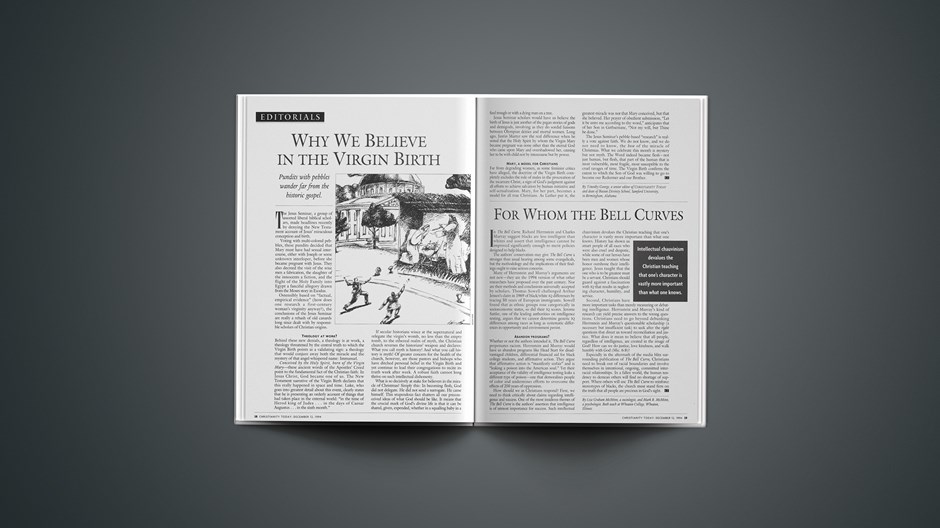
The Jesus Seminar, a group of assorted liberal biblical scholars, made headlines recently by denying the New Testament account of Jesus' miraculous conception and birth.
Voting with multi-colored pebbles, these pundits decided that Mary must have had sexual intercourse, either with Joseph or some unknown interloper, before she became pregnant with Jesus. They also decreed the visit of the wise men a fabrication, the slaughter of the innocents a fiction, and the flight of the Holy Family into Egypt a fanciful allegory drawn from the Moses story in Exodus.
Ostensibly based on "factual, empirical evidence" (how does one research a first-century woman's virginity anyway?), the conclusions of the Jesus Seminar are really a rehash of old canards long since dealt with by responsible scholars of Christian origins.
THEOLOGY AT WORK?
Behind these new denials, a theology is at work, a theology threatened by the central truth to which the Virgin Birth points as a validating sign: a theology that would conjure away both the miracle and the mystery of that angel-whispered name: Immanuel.
Conceived by the Holy Spirit, born of the Virgin Mary - these ancient words of the Apostles' Creed point to the fundamental fact of the Christian faith: In Jesus Christ, God became one of us. The New Testament narrative of the Virgin Birth declares that this really happened in space and time. Luke, who goes into greatest detail about this event, clearly states that he is presenting an orderly account of things that had taken place in the external world: "in the time of Herod king of Judea … in the days of Caesar Augustus … in the sixth month."
If secular historians wince at the supernatural and relegate the virgin's womb, no less than the empty tomb, to the ethereal realm of myth, the Christian church reverses the historians' weapon and declares: What you call myth is history! And what you call history is myth! Of greater concern for the health of the church, however, are those pastors and bishops who have ditched personal belief in the Virgin Birth and yet continue to lead their congregations to recite its truth week after week. A robust faith cannot long thrive on such intellectual dishonesty.
What is so decisively at stake for believers in the miracle of Christmas? Simply this: In becoming flesh, God did not delegate. He did not send a surrogate. He came himself. This stupendous fact shatters all our preconceived ideas of what God should be like. It means that the crucial mark of God's divine life is that it can be shared, given, expended, whether in a squalling baby in a feed trough or with a dying man on a tree.
Jesus Seminar scholars would have us believe the birth of Jesus is just another of the pagan stories of gods and demigods, involving as they do sordid liaisons between Olympian deities and mortal women. Long ago, Justin Martyr saw the real difference when he noted that the Holy Spirit by whom the Virgin Mary became pregnant was none other than the eternal God who came upon Mary and overshadowed her, causing her to be with child not by intercourse but by power.
MARY, A MODEL FOR CHRISTIANS
Far from degrading women, as some feminist critics have alleged, the doctrine of the Virgin Birth completely excludes the role of males in the procreation of the incarnate Christ, a sign of God's judgment against all efforts to achieve salvation by human initiative and self-actualization. Mary, for her part, becomes a model for all true Christians. As Luther put it, the greatest miracle was not that Mary conceived, but that she believed. Her prayer of obedient submission, "Let it be unto me according to thy word," anticipates that of her Son in Gethsemane, "Not my will, but Thine be done."
The Jesus Seminar's pebble-based "research" is really a vote against faith. We do not know, and we do not need to know, the how of the miracle of Christmas. What we celebrate this month is mystery but not myth. The Word indeed became flesh - not just human, but flesh, that part of the human that is most vulnerable, most fragile, most susceptible to the cruel ravages of time. The Virgin Birth confirms the extent to which the Son of God was willing to go to become our Redeemer and our Brother.
********************
Timothy George is a senior editor of Christianity Today and dean of Beeson Divinity School, Samford University, in Birmingham, Alabama.















 While we pray for peace, we need moral clarity about this war.
 As my doubts about his teachings grew, so did a secret fascination with Jesus.
 NIL deals in college athletics present new challenges—and opportunities—for colleges and students.






