The May 16 cover story, "Psychobabble" by Robert C. Roberts, was most instructive. During the past 20 years I have observed a subtle trend in the church to emphasize psychology more than redemption. It has troubled me. The article helped clarify the issue for me.
- Karen Gronvall Larson
Monticello, Mmn.
Roberts's "Psychobabble" is just more psychobabble. Calling spirituality psychology is even more deceiving. James states, "This wisdom is not that which comes from above, but is earthly, natural, demonic." James calls this wisdom psychikee (unspiritual) in contrast to pneumatikos (spiritual). The natural wisdom of psychology should not be confused with the spiritual wisdom of God. For those who have the mind of Christ (1 Cor. 2:16) and are complete in him (Col. 2 10), they have no need of this wisdom.
- Pastor Tom Watson
Countryside Bible Church Soutblake, Tex.
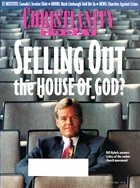
I think the cover art is worth a thousand words. The boat is headed toward the rocks, and I am reminded of 1 Timothy 1: l9: "Holding faith, and a good conscience; which some having put away concerning faith have made shipwreck."
- John Schaefer
Herndon, Va.
"Psychobabble" was excellent in most respects. I missed only one thing—the opposite premises that distinguish Christianity from all humanists' theories of human nature. Humanism holds that we are either "good," or at least "innocent," and corrupted by society. Rousseau popularized this view. Christianity holds that we are "fallen" and in God's eyes "totally depraved." As the Fourth Thesis of Luther puts it, "God does not love us because we are valuable; we are valuable because God loves us."
All secular therapies begin with the false premise that "man is the measure of all things." All the conversational techniques in the world cannot cancel this lie.
- Matthew R. Chapperon
Chicago, ILL
This controversial subject reminds me of the six blind men who independently touched one distinctive part of an elephant. Then each claimed he exclusively "saw" the entire mammal. Although I disagree with David Powlison's definition and understanding of "needs" [sidebar interview], he's absolutely correct in his assertion that unbelievers can "be extremely astute observers of life." When we confidently, though cautiously, accept the truth that the world offers—whether it's from Jung, Ellis, or others (as Roberts rightly suggests)—we find ourselves in good company. Jesus and Paul often alluded to or quoted truth not found in the Old Testament.
It's not a question, then, of whether secular psychologists can teach us truth about the human condition. They can, indeed. But we must remember who they ultimately are—blind men (and women)—always "seeing" a part, but never the whole.
- Ron Habermas
John Brown University
Siloam Springs, Ark.
ANXIETY RELIEVED
Please tell Marshall Shelley I was moved and thrilled with his article "Two Minutes to Eternity" [May 16]. The thought that we might be surprised to find in heaven the role we really were created for has taken a great weight and anxiety off my shoulders.
- Carolyn Malmstadt
Bridgman, Mich
MINIMIZING DIFFERENCES
As word comes that Catholics and evangelicals have forged a common document of faith ["Catholics and Evangelicals in the Trenches," editorial by Timothy George, May 16], it is refreshing, on the one hand, that both camps can sit down and dialogue on issues of faith, rather than the old method of persecution and the clashing of swords. We all repudiate the decades of violence and bloodshed between Catholics and Protestants in Northern Ireland. But on the other hand, are we not in danger of minimizing the differences and neutralizing the gospel?
Now is the time for evangelicals to herald the distinctives of our movement. I can see affirming the Apostles' Creed and belief in the Trinity in common with our "separated brethren" of the older traditions, and even common adherence to moral and social values. However, Catholics and Protestants do not hold to the same faith. Both traditions take diametric turns on matters of (1) salvation and (2) the church. Catholicism is not likely to change on those two vital matters, and neither should Protestants.
In this era of toleration, it is best to remind ourselves that finding common ground is not the same thing as ignoring differences of faith.
- Gerard Fonte
Irmo, SC.
(CT senior editor Kenneth Kantzer has had similar thoughts. See his column in this issue.)
The objectives of the document are commendable, but the theological basis for evangelical Protestants and Catholics working together on them might be accomplished more effectively with less controversy. The less debatable theological base for concerted social action is not primarily the unity of the Savior's redeemed body, but the purposes of the Logos in creation and general revelation. Christian individuals may work together with Catholics and with persons of any other religious, philosophical, or cultic persuasion who want to improve the public schools, have parental choice in education, and oppose pornography, violence, depravity, and religious bigotry in the entertainment media. Individual Christians can work with people of any world-view for economic freedom in a free society and market economy and seek a renewed appreciation of Western culture in opposition to those who glorify other cultures in the name of multiculturalism.
Article continues below
Cooperation for social justice on the basis of respect for the universal moral values of humanity in a theistic world-view would provide a much wider support group and avoid the problem of defining who is a "Christian." It would avoid the problems of identifying people with Christ and his body without clarifying the meaning of repentance, Christ's imputed righteousness, a justification by grace that rules out works as a basis of acceptance, and a personal relationship with the living Christ rather than his representatives in the church.
- Gordon R. Lewis
Denver Seminary
Denver, Colo.
NEEDED: ORTHODOXY
I thank God for Tony Campolo's and David and Karen Mains's unwavering commitment to Jesus Christ and his mission in the world ["Hunting for Heresy," News, May 16]. Like tens of thousands of others, I have been deeply touched and challenged by their ministries. I know of no one who knows these good people who would for a moment question their orthodoxy or faithfulness to the gospel of Jesus Christ.
While a small handful of self-appointed judges are raising questions about an orthodoxy of doctrine, it is past time for evangelicals to raise a call for an orthodoxy of practice. An enormously destructive season of viciousness is presently sweeping through American society and the church.
Have we forgotten that, as followers of Jesus Christ, we are taught in the Bible that the hallmark of our movement is to be found in the way we love one another?
- Tom Sine
Seattle, Wash.
I am troubled by the tone of the article. The author seems to be questioning the "attackers" rather than searching for the actual truth of what Mains said. I read "Lonely No More" and was shocked. Her portrayal of our Lord cannot be construed as anything but unbiblical. And it is this fact that has many of us concerned. Every name Christ has in the Bible is true to his character; never would he call himself "Eddie Bishop."
Your article seemed to say that we shouldn't bring such unbiblical writing to task. Is it narrow-minded to say that to portray Christ in a way that is unbiblical is wrong? Should we keep silent when our Lord is thus described?
Article continues below
Please do not discourage those who would keep Christianity true to the Bible.
- Barbara J. Whitmarsh
Seattle, Wash.
Karen Mains's book was a blessing to my soul, and never once did I doubt Karen's faith in the Lord.
- Helen Henty
Middlesburg Fla.
While Vic Eliason's eagerness to trounce Christian leaders is unsettling, his criticism of Tony Campolo reassures me that someone in the church other than myself finds Campolo's compassion for homosexuals dangerously close to endorsement.
As one who struggled hard to leave the homosexual lifestyle 12 years ago, I can only thank God Campolo's twisted advice was never given to me.
- Michael Carter
Orange, Calif
There is a seduction of Christianity today whereby the teachings of Christ are quickly being eclipsed. "Love your enemy" has become "hate everyone different from you." "Forgive that ye may be forgiven" has been discarded for stone throwing. No longer do we seek the outcast; we seek instead to destroy all those we don't (won't, can't, refuse to) understand. All in the name of Jesus. Clearly, preaching God's grace has now been modified to read: "only when it can make you money."
I'm grateful to Karen Mains and Tony Campolo, intellectual and compassionate, for they remain as always a source of inspiration and challenge—and serve as a necessary reminder to us all of the wondrous teachings of Jesus which, in recent years, have been so totally eclipsed.
- Brenda Wilbee
Bellingham, Wash.
I hope I will remember to extend the same Christ-like grace to others that Dr. Joe Stowed of Moody Bible Institute (and many of like Christian maturity) have extended to me during this season of criticism. And I hope I also remember not to pray for humility as I did last year!
- Karen Mains
The Chapel of the Air
Wheaton, Ill
A TREMENDOUS ACCOMPLISHMENT
I want to commend you for Philip Yancey's article on President Clinton's faith [April 25]. The piece was a tremendous accomplishment in that it showed the complexities of being a Christian in the real world. The President appears to be a man of faith in a world that has no regard for faith. He is balancing these conflicting weights with remarkable success.
Yancey's article should be required reading at all adult Sunday-school classes and in Christian schools and colleges. We evangelicals need to see that life is not black-and-white. Real life is less clear, with many shades of gray.
- Craig A Repp
Rancho Santa Margarita, Calif
If Bill Clinton's god was the God of the Bible, he would turn to the Bible for his moral guidance. Since his god is politics, he turns instead to public-opinion polls.
Article continues below
- Sheila F. Eismann
Murphy, Idaho
I was outraged to read the article questioning the sincerity of President Clinton's faith. The article mentions a lack of consistency between the Presidents faith background and some of his policies. What a load of nonsense. It is not humanly possible for anyone to achieve a perfect consistency between faith and actions. Isn't that why we believe in the doctrine of grace?
- Virginia Smith
Rochester, Mann.
Here's some doggerel that came at 3:00 in the morning after reading Philip Yancey's recent article:
David and Phil went up the Hill
To see if the President's a believer
The answer seems plain,
But the question remains,
Did they both catch Potomac Fever?
- Garth Bolinder
Prairie Village, Kans.
The big thing about President Clinton that appeals to a lot of people, including a few evangelicals like me, is that he has a passion for progress. And although many evangelicals and Clinton may disagree on what "progress" is, most of the conservative leaders preferred by evangelicals are apparently not very concerned about confronting social problems such as racism, wretched poverty in the inner cities, and health-care reform.
There is a growing number of college-age evangelical activists like myself attracted to Clinton not just because he is committed to issues of progress, but even more because we haven't found many conservatives (or evangelicals) who are.
- Dan Nickel
Pomt Lookout, Mo.
Clinton's actions (according to Yancey) definitely make the man a politician. His actions as a husband, a Bible reader, a golfer, a jogger, a classic car rider, a video watcher, a church attender, and a reader of many books, including those by Christian writers, show that he is a man of many other interests and hobbies. So where is Jesus in all this? Looks like Jesus is in second place right behind selfish ambition, and right next to other things that nice, good American Presidents do.
- Nan Van Andel
Ada, Mich.
*************************
Brief letters are welcome; all are subject to editing. Write to Eutychus, CHRISTIANITY TODAY, 465 Gundersen Drive, Carol Stream, Illinois 60188; fax (708) 260-0114
















 While we pray for peace, we need moral clarity about this war.
 A Christian reconciliation group in Israel and Palestine warned that war would come. Now the war threatens their relevance.españolالعربيةFrançaisрусскийУкраїнська
 Beyoncé’s right. Whether listening to Cowboy Carter or reading theology, diversity is a good thing.






