I was so pleased on that crisp December day to host my family and to show off my newborn son, Nathanael—the first grandchild of the Murray clan.
I welcomed my parents' offers to take Nathanael, burp him, change him, whatever. Toward less-experienced aunts and uncles, however, I possessed a bit more reticence. Did they know to support his head? He doesn't like to be held over the shoulder—he cries. And, nothing—nothing—passes through his delicate digestive tract except sweet, unadulterated mother's milk.
Which explains my horror at seeing his uncle spoon-feed my cherub chocolate frosting right off the cake.
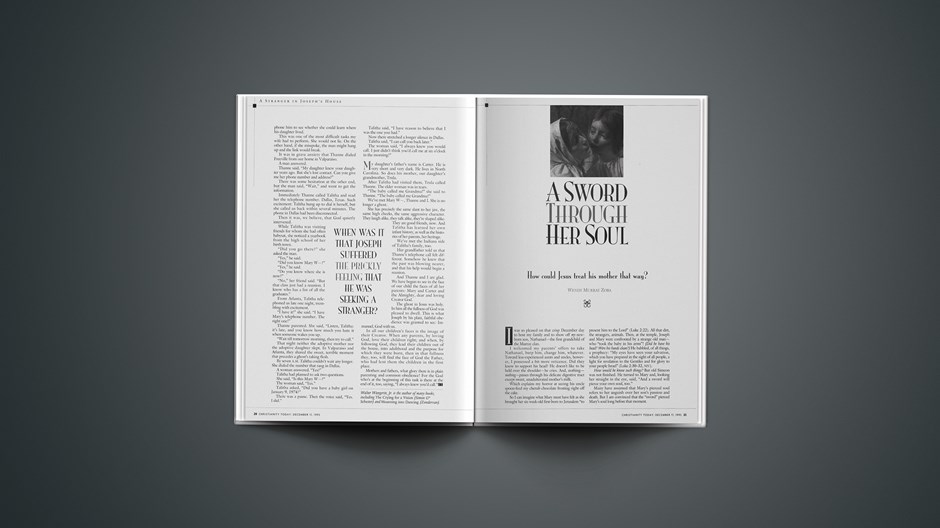
So I can imagine what Mary must have felt as she brought her six-week-old first-born to Jerusalem "to present him to the Lord" (Luke 2:22). All that dirt, the strangers, animals. Then, at the temple, Joseph and Mary were confronted by a strange old man—who "took the baby in his arms"! (Did he have his head? Were his hands clean?) He babbled, of all things, a prophecy: "My eyes have seen your salvation, which you have prepared in the sight of all people, a light for revelation to the Gentiles and for glory to your people Israel" (Luke 2:30-32, NIV).
How would he know such things? But old Simeon was not finished. He turned to Mary and, looking her straight in the eye, said, "And a sword will pierce your own soul, too."
Many have assumed that Mary's pierced soul refers to her anguish over her son's passion and death. But I am convinced that the "sword" pierced Mary's soul long before that moment.
A MOTHER'S HEART
All mothers can tell of proud moments related to their kids. I had such a moment with one of my sons a year and a half ago. We were missionaries living in Honduras, and Jon was playing right field for the Little League baseball team, the Promesas (Spanish for "Promises"). The Promesas, in a word, stunk. They had not won a game all season. During one particular game, we were losing 12 to 7 in the bottom of the eighth inning when my youngest son, Jon, stepped to the plate. The opposing team had just brought in a new pitcher, who struck out the first two Promesa batters without breaking a sweat. But then he became overconfident, and before we knew it, the bases were loaded with walked batters. That's when my son came up to bat. The team was down by five runs, and Jon could erase four of those and make it, for once, a real game.
Frantic instructions from his coaches and the crowd—"Choquela, Juan! Cuidala!"—is all my boy could hear. He was tentative, nervous. I knew—as he stood there in the batter's circle, slicing the bat around with only a half-effort—that he needed his mother.
I made my way down the bleachers until I was pressed up against the chainlink fence behind the batter's box. I knew better than to try to get him to look at me. He just needed to hear my voice.
"Don't back off this guy, Jon," I told him. "He's getting tired; he's wild. Meet the pitch." He scraped home plate and crouched into the batting position. "Juan! Juan! Juan!" roared the crowd. "You can do it, Jon," I yelled.
Don't you know that boy made contact the very first pitch—a blooper right between second and third—scoring two runs and losing his batting helmet as he pedaled around the bases.
I couldn't even yell "That's my boy!" for the huge lump that had settled in my throat. Tears filled my eyes when I saw my son—fully ensconced at second base—throw a glance my way in that glorious, crowd-pleasing moment.
That was my boy, and I was his mom—and apart from the bat meeting the ball, that was the only connection that mattered.
The Gospels' parenting stories, however, imply that Mary's famous son did not give her many such heartwarming moments. It always troubled me when I read these narratives that Jesus seemed so insensitive, if not rude, to his mother.
Who can doubt that wonder and pride welled up within the young virgin as she began to understand that she was to give birth to the only Son of God? As perplexing as that news was to her when the angel Gabriel announced it, she later exalted: "My soul glorifies the Lord … from now on all generations will call me blessed" (Luke 1:46, 48). But that is the last time we see Mary unambiguously happy.
Next she was confronted with the unenviable task of notifying her fiance that she was pregnant. Later she traveled, on an ass, nine months pregnant, across the country, only to end up giving birth in the company of goats and sheep. But these inconveniences, no doubt, evaporated in her memory once she held and suckled that glorious being pushed through her loins, her very own son.
A MOTHER'S HEARTACHE
I can imagine something of what Mary felt when she and Joseph realized they had left their preadolescent behind in Jerusalem, the big city. For one brief interlude ten years ago, we lost our two-year-old son on the public green in Washington, D.C. One minute he was toddling at our feet, and the very next he was nowhere to be seen. In a single moment, I was overrun with terror, panic, and utter helplessness. We found him, thankfully, several yards away, but by that point my pulse rate had dropped, my skin waxed ashen, and my knees were ready to give way.
Article continues below
But Jesus' parents did not know where he was for three days—three days. (I doubt that Mary slept much.) His parents finally discovered Jesus chatting casually in the temple. Understandably, Mary was miffed at his apparent lack of regard over the whole affair. "Son, why have you treated us like this? Your father and I have been anxiously searching for you" (Luke 2:48).
The reproof was turned back upon them. Their son told them two things. First, they should have known where he would be ("Why were you searching for me?"); and second, that God, not Joseph, was his father ("Didn't you know that I had to be in my Father's house?")—and they should have known that, too.
Ouch. What mother would not feel heartache at such a stinging response from a 12-year-old? Such audacity on the part of one of my sons would surely warrant "time out" in the bedroom to "think it over."
Jesus, in the end, despite the rebuke, returned to Nazareth with them and "was obedient to them."
Another piercing moment for Mary came on the day when Jesus heard the call of John the Baptist. By this time it is presumed that Joseph had died—we don't know when—and that Jesus had assumed the role of carpenter in his father's stead (Mark 6:3). And in keeping with the Law, he had taken on the mantle of leadership in the family as well. But soon the day came when the moment of "the call" arrived—who can explain it?—and, as preacher Fred Craddock describes it, "Jesus untied the apron strings, lifted the carpenter's apron over his head, put it on the bench and left the shop."
Did he go to his mother and kiss her on the cheek to say good-bye? What will you do about dinner? Or did he simply depart without a word, leaving Mary to find the shop empty, the apron on the bench, her son gone.
Perhaps Mary thought of Joseph when she stood in the empty wood shop. His ghost had eventually been overtaken by the scraping and pounding of her son. Now he was gone, too.
Article continues below
I knew this day would come, she may have said to herself. But so much time had passed since the angel appeared that I couldn't help thinking that, maybe, God had somehow forgotten this part of the arrangement.
"And a sword will pierce your own soul, too … "
A MOTHER'S INSTINCTS
I am sure Mary took heart when she realized that although Jesus no longer lived in the house, she could still see him and even could remain within his close circle of associates. That may be why she had the boldness to go to him at the wedding in Cana when the wine had run out. "They have no more wine," Mary informed her son—perhaps tugging at his elbow.
But he did not respond as a loving, obedient son would. In fact, he seemed annoyed. He turned to Mary and addressed her, "Woman"—not an expression of derision like today's "hey, lady!" but not the term denoting a mother-son relationship, either. His curt response, "Why do you involve me?" (John 2:4, NIV), can also be translated "What is there between you and me?" which suggests that the maternal boundaries had been redefined.
Is this my son talking to me? she must have wondered.
Jesus' reprimand of Mary was followed by a further rebuke, "My time has not yet come." Was Mary pressuring him to assume his messianic appointment? After all, he had left the carpenter's shop to do something. Or had she merely turned to him out of habit, seizing upon her instincts to depend on her first-born to "fix things"?
He did what his mother requested in the end, but only after assuring her that whatever "glory" he would exhibit would not be the result of her petitions. The terms of the relationship had changed, he reminded her. It was as if he had said, "When are you going to stop calling me your son?"
But a mother's love knows no boundary. She came to him yet another time, when things began to look a bit strained for him. He had become popular as a teacher and known as someone possessing "unusual" powers. Crowds swarmed, clamoring requests, and invitations came in by the boatload. Constant demands for his time and attention pressed upon him. He's overworked, Mary probably thought. What mother would not try to assert a stabilizing influence?
When Jesus and his followers sought respite in a home (probably Peter's), it soon became packed with curiosity seekers (Mark 3:20ff.). The hubbub was so intense that "he and his disciples were not even able to eat."
Article continues below
The lack of food and fresh air must be affecting his mind, a mother's heart construed. So Mary and the other family members decided it was time to intervene—for his own good—in order to save him. Thinking that he was "out of his mind," his family found him and tried "to take charge of him."
When Jesus realized his mother and brothers were outside looking for him, did he interrupt his conversation, excuse himself, and make his way out to see them, to reassure them? No. In fact, he asked, "Who are my mother and my brothers?" (Mark 3:33).
The terms of the relationship had changed. As far as he was concerned, his family bonds were no longer defined by blood but by "whoever does the will of God" (Mark 3:35).
But what else could Mary have done? All the angelic revelations and prophetic confirmations in the world did not change the fact that he was still her son.
A MOTHER'S MOMENT
Amidst the "very large crowd" hailing her donkey-riding son as king, did she wave her palm branch with the rest of the jubilant crowd? When some queried, "Who is this?" (Matt. 21:10), do you think Mary was tempted to shout, "That's my boy!"?
Probably not.
A mother knows her son's heart; she knows his face. And Mary saw that Jesus' was set "like flint." She understood that the tears streaming down his cheeks as he entered Jerusalem (Luke 19:41) did not spring from a feeling of effervescence about the palms and "hosannas" being proffered.
And a sword will pierce your own soul, too, echoed relentlessly.
Perhaps, when the disciples scattered as they took Jesus away, one of them (probably John) thought to inform Mary that her son had been seized. What mother wouldn't—in the words of C. S. Lewis—"crawl through the sewers" to find what had become of her commandeered child?
Mary was no doubt numbered among the "women who mourned and wailed for him" (Luke 23:27). She watched as he staggered under the weight of the beam trying to make his way torturously up the hill to Golgotha.
Can't somebody help him, please!
Perhaps it was a mother's pleading that moved the stony heart of the guards to seize "Simon of Cyrene … and put the cross on him and [make] him carry it behind Jesus" (Luke 23:26).
The next picture we have of Mary is when she was at her son's bleeding feet, watching him die. Where else would she be, this woman who once checked him for fevers, nursed his cut fingers, and washed his cloaks? Simeon was right—I never want to see another prophetic visitor again—this crumpled woman at the foot of her son's cross was all that remained of a loving mother's pierced soul.
Article continues below
Why did the angel call me highly favored? Someone please tell me, where is the favor of this?
My son, my son …
"Dear woman." She looked up to the face of her dying son. His eyes met hers. "Here is your son," he struggled to say between gasps for air. He turned his face slightly to the disciple beside her and managed to finish the thought, "here is your mother."
Mother.
The crowd was yelling to him, "Save yourself! If you are truly king, come down from that cross!" He could barely speak; he labored for each breath. I didn't need him to acknowledge me. I just wanted him to hear my voice, though I couldn't utter a word for the lump in my throat. Tears filled my eyes. I saw my son throw a glance my way. In that moment, when he remembered me as his mother, his eyes on mine, no other connection mattered. That was my boy, and I was his mother.
How could Jesus treat his mother that way?
Why did Jesus leave the carpenter's shop that day? Why, at the wedding, did he push his mother away? Why couldn't he identify her as "mother" amidst the throng at Peter's house?
A mother needs to know these things. But then a mother—even Jesus' mother—needs to know the Savior more. And how else could she have found her Savior without first losing him as her son?
















 While we pray for peace, we need moral clarity about this war.
 We’ve got little information on Jesus’ appearance and personality. But that’s the way God designed it.españolFrançais
 The founder of Concerned Women for America was credited by President Ronald Reagan with “changing the face of American politics.”






