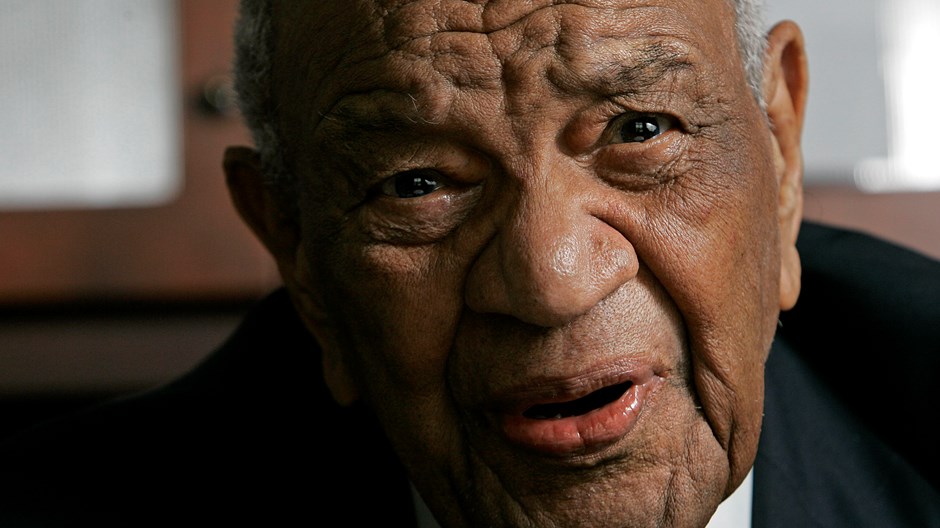
Gardner Taylor, one of America's best-known and most-respected preachers, died Easter Sunday, April 5. He retired in 1990 from Concord Baptist Church of Christ in Brooklyn, New York, after serving there for 42 years. In 1995, Christianity Today sent Ed Gilbreath to New York to profile the pastor.
Charles Haddon Spurgeon, the “Prince of Preachers,” summed up his philosophy of preaching this way: “Above all, [the preacher] must put heart work into his preaching. He must feel what he preaches. It must never be with him an easy thing to deliver a sermon. He must feel as if he could preach his very life away before the sermon is done.” Gardner C. Taylor knows something about this kind of preaching. For more than 50 years he has “preached his life away.” In 1980, Time named him “the dean of the nation’s black preachers,” and in a recent issue of The Christian Century, he was dubbed the “poet laureate of American Protestantism.”
“Gardner Taylor is a consummate communicator,” says William Pannell, professor of preaching at Fuller Theological Seminary in Southern California. Timothy George, dean of Samford University’s Beeson Divinity School, concurs: “More than anybody else I have heard in my life, Gardner Taylor combines eloquence and passion in the endeavor of preaching.”
As pastor of the 14,000-member Concord Baptist Church of Christ, Taylor, 77, labored as shepherd and prophet in Brooklyn’s rugged Bedford-Stuyvesant neighborhood for 42 years until his retirement in 1990. Today, as Concord’s pastor emeritus, Taylor is called upon to fill pulpits, give lectures, and provide keynote addresses at churches and educational institutions throughout the country. Though the legend of Gardner Taylor is great, those who know him readily admit the actual man is even greater.
Taylor is a grand, stately figure, so it is incongruous to see him behind the wheel of his late-model Ford rather than perched behind a pulpit. As he drives by Concord Baptist Church, I notice the street name on the corner: “Rev. Gardner C. Taylor Boulevard.”
“Yes, it’s a great honor,” he chimes in. “But I come from Louisiana, where they named the state law school for former governor Richard Leche. His name was placed high up on the building, engraved in stone. However, when he went to the penitentiary, they took it down.”
Such wry humor is customary with Taylor, who regularly uses anecdotes and personal remembrances to deflect attention away from himself and toward the business of preaching the gospel.
Born in 1918 to the Reverend Washington and Selina Taylor, Gardner Calvin Taylor inherited “Baptist genes” that many assumed would lead him to pastoral ministry. But he recalls, “I recoiled from the thought of being a preacher. I wanted to go to law school and become a criminal lawyer. My boyhood friends in Louisiana tried to discourage me from that idea, though; at that time, no black person had ever been admitted to the Louisiana bar.”
Taylor, nevertheless, continued his plans and gained admission to the University of Michigan Law School. But in 1937, prior to leaving for Michigan, Taylor was involved in a tragic car accident. As he drove one night in rural Louisiana, a Model T Ford suddenly cut across his path. “I tried to avoid them, but I couldn’t,” he recalls. Both of the passengers in the other car died. And, though Taylor survived, he was left “shaken at my roots.” Not only were two men dead, but they were two white men. And the only witnesses to the accident were a white farmer and a white oil refinery worker.
“In that day, for a white person to tell the truth about a black person in that situation was incredible; but those men told the truth. I would not be here today if they had not.”
Through that jarring event, Taylor received his call to the ministry. “I was surprised by God’s grace. I had been brooding about my future for a long time, but that was the defining moment.”
Taylor went on to three “bright years” at the Oberlin (Ohio) School of Theology, where he developed a scholarly appreciation for a wide range of subjects. While at Oberlin, Taylor met his wife and pastored a church in Elyria, Ohio. Following Oberlin, he served pastorates in Baton Rouge, Louisiana, and finally at Brooklyn’s Concord Baptist Church. Taylor was only 30 years old when he arrived on the scene at Concord, which in 1948 was already a flourishing congregation of over 5,000.
“One must get out of life and into the Bible. But there are also times one must get out of the Bible and into people’s lives.”
Taylor deepened Concord’s now 148-year tradition as a prestigious and vital presence in the heart of New York’s inner city. He not only filled pews on Sunday morning, but he took faith out onto the streets. “One must get out of life and into the Bible,” he says. “But there are also times when one must get out of the Bible and into people’s lives.”
Article continues below
Taylor’s holistic grasp of the gospel has resulted in a church that serves as a model for urban congregations across the nation with its commitment to community outreach and development. With Taylor at the helm, Concord established a senior citizens’ home, a fully accredited Christian grade school, a professionally staffed nursing home, and an economic-development program that draws on a $1 million endowment to provide grants to various social projects in the Brooklyn area.
But despite his tireless work in the roles of pastor and community activist, the wider world will likely see his oratorical gifts as his defining quality.
Often, in spite of the preacher, the people are ministered to,” he says. “The Word of God breaks through the preacher by the power of the Holy Spirit.”
Taylor recounts a story from his days as a fledgling minister in Baton Rouge. In that Depression-ravaged era, he was in the midst of a sermon one Sunday evening when suddenly the electricity in his small church building flickered out. Encased in darkness, the young Taylor stood motionless, not knowing what to do. Finally, an elder deacon yelled out from the congregation, “Preach on, preacher, we can still see Jesus in the dark.” And that’s what Taylor has been doing ever since: proclaiming the Word into and amid the darkness.
Listening to Gardner Taylor preach is like “hearing the voice of God,” a colleague of Taylor’s has said. As quoted in Time, Richard John Neuhaus, now editor-in-chief of First Things, expressed amazement at Taylor’s ability to “[play] with a single word. … He whispers it, and then he shouts it; he pats, pinches and probes it.”
Listening to Taylor speak over an informal meal, like our lunchtime meeting, or under any circumstance is akin to hearing him on a Sunday morning. Even his common language is colored with rich poetic rhythm and imagery. He is not a preacher by profession but by nature; it’s who he is.
Richard Lischer, professor of homiletics at the Duke Divinity School, says Taylor can draw applause from his listeners by simply reading a text. In his book The Preacher King, Lischer writes, “On one occasion as [Taylor] read some of the proper names in Luke 3 (Tiberius, Ituraiea, Trachonitis), members of the congregation began responding, ‘My Lord, My Lord!’ “
Article continues below
Noted preaching scholar James Earl Massey believes Taylor has “one of the best working vocabularies of any minister alive.” Massey, who recently retired as dean of the Anderson (Ind.) School of Theology, has been a friend of Taylor’s for more than 20 years. He says Taylor’s command lies in his breadth of cultural knowledge. “He has a firm understanding of the best of both African-American and Anglo-Saxon culture,” he explains. “The best preaching is that which can go beyond one’s self and one’s own culture to touch others who are from different backgrounds—and that’s what Dr. Taylor does.”
“Dr. Taylor is a person who is able to move effortlessly across denominational and social boundaries to touch people’s lives,” adds Timothy George, who was introduced to Taylor as a student at Harvard Divinity School in the early seventies when the school flew Taylor in once a week to teach a homiletics course. But George remembers it being more of a course on life. “He has such great wisdom and tremendous theological depth and insight.”
Indeed, “wisdom,” “depth,” and “insight” are woven through all of Taylor’s preaching. The force of his sermons exercise both mind and emotion. Like many traditional African-American pulpiteers, Taylor applies a meandering introduction that is as much a mental warm-up for the preacher as it is a preface for the sermon topic. But once Taylor launches into the body of the message, the congregation is transfixed by his skillful handling of the scriptural text. Both sound and content combine to propel the sermon to its roaring climax.
“Often, in spite of the preacher, the people are ministered to.”
One is immediately attuned to Taylor’s flair for cunning exposition. He is at once storyteller and theologian. Thus the apostle Paul is presented as “a deformed wanderer with the label of Tarsus on his baggage.” And familiar passages are reenvisioned with profound implication: “Paul was filled with competence and commitment, on his way to Damascus from Jerusalem. … But on that road where he was, Somebody else was on that road. Because Somebody else is on every road. I don’t know what road you’re traveling today—it may be a road of great joy, it may be a road of sorrow—but Somebody else is on it.”
Article continues below
Taylor himself is less certain about the mechanics of his preaching. “Black preachers used to have a formula for delivering a sermon,” he told Leadership Journal. “Start low, go slow, get high, strike fire, retire. But I can’t offer a formula for how I deliver a sermon; it depends on the sermon, on the mood of the preacher, on the mood of the congregation.”
Taylor insists that, whatever a sermon does, it must bring humanity in touch with its Creator. “There’s no excuse for the preacher if he or she is not speaking to people for God,” he asserts. “Preaching that does not bring in the vertical aspect of the sermon—the impact of God upon human life—cannot be called a sermon.”
Preaching “the impact of God upon human life” is an admirable aim. But often the human life becomes so complex, so messy that pat theological answers seem inadequate for speaking to a congregation’s concerns.
Taylor remembers countless instances when he was called upon to minister against the backdrop of both personal and national crises, such as World War II, the Cuban missile crisis, and the civil-rights revolution. “As I preached during those difficult days,
I wanted people to know that God is still on the throne,” he says. “I couldn’t predict the future; I could only give them the assertion made by my old theology dean, Thomas Graham: ‘Faith is reason gone courageous.’ “
Taylor’s own darkest night came earlier this year, when his wife of 52 years, Laura Scott Taylor, an accomplished intellectual and community leader in her own right, was tragically killed by a city vehicle while crossing a Brooklyn street.
Laura Taylor was the founder of the Concord Baptist Elementary School, where she served as principal for 32 years without pay. “She was a very fine scholar and intellectual herself,” says Pannell. “She was the one who exposed him to the theater and a much broader cultural and artistic pallet.”
“She was a very sharp and classy woman,” Taylor says of his wife. “At one point, I had gotten too involved in Brooklyn politics because of the size of the church. After a while, my wife said to me, ‘Your preaching is getting very thin.’ It was one of the most scathing things I’ve ever heard. I soon got out of preaching too much about politics.”
Article continues below
Taylor has now lived through the pain and grief about which he has consoled so many others. “They told me, ‘You have to listen to what you told us now, Pastor,’ “ he says. “The assurances that I passed out to people before—I thought I was sincere, and I thought I understood what they were going through. But I did not.”
In a recent address to his former parishioners at Concord, Taylor’s sorrow was visibly evident. “We are grateful to you [for your kindness during our loss],” he prefaced his message. “But I must not dwell on that now, because sometimes the heart is so sore—incurably so—that it cannot stand the touch of memory. So I will go forward.”
Through his forward journey, Taylor has gained an even greater appreciation of his faith. “When you come to personal crises in your life, as I have, I don’t know what people do without faith,” he observes. “I don’t always have a calm assurance about it, but I believe in all my heart that God will not do us evil. And when I understand what he is doing, I will appreciate it.”
Lately, Taylor speaks often of “the illusion of permanence.” He says, “I don’t think the young could live very well without that illusion. But as one gets older, this life begins to show its true quality of impermanence and unreliability. I believe God has ordained it so that as we must leave this world, it becomes less attractive.”
Besides being recognized as the senior statesman of African-American preachers, Taylor was a close friend and ally of civil-rights activist Martin Luther King, Jr., whom he supported during a particularly tense period in black Baptist circles. During that chaotic time 35 years ago, Taylor, King, and other ministers were involved in a controversial split from the National Baptist Convention, U.S.A. (NBC, currently the largest black denomination in the U.S.) after a fierce debate over King’s civil-rights agenda. Some within the NBC felt it was too politically liberal. As a result, Taylor and others went on to form the Progressive National Baptist Convention, which today has a membership of 2.5 million.
Taylor is one of the few surviving Baptists who were involved in that ugly dispute. “Younger Baptists don’t talk about it much anymore,” he says, “but it was a very difficult time in my life. I lost many friends.”
Article continues below
Despite being so intimately tied to modern African-American history and despite his stature as a gifted orator, Taylor remains largely unknown within the evangelical community today. “It’s just another sign,” says Timothy George, “of the ghettoization of the church.”
Perhaps Taylor’s ability to move in and out of diverse Protestant circles—both mainline and conservative—has contributed to his lack of recognition among evangelicals. But, as Lischer notes, while Taylor “infuses his sermons with principles drawn from the liberal view of human nature and history,” he “holds to an explicitly evangelical doctrine of salvation centered in the substitutionary atonement of Christ.”
But does Taylor consider himself an evangelical? Only in “the European sense,” he says. “European evangelicalism had a commitment to the gospel in its outreach toward human beings and the sufficient work of Jesus Christ,” Taylor explains. “But it was not a rigid kind of doctrinaire position, as it has been among many evangelicals in America.”
He adds, “I think evangelicals need a social conscience about the people who are least defended and most vulnerable in the society. If Christianity is not that, forget about it.”
Still, Taylor is encouraged by the hopeful signs of racial reconciliation that are emerging in the church today. Although he regrets that Concord Baptist Church never achieved a greater level of racial diversity during his tenure there, he appreciates the new sensitivity among Christians to the issue. “It is impossible, I think, to estimate the enormous impact that the whole evangelical community could have on this nation if it would free itself of its bias of race.”
When Taylor volunteers his ideas on what makes a “great preacher,” the discussion turns to his list of personal heroes—a multiracial aggregate of pulpiteers. He speaks fondly of what he considers a golden age of preaching in New York during his early days in Brooklyn, when preachers like George Buttrick, Robert McCracken, Sandy Ray, Paul Sherer, and Adam Clayton Powell filled local pulpits.
That great tradition of preaching, fostered by Taylor and others, reverberates from today’s pulpits in one form or another. The call-and-response liturgy, rhythmic pacing and intonations, and holistic scriptural exposition are very much in evidence within contemporary black churches. Younger ministers such as James A. Forbes, Jr., of the Riverside Church of New York and Gary V. Simpson, who succeeded Taylor as pastor of Concord Baptist, carry on the tradition of passionate black preaching. Yet some fear that there may be more flash than substance among many preachers in the younger set.
Article continues below
Taylor has no worries about the future of African-American preaching but does offer one cautionary note: “There is not too much emotion in the African-American church, but there is too much emotionalism. If what one is dealing with is so great, so gripping that it defies expression, then, yes, I can understand the emotional praise and preaching; but when it is done as a device, I think it’s reprehensible.”
He admits that he, too, had an obsession with emotion and calculated eloquence in his younger days. “At one point, I wanted to take elocution to train my voice,” he told Leadership. “My wife discouraged me from it, so I never did it. Her reasoning was that preaching never ought to be a finished thing, a polished performance. She was right.”
In these, his twilight years, Taylor speaks openly about the reality of old age: “You have only to look on my countenance to know that my years have faded into the light of the common day,” he said in a recent address. “But I can say this to you: Every time I have felt at the end of my tether, the old promise has come true. There has been restoration; there has been renewal; there has been revival.”
What makes a great preacher? “In the Book of Ruth, Naomi says, ‘I went out full, and I’ve come back empty,’” Taylor says. “That’s the story of life. It’s also the story of preaching; we must keep ourselves full so we can empty ourselves in the pulpit.”
At the end of Taylor’s sermon “A Promise for Life’s Long Pull,” he offers a word on his life’s ministry, drawing from his favorite black spiritual, “There Is a Balm in Gilead”:
“‘Sometimes I feel discouraged and think my work’s in vain’ … But then, just at the end of my tether; but then, when all of my strength seems spent and gone; then, when I come almost to the borders of despair; then, when I feel frustrated and confused and out of it; ‘Then … the Holy Spirit’ comes and ‘revives my soul again.’”















 While we pray for peace, we need moral clarity about this war.
 We’ve got little information on Jesus’ appearance and personality. But that’s the way God designed it.españolFrançais
 The Grammy-winning artist was found dead at her home in Nashville at age 47.






