Those two questions have always engendered controversy. Early critics labeled the magazine "Christianity Yesterday." More recent critics lament its perceived seduction by modernity. Others emphatically demand CT hit harder-at Clinton or Gingrich, at feminism or chauvinism, at homosexuals or homophobes. Yet most readers express strong appreciation for objective reporting, nuances, dialogue, theological bedrock.
I write this as we prepare for our June CTi board meeting. Russ Esty will not be with us-he was "promoted to glory" several weeks ago.
As I think about what CT ought to be, it strikes me that leaders like Russ personify its mission. They bring our mandate to life: establishing a biblical world-view, making the gospel credible, encouraging evangelism.
Russ was simply saturated with Scripture, and he would quote it—often with a twinkle in his eye—at the most opportune times. Integrated with his wide reading, it shaped all his thinking—and gave him resources to face crushing reversals in business and family health. It gave him the pluck in his last year, despite being nearly blind from an eye operation and weak from cancer surgery, to brave New York and Chicago airports to chair our executive committee and speak to our staff.
This summer completes my twentieth year with CT, and during that time, seven board members have joined "the great cloud of witnesses." Each embodied our mission in his own way.
Harold Ockenga, chairman of CTi for its first 25 years, embodied CT's intellectual and theological mission. The first president of Fuller Theological Seminary and later of Gordon-Conwell, he combined scholarship with ministry, serving also as pastor of Boston's historic Park Street Church. And his work as NAE's first president reflects CT's desire to serve as a unifying force for evangelicals.
Ockenga thought broadly and conceptually, with a refreshing practicality. He was affirming, patient, visionary, with a godly pragmatism. And the engine of it all was his spiritual life.
We once asked him how he got everything done, decade after decade. He answered that the secret was his prayer list, which he kept for 41 years. "I have everything on that list. When I go over it, I'm reminded by the Lord if I haven't tried to solve a problem … if I have enemies I am praying for, something may come to my mind that I can do about that."
In Ockenga we see a blend of scholarly intensity—his depth of reading was legendary—theological orthodoxy, and driving spiritual passion. CT's mission in a nutshell.
Duncan Brown was equally committed, but a very different personality. I first met him in the spring of 1975 when he pulled up beside me in a snappy convertible at the Pittsburgh airport, and I thought, This handsome, wealthy man does not have to do this sort of volunteer work. Like his wealthy peers, he could feed his own pleasures-and later he would tell me of rich friends who did just that and found misery instead of pleasure. Duncan poured himself out for the gospel, for "those without hope in the world." As the Salvation Army's top lay leader, he showed tremendous compassion for the poor. He also cared deeply for pastors and was influential in our launching of Leadership journal.
Maxey Jarman, who built from Jarman Shoes the giant Genesco Corporation, faithfully taught his Sunday-school class decade after decade, always ready to do his duty, whatever the personal cost. In 1974 in Switzerland, he signed the Lausanne Covenant with its commitment to a simple lifestyle, so he promptly started driving a very small automobile. When CT was struggling in the late 1970s, he was always willing to jump on a plane to come tackle a problem.
While taking a walk with him in Florida, I asked how he was handling the pain of Genesco's dramatically plummeting stock after his retirement. Many of his long-time employees had been let go; Fortune had made a cover story of it. "I've prayed that I wouldn't be bitter," he said. "At first it was hard. But I am not bitter!" And although most of his personal wealth had been lost, Maxey kept saying, "It's only what I give away that I ultimately keep."
Wayte Fulton was an encourager. Pastor, scholar, navy chaplain, after retirement he became interim pastor in church after church that needed the old master's touch. In our board meetings, he would, with eloquence-he was a lover of "Anglo-Saxon prose"-affirm and encourage. He saw the gospel as liberating, invigorating. Despite failing health, nothing could keep him from his duty. On a harsh winter day in Chicago, I was amazed at his resolve as he navigated his frail, chilled body toward me to give a warm greeting.
Cary Weisiger was also a pastor, a man of wisdom and compassion. Like so many of CT's board members, Cary was a reader and a thinker-but he didn't have a doctorate. So, after retiring from his effective and large ministry, he decided to matriculate at Fuller, completing his doctoral degree in his seventies.
Paul Rees was often described as a missionary statesman. Toughminded, optimistic, evangelistic, I still see him in his late eighties, vigorously propounding a point in the Wheaton College dining hall.
Article continues below
When we interviewed him for Leadership, I was saddened to hear that both his daughter and her husband had died of cancer within a short time of each other. Paul and his wife weathered that storm; his devotional life, his commitment to Christ, his probing intellect, all carried him forcefully into his ninth decade.
All these men put shoeleather on the principles of CT's mission.
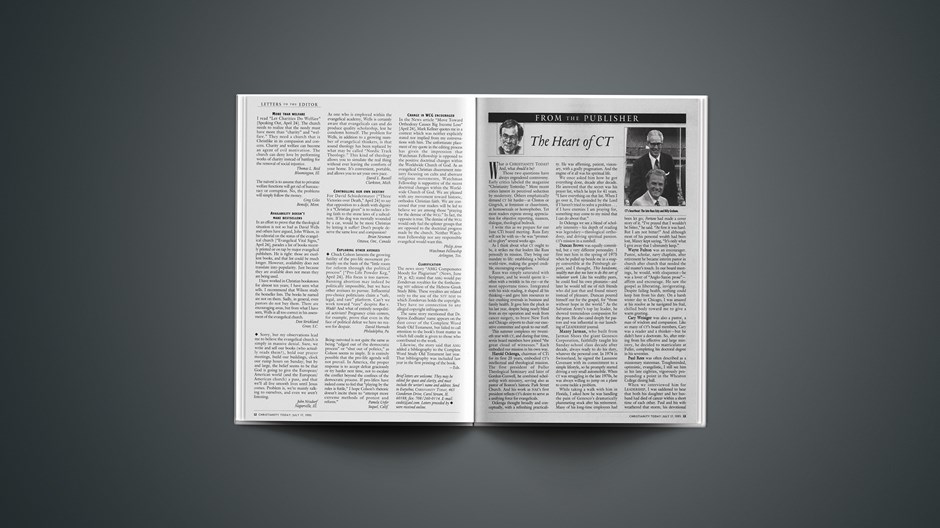
Billy Graham described Russ Esty as a loyal friend, who "had made a contribution to the evangelical world in many areas that were unknown and unheralded, but they are written down in God's book of remembrance." Esty had chaired Billy Graham's second New York Crusade, and it was Billy who had brought most of the CTi board together. In its history, CTi has had only two chairmen: Harold Ockenga and, currently, its founder, Billy Graham. In 1956, Billy presented a detailed paper outlining the proposed Christianity Today, and this publication, to a remarkable degree, still reflects his original vision.
CT's mission statements developed more recently by the board and staff include:
* To communicate the transforming power of the gospel and to enlarge readers' capacity to live out its mandates in both mind and heart;
* To publish a biblical world-view for thoughtful Christian leaders;
* To confirm the credibility and significance of the historic Christian faith to the present generation;
* To encourage and inform leaders in the church's task of evangelism;
* To enlist the best Christian minds to address the issues of the day with wisdom, journalistic skill, and sound theology;
* To provide a forum for evangelical views on major issues;
* To constructively inform Christians of relevant news and trends;
* To contribute to a sense of community, coherence, and direction among evangelicals.
All of the above resonate with Billy Graham's life and the lives of the board members he recruited. Although Graham has always insisted he is not an intellectual, he has held scholars in high respect and carefully "enlisted the best Christian minds" for many key roles. In fact, his gift for choosing the ably wise and spiritual has been a little known but major legacy to evangelicalism.
We at CT are grateful for board members who have embodied the magazine's mandate, showing that the gospel can be lived out with mind, heart, and spirit.















 While we pray for peace, we need moral clarity about this war.
 A Christian reconciliation group in Israel and Palestine warned that war would come. Now the war threatens their relevance.españolالعربيةFrançaisрусскийУкраїнська
 Beyoncé’s right. Whether listening to Cowboy Carter or reading theology, diversity is a good thing.






