We love to give. Every year, evangelical Christians give hundreds of millions of dollars annually to missions, Christian colleges, relief organizations, rescue missions, and other proxies for our do-good impulses. Indeed, 92 percent of CT readers give to nonchurch-based Christian organizations. On average, those readers give more than $2,000 annually to parachurch groups, based on research surveys.
We love to give because we want to extend our ministry beyond our own reach by supporting those who will devote themselves full-time to saving, shaping, and changing lives.
What do we expect in return for our dollars? Efficiency: We expect an organization not to spend too much on fundraising or too lavishly on administrative salaries and perks, and we expect it to get maximum mileage from donor dollars. Effectiveness: We expect the organization to use the money to produce measurable results. Faithfulness: We expect a Christian nonprofit to conform every aspect of its work to the gospel. Christian nonprofits that are efficient, effective, and faithful earn our trust-and our gifts.
DAMAGED TRUST
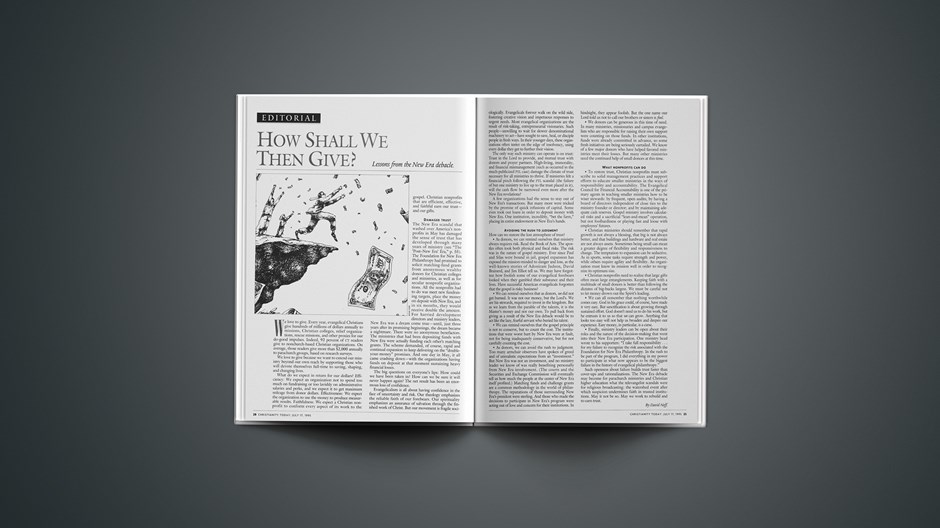
The New Era scandal that washed over America's nonprofits in May has damaged the sense of trust that has developed through many years of ministry (see "The 'Post-New Era' Era," in this issue). The Foundation for New Era Philanthropy had promised to solicit matching-fund grants from anonymous wealthy donors for Christian colleges and ministries, as well as for secular nonprofit organizations. All the nonprofits had to do was meet new fundraising targets, place the money on deposit with New Era, and in six months, they would receive double the amount. For harried development directors and ministry leaders, New Era was a dream come true-until, just three years after its promising beginnings, the dream became a nightmare. There were no anonymous benefactors. The ministries that had been depositing funds with New Era were actually funding each other's matching grants. The scheme demanded, of course, rapid and continual expansion to keep delivering on the "double-your-money" promises. And one day in May, it all came crashing down-with the organizations having funds on deposit at that moment sustaining heavy financial losses.
The big questions on everyone's lips: How could we have been taken in? How can we be sure it will never happen again? The net result has been an enormous loss of confidence.
Evangelicalism is all about having confidence in the face of uncertainty and risk. Our theology emphasizes the reliable faith of our forebears. Our spirituality emphasizes an assurance of salvation through the finished work of Christ. But our movement is fragile sociologically. Evangelicals forever walk on the wild side, fostering creative vision and impetuous responses to urgent needs. Most evangelical organizations are the result of risk-taking, entrepreneurial visionaries. Such people-unwilling to wait for slower denominational machinery to act-have sought to save, heal, or disciple people in fresh ways. In their younger days, these organizations often teeter on the edge of insolvency, using every dollar they get to further their vision.
The only way such ministry can operate is on trust: Trust in the Lord to provide, and mutual trust with donors and prayer partners. High-living, immorality, and financial mismanagement (such as occurred in the much-publicized PTL case) damage the climate of trust necessary for all ministries to thrive. If ministries felt a financial pinch following the PTL scandal (the failure of but one ministry to live up to the trust placed in it), will the cash flow be narrowed even more after the New Era revelations?
A few organizations had the sense to stay out of New Era's transactions. But many more were tricked by the promise of quick infusions of capital. Some even took out loans in order to deposit money with New Era. One institution, incredibly, "bet the farm," placing its entire endowment in New Era's hands.
AVOIDING THE RUSH TO JUDGMENT
How can we restore the lost atmosphere of trust?
* As donors, we can remind ourselves that ministry always requires risk. Read the Book of Acts. The apostles often took both physical and fiscal risks. The risk was in the nature of gospel ministry. Ever since Paul and Silas were bound in jail, gospel expansion has exposed the mission-minded to danger and loss, as the well-known stories of Adoniram Judson, David Brainerd, and Jim Elliot tell us. We may have forgotten how foolish some of our evangelical forebears looked when they gambled their substance and their lives. Have successful American evangelicals forgotten that the gospel is risky business?
* We can remind ourselves that as donors, we did not get burned. It was not our money, but the Lord's. We are his stewards, required to invest in the kingdom. But as we learn from the parable of the talents, it is the Master's money and not our own. To pull back from giving as a result of the New Era debacle would be to act like the lazy, fearful servant who buried his talent.
Article continues below
* We can remind ourselves that the gospel principle is not to conserve, but to count the cost. The institutions that were worst hurt by New Era were at fault, not for being inadequately conservative, but for not carefully counting the cost.
* As donors, we can avoid the rush to judgment. Too many armchair observers have spoken of greed and of unrealistic expectations from an "investment." But New Era was not an investment, and no ministry leader we know of was really benefiting personally from New Era involvement. (The courts and the Securities and Exchange Commission will eventually tell us how much the people at the center of New Era itself profited.) Matching funds and challenge grants are a common methodology in the world of philanthropy. The reputations of those surrounding New Era's president were sterling. And those who made the decisions to participate in New Era's program were acting out of love and concern for their institutions. In hindsight, they appear foolish. But the one name our Lord told us not to call our brothers or sisters is fool.
* We donors can be generous in this time of need. In many ministries, missionaries and campus evangelists who are responsible for raising their own support were counting on those funds. In other institutions, funds were already committed in advance, so some fresh initiatives are being seriously curtailed. We know of a few major donors who have helped favored ministries meet their losses. But many other ministries need the continued help of small donors at this time.
WHAT NONPROFITS CAN DO
* To restore trust, Christian nonprofits must subscribe to solid management practices and support efforts to educate smaller ministries in the ways of responsibility and accountability. The Evangelical Council for Financial Accountability is one of the primary agents in teaching smaller ministries how to be wiser stewards: by frequent, open audits; by having a board of directors independent of close ties to the ministry founder or director; and by maintaining adequate cash reserves. Gospel ministry involves calculated risks and a sacrificial "lean-and-mean" operation, but not foolhardiness or playing fast and loose with employees' futures.
* Christian ministries should remember that rapid growth is not always a blessing, that big is not always better, and that buildings and hardware and real estate are not always assets. Sometimes being small can mean a greater degree of flexibility and responsiveness to change. The temptation to expansion can be seductive. As in sports, some tasks require strength and power, while others require agility and flexibility. An organization must know its mission well in order to recognize its optimum size.
Article continues below
* Christian nonprofits need to realize that large gifts often mean large entanglements. Keeping faith with a multitude of small donors is better than following the dictates of big-bucks largess. We must be careful not to let money drown out the Spirit's leading.
* We can all remember that nothing worthwhile comes easy. God in his grace could, of course, have made it very easy. But sanctification is about growing through sustained effort. God doesn't need us to do his work, but he entrusts it to us so that we can grow. Anything that looks too easy will not help us broaden and deepen our experience. Easy money, in particular, is a curse.
* Finally, ministry leaders can be open about their roles and the nature of the decision-making that went into their New Era participation. One ministry head wrote to his supporters: "I take full responsibility … for my failure to recognize the risk associated with the Foundation for New Era Philanthropy. In the rush to be part of the program, I did everything in my power to participate in what now appears to be the biggest failure in the history of evangelical philanthropy."
Such openness about failure builds trust faster than cover-ups and rationalizations. The New Era debacle may become for parachurch ministries and Christian higher education what the televangelist scandals were for religious broadcasting: the watershed event after which suspicion undermines faith in trusted institutions. May it not be so. May we work to rebuild and to earn trust.

















 While we pray for peace, we need moral clarity about this war.
 A Christian reconciliation group in Israel and Palestine warned that war would come. Now the war threatens their relevance.españolالعربيةFrançaisрусскийУкраїнська
 Beyoncé’s right. Whether listening to Cowboy Carter or reading theology, diversity is a good thing.






