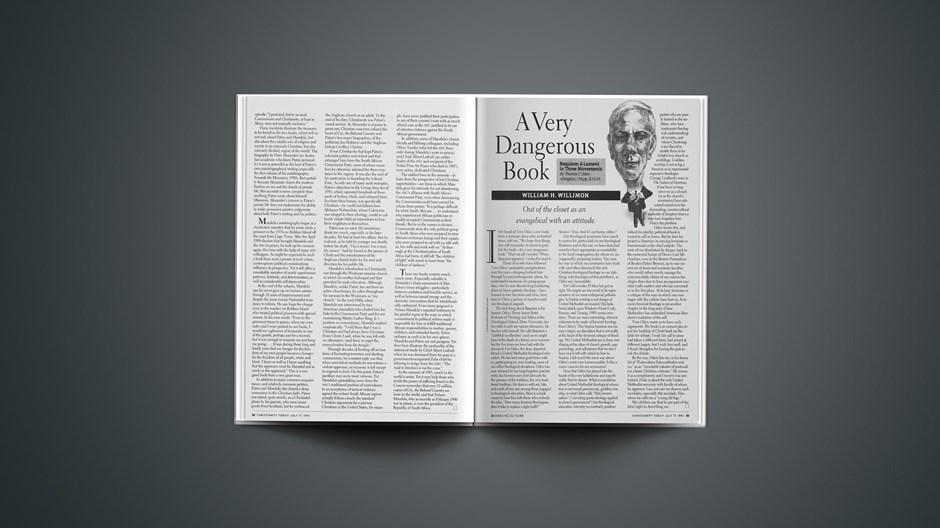
I first heard of Tom Oden's new book from a seminary dean who, in hushed tones, told me, "We hope that Abingdon will reconsider its desire to publish the book-it's a very dangerous book." That was all I needed. When "Requiem" appeared, I rushed to read it.
Those of us who have followed Tom Oden's peripatetic peregrinations over the years—trooping behind him through his psychotherapeutic phase, his existentialist moments, his group-grope days, into his now decade-long hunkering down in heavy patristic theology—have learned to love his twists and turns, have seen in Oden a picture of ourselves and our theological anguish.
The best thing about "Requiem" is the humor. Oden, Henry Anson Buttz Professor of Theology and Ethics at the Theological School, Drew University, has fun with us and our various obsessions. He has fun with himself. He calls "Requiem" a "mirthful recollection" such as we might have at the death of a friend, as we remember the fun times we have had with the deceased. For Oden, the dear, departed friend is United Methodist theological education. He has had some good times with us, participating in, even leading, some of our sillier theological deviations. Oden has now returned to our long-forgotten patristic roots, has become our chief advocate for the primacy of the tradition, the very traditional tradition. He does so with wit, bite, and mirth all too rare among those engaged in theological education. Here is a book meant to have fun with those who embody the joke, "How many feminist theologians does it take to replace a light bulb?" Answer: "One. And it's not funny, either."
Our theological seminaries have much to answer for, particularly in our theological flirtations and in the way we have detached ourselves from appropriate accountability to the local congregations for whom we are (supposedly) preparing leaders. The cavalier way in which our seminaries have dealt with (and often dismissed) the rich Christian theological heritage in our dabblings with theologies-of-this-and-that is, as Oden says, lamentable.
Yet I still wonder if Oden has got us right. His targets are too weird to be representative of our most widespread pathologies. Is Sophia worship a real danger at United Methodist seminaries? His belabored attack upon "Wisdom's Feast" (Cady, Roman, and Taussig, 1989) seems overdone. There are more interesting, relevant criticisms to be made of feminist theology than Oden's. This Sophia business was too easy a target, an aberration that is not really at the heart of the feminist critique of theology. We United Methodists are so busy worshiping at the altars of church growth, pop psychology, and self-esteem that we don't have much left with which to bow to Sophia. I felt much the same way about Oden's worry over homosexuality. Is this a major concern for our seminaries?
I fear that Oden has played into the hands of the very faddishness and superficiality that he detests. What is scandalous about United Methodist theological education is not sexual promiscuity, goddess worship, or what Oden calls "McGovernization" ("a leveling quota ideology applied to church government") but theological education whereby we routinely produce pastors who are poorly trained in the tradition, who have inadequate theological understandings of ministry, and whose Christology is too flaccid to enable them to be helpful to a church in centrifuge. Goddess worship is not as big a threat to us as experiential/ expressive theologies (George Lindbeck's term in "The Nature of Doctrine"). It has been so long since we as a church (or as the church's seminaries) have submitted ourselves to the demanding, countercultural authority of Scripture that we may have forgotten how. That is the problem.
Oden knows this, and indeed his playful, polemical book is meant to call us home. But he does his project a disservice in naming feminists or homosexuals as the chief culprits. The roots of our dissolution lie deeper, back to the existential heresy of Drew's Carl Michaelson, even to the Boston Personalism of Borden Parker Browne, up to our current set of deans and seminary faculties who would rather merely manage the unreconcilable claims of our various theologies than dare to have an argument over what really matters and who has convened us in the first place. At its best, feminism is a critique of the ways in which our marriages with the culture have hurt us. At its worst, feminist theology is yet another chapter in the long story of how Methodism has embodied American liberalism's exaltation of the self.
Tom Oden wants us to have such arguments. His book is an earnest plea to put the lordship of Christ back on the table for debate. I wish his call to arms had taken a different form, had aimed at different targets, but I wish him well, and I thank Abingdon for having the guts to risk the debate.
By the way, Oden lists me, in his funny list of "Postmodern Paleo-orthodox writers," as an "inimitable jokester of postmodern classic Christian criticism." He means it as a compliment, and I receive it as one. Indeed, Duke is about the only United Methodist seminary with faculty of whom he approves. I am not sure we deserve such accolades, especially this accolade. Elsewhere he calls me a "young old fogy."
My children say that he got part of the label right in describing me.















 While we pray for peace, we need moral clarity about this war.
 As my doubts about his teachings grew, so did a secret fascination with Jesus.
 Christian artists work at the intersection of music and climate change.






