In the early 1970s, Malcolm Muggeridge was surprised to hear that members of the intellectual elite in the Soviet Union were experiencing a spiritual revival. Anatoli Kuznetsov, living in exile in England, told him there was scarcely a single writer or artist or musician in the USSR who was not exploring spiritual issues. Against all government policy, the most favored children of the regime were abandoning hope in a kingdom on earth and turning instead toward belief in transcendence.
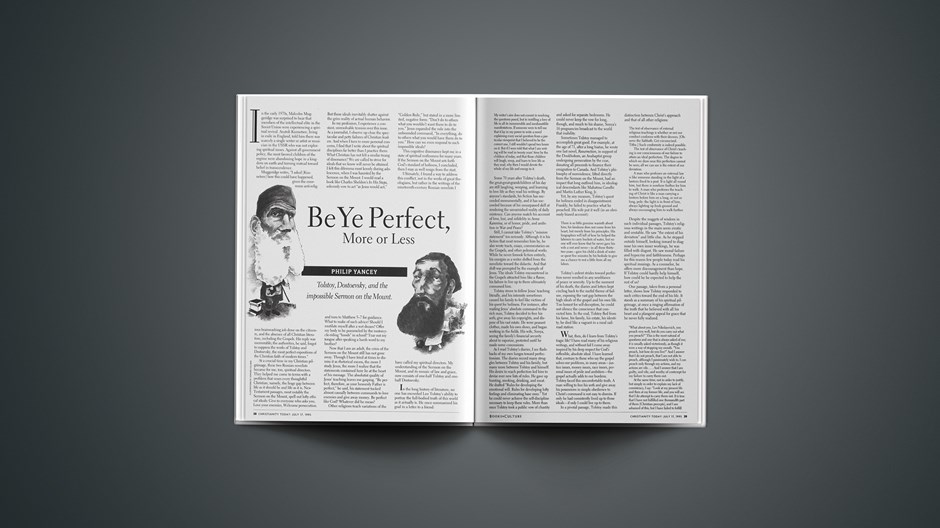
Muggeridge writes, "I asked [Kuznetsov] how this could have happened, given the enormous anti-religious brainwashing job done on the citizenry, and the absence of all Christian literature, including the Gospels. His reply was memorable; the authorities, he said, forgot to suppress the works of Tolstoy and Dostoevsky, the most perfect expositions of the Christian faith of modern times."
At a crucial time in my Christian pilgrimage, these two Russian novelists became for me, too, spiritual directors. They helped me come to terms with a problem that vexes every thoughtful Christian, namely, the huge gap between life as it should be and life as it is. New Testament passages, most notably the Sermon on the Mount, spell out lofty ethical ideals: Give to everyone who asks you, Love your enemies, Welcome persecution. But these ideals inevitably shatter against the grim reality of actual human behavior.
In my profession, I experience a constant, unresolvable tension over this issue. As a journalist, I observe up close the spectacular and petty failures of Christian leaders. And when I turn to more personal concerns, I find that I write about the spiritual disciplines far better than I practice them. What Christian has not felt a similar twang of dissonance? We are called to strive for ideals that we know will never be attained.
I felt this dilemma most keenly during adolescence, when I was haunted by the Sermon on the Mount. I would read a book like Charles Sheldon's "In His Steps," solemnly vow to act "as Jesus would act," and turn to Matthew 5-7 for guidance. What to make of such advice! Should I mutilate myself after a wet dream? Offer my body to be pummeled by the motorcycle-riding "hoods" in school? Tear out my tongue after speaking a harsh word to my brother?
Now that I am an adult, the crisis of the Sermon on the Mount still has not gone away. Though I have tried at times to dismiss it as rhetorical excess, the more I study Jesus, the more I realize that the statements contained here lie at the heart of his message. The absolutist quality of Jesus' teaching leaves me gasping. "Be perfect, therefore, as your heavenly Father is perfect," he said, his statement tucked almost casually between commands to love enemies and give away money. Be perfect like God? Whatever did he mean?
Other religions teach variations of the "Golden Rule," but stated in a more limited, negative form: "Don't do to others what you wouldn't want them to do to you." Jesus expanded the rule into the unbounded command, "In everything, do to others what you would have them do to you." How can we even respond to such impossible ideals?
This cognitive dissonance kept me in a state of spiritual restlessness for many years. If the Sermon on the Mount sets forth God's standard of holiness, I concluded, then I may as well resign from the start.
Ultimately, I found a way to address this conflict, not in the works of great theologians, but rather in the writings of the nineteenth-century Russian novelists I have called my spiritual directors. My understanding of the Sermon on the Mount, and its mosaic of law and grace, now consists of one-half Tolstoy and one-half Dostoevsky.
In the long history of literature, no one has exceeded Leo Tolstoy's ability to portray the full-bodied truth of this world as it actually is. He once summarized his goal in a letter to a friend:
My writer's aim does not consist in resolving the questions posed, but in instilling a love of life in all its innumerable and inexhaustible manifestations. If someone were to tell me that it lay in my power to write a novel explaining every social question from a particular viewpoint that I believed to be the correct one, I still wouldn't spend two hours on it. But if I were told that what I am writing will be read in twenty years' time by the children of today, and that those children will laugh, weep, and learn to love life as they read, why then I would devote the whole of my life and energy to it.
Some 70 years after Tolstoy's death, the great-great-grandchildren of his day are still laughing, weeping, and learning to love life as they read his writings. By anyone's standards, his fiction has succeeded monumentally, and it has succeeded because of his unsurpassed skill at rendering the unvarnished reality of daily existence. Can anyone match his account of love, lust, and infidelity in Anna Karenina, or of honor, pride, and ambition in War and Peace?
Still, I cannot take Tolstoy's "mission statement" too seriously. Although it is his fiction that most remember him by, he also wrote tracts, essays, commentaries on the Gospels, and other polemical works. While he never forsook fiction entirely, his energies as a writer shifted from the novelistic toward the didactic. And that shift was prompted by the example of Jesus. The ideals Tolstoy encountered in the Gospels attracted him like a flame; his failure to live up to them ultimately consumed him.
Article continues below
Tolstoy strove to follow Jesus' teaching literally, and his intensity sometimes caused his family to feel like victims of his quest for holiness. For instance, after reading Jesus' absolute command to the rich man, Tolstoy decided to free his serfs, give away his copyrights, and dispose of his vast estate. He wore peasant clothes, made his own shoes, and began working in the fields. His wife, Sonya, seeing the family's financial security about to vaporize, protested until he made some concessions.
As I read Tolstoy's diaries, I see flashbacks of my own lunges toward perfectionism. The diaries record many struggles between Tolstoy and his family, but many more between Tolstoy and himself. His desire to reach perfection led him to devise ever new lists of rules. He gave up hunting, smoking, drinking, and meat. He drafted "Rules for developing the emotional will. Rules for developing lofty feelings and eliminating base ones." Yet he could never achieve the self-discipline necessary to keep these rules. More than once Tolstoy took a public vow of chastity and asked for separate bedrooms. He could never keep the vow for long, though, and much to his shame, Sonya's 16 pregnancies broadcast to the world that inability.
Sometimes Tolstoy managed to accomplish great good. For example, at the age of 71, after a long hiatus, he wrote one last novel, Resurrection, in support of the Doukhobors, an Anabaptist group undergoing persecution by the czar, donating all proceeds to finance their emigration to Canada. And Tolstoy's philosophy of nonviolence, lifted directly from the Sermon on the Mount, had an impact that long outlived him, in ideological descendants like Mahatma Gandhi and Martin Luther King, Jr.
Yet, by any measure, Tolstoy's quest for holiness ended in disappointment. Frankly, he failed to practice what he preached. His wife put it well (in an obviously biased account):
There is so little genuine warmth about him; his kindness does not come from his heart, but merely from his principles. His biographies will tell of how he helped the laborers to carry buckets of water, but no one will ever know that he never gave his wife a rest and never—in all these thirty-two years—gave his child a drink of water or spent five minutes by his bedside to give me a chance to rest a little from all my labors.
Article continues below
Tolstoy's ardent strides toward perfection never resulted in any semblance
of peace or serenity. Up to the moment of his death, the diaries and letters kept circling back to the rueful theme of failure, exposing the vast gap between the high ideals of the gospel and his own life. Too honest for self-deception, he could not silence the conscience that convicted him. In the end, Tolstoy fled from his fame, his family, his estate, his identity; he died like a vagrant in a rural railroad station.
What, then, do I learn from Tolstoy's tragic life? I have read many of his religious writings, and without fail I come away inspired by his deep respect for God's inflexible, absolute ideal. I have learned that, contrary to those who say the gospel solves our problems, in many areas—justice issues, money issues, race issues, personal issues of pride and ambition—the gospel actually adds to our burdens. Tolstoy faced this uncomfortable truth. A man willing to free his serfs and give away his possessions in simple obedience to Christ's command is not easy to dismiss. If only he had consistently lived up to those ideals—if only I could live up to them.
In a pivotal passage, Tolstoy made this distinction between Christ's approach and that of all other religions:
The test of observance of external religious teachings is whether or not our conduct conforms with their decrees. [Observe the Sabbath. Get circumcised. Tithe.] Such conformity is indeed possible.
The test of observance of Christ's teaching is our consciousness of our failure to attain an ideal perfection. The degree to which we draw near this perfection cannot be seen; all we can see is the extent of our deviation.
A man who professes an external law is like someone standing in the light of a lantern fixed to a post. It is light all round him, but there is nowhere further for him to walk. A man who professes the teaching of Christ is like a man carrying a lantern before him on a long, or not so long, pole: the light is in front of him, always lighting up fresh ground and always encouraging him to walk further.
Despite the nuggets of wisdom in such individual passages, Tolstoy's religious writings in the main seem erratic and unstable. He saw "the extent of his deviation" and little else. As he stepped outside himself, looking inward to diagnose his own inner workings, he was filled with disgust. He saw moral failure and hypocrisy and faithlessness. Perhaps for this reason few people today read his spiritual musings. As a counselor, he offers more discouragement than hope. If Tolstoy could hardly help himself, how could he be expected to help the rest of us?
Article continues below
One passage, taken from a personal letter, shows how Tolstoy responded to such critics toward the end of his life. It stands as a summary of his spiritual pilgrimage, at once a ringing affirmation of the truth that he believed with all his heart and a plangent appeal for grace that he never fully realized.
"What about you, Lev Nikolayevich, you preach very well, but do you carry out what you preach?" This is the most natural of questions and one that is always asked of me; it is usually asked victoriously, as though it were a way of stopping my mouth. "You preach, but how do you live?" And I answer that I do not preach, that I am not able to preach, although I passionately wish to. I can preach only through my actions, and my actions are vile. … And I answer that I am guilty, and vile, and worthy of contempt for my failure to carry them out.
At the same time, not in order to justify, but simply in order to explain my lack of consistency, I say: "Look at my present life and then at my former life, and you will see that I do attempt to carry them out. It is true that I have not fulfilled one thousandth part of them [Christian precepts], and I am ashamed of this, but I have failed to fulfill them not because I did not wish to, but because I was unable to. Teach me how to escape from the net of temptations that surrounds me, help me and I will fulfill them; even without help I wish and hope to fulfill them.
"Attack me, I do this myself, but attack me rather than the path I follow and which I point out to anyone who asks me where I think it lies. If I know the way home and am walking along it drunkenly, is it any less the right way because I am staggering from side to side! If it is not the right way, then show me another way; but if I stagger and lose my way, you must help me, you must keep me on the true path, just as I am ready to support you. Do not mislead me, do not be glad that I have got lost, do not shout out joyfully: 'Look at him! He said he was going home, but there he is crawling into a bog!' No, do not gloat, but give me your help and support."
Article continues below
I feel sad as I read Tolstoy's religious writings. The x-ray vision into the human heart that made him a great novelist also made him a tortured Christian. Like a spawning salmon, he fought upstream all his life, in the end collapsing from moral exhaustion.
Yet I also feel grateful to Tolstoy, for his relentless pursuit of authentic faith has made an indelible impression upon me. I first came across his novels during a period when I was suffering the delayed effects of "biblical child abuse." The churches I grew up in contained too many frauds—or at least, that is how I saw it in the arrogance of youth. When I observed the huge gap between the ideals of the gospel and the flaws of its followers, I was sorely tempted to abandon those ideals as hopelessly unattainable.
Then I discovered Tolstoy. He was the first author who, for me, accomplished that most difficult of tasks: to make good as believable and appealing as evil. I found in his novels, fables, and short stories a Vesuvian source of moral power.
A few years ago a friend of mine, a literature professor, received a frantic cry for help from a former student then serving in a squalid refugee camp in Indochina. Every day she was interviewing boat people who had escaped Cambodia and Vietnam, listening to their stories of brutality and evil. She could hardly believe in human goodness any more, she said. She could hardly believe in God. Could he send her a few books that might help resuscitate her faith? My friend chose five books, and first among them was Leo Tolstoy's Resurrection.
A biographer of Tolstoy, A. N. Wilson, remarks that Tolstoy suffered from a "fundamental theological inability to understand the Incarnation. His religion was ultimately a thing of law rather than of grace, a scheme for human betterment rather than a vision of God penetrating a fallen world." With crystalline clarity, Tolstoy could see his own inadequacy in the light of God's ideal. But he could not take the further step of trusting God's grace to overcome that inadequacy.
Shortly after first reading Tolstoy, I discovered his countryman Fyodor Dostoevsky. These two, the most famous and accomplished of all Russian writers, lived and worked during the same period of history. Oddly, they never met, and perhaps it was just as well-they were opposites in every way. Where Tolstoy wrote bright, sunny novels, Dostoevsky wrote dark and brooding ones. Where Tolstoy worked out ascetic schemes for self-improvement, Dostoevsky periodically squandered his health and fortune on alcohol and gambling. Dostoevsky got many things wrong, but he got one thing right. His novels communicate grace and forgiveness with a Tolstoyan force.
Article continues below
Early in his life, Dostoevsky underwent a virtual resurrection. He had been arrested for belonging to a group judged treasonous by Czar Nicholas I, who, to impress upon the young parlor radicals the gravity of their errors, sentenced them to death and staged a mock execution. The conspirators were dressed in white death gowns and led to a public square where a firing squad awaited them. Blindfolded, robed in white burial shrouds, hands bound tightly behind them, they were paraded before a gawking crowd and then tied to posts. At the very last instant, as the order, "Ready, aim!" was heard, and rifles were cocked and lifted upward, a horseman galloped up with a prearranged message from the czar: he would mercifully commute their sentences to hard labor.
Dostoevsky never recovered from this experience. He had peered into the jaws of death, and from that moment, life became for him precious beyond all calculation. "Now my life will change," he said: "I shall be born again in a new form." As he boarded the convict train toward Siberia, a devout woman handed him a New Testament, the only book allowed in prison. Believing that God had given him a second chance to fulfill his calling, Dostoevsky pored over that New Testament during his confinement. After ten years, he emerged from exile with unshakable Christian convictions, as expressed in one famous passage: "If anyone proved to me that Christ was outside the truth … then I would prefer to remain with Christ than with the truth."
Prison offered Dostoevsky another opportunity as well. It forced him to live at close quarters with thieves, murderers, and drunken peasants. His shared life with these people later led to unmatched characterizations in his novels, such as that of the murderer Raskolnikov in Crime and Punishment. Dostoevsky's liberal view of the inherent goodness in humanity could not account for the granitic evil he found in his cellmates. Over time, though, he glimpsed the image of God in even the lowest of these prisoners. He came to believe that only by receiving love is a human being capable of love; "We love because he [God] first loved us," as the apostle John says.
I encountered grace in the novels of Dostoevsky. "Crime and Punishment" portrays a despicable man who commits a despicable crime. Yet the soothing balm of grace enters Raskolnikov's life as well, through the person of the converted prostitute Sonia, who follows him all the way to Siberia and leads him to redemption. In the magical novel "The Idiot," Dostoevsky presents a Christ figure in the form of an epileptic prince. Quietly, mysteriously, Prince Myshkin moves among the circles of Russia's upper class, exposing their hypocrisy while also illuminating their lives with goodness and truth.
Article continues below
Finally, "The Brothers Karamazov," perhaps the greatest novel ever written, draws a contrast between Ivan, the brilliant agnostic, and his devout brother, Alyosha. Ivan can critique the failures of humankind and every political system designed to deal with those failures, but he can offer no solutions. Alyosha has no answers to the intellectual problems Ivan raises, but he has a solution for humanity: love. "I do not know the answer to the problem of evil," said Alyosha, "but I do know love."
I call these two Russians my spiritual directors because they helped me accept a central paradox of the Christian life. From Tolstoy I learned the need to look inside, to the kingdom of God that is within me. I saw how miserably I had failed the high ideals of the gospel. But from Dostoevsky I learned the full extent of grace. Not only the kingdom of God is within me; Christ himself dwells there. "Where sin increased, grace increased all the more," is how Paul expressed it in Romans.
There is only one way for any of us to resolve the tension between the high ideals of the gospel and the grim reality of ourselves: to accept that we will never measure up, but that we do not have to. We are judged by the righteousness of the Christ who lives within, not our own. Tolstoy got it halfway right: Anything that makes me feel comfort with God's moral standard, anything that makes me feel, "At last I have arrived," is a cruel deception. But Dostoevsky got the other half right: Anything that makes me feel discomfort with God's forgiving love is also a cruel deception. "There is now no condemnation to those who are in Christ Jesus": that message, Leo Tolstoy never fully grasped.
Absolute ideals and absolute grace: after learning that dual message from Russian novelists, I returned to Jesus and found that it suffuses his teaching. In his response to the rich young ruler, in the parable of the Good Samaritan, in his comments about divorce, money, or any other moral issue, Jesus never lowered God's ideal. "Be perfect, as your heavenly Father is perfect," he said. "Love the Lord your God with all your heart and with all your soul and with all your mind." No one—not Tolstoy, not Francis of Assisi, not Mother Teresa—has completely fulfilled those commands.
Article continues below
Yet the same Jesus tenderly offered absolute grace. Jesus forgave an adulteress, a thief on the cross, a disciple who had denied ever knowing him. He tapped that traitorous disciple, Peter, to found his church, and for the next advance, turned to a man named Saul, who had made his mark persecuting Christians. Grace is absolute, inflexible, all-encompassing. It extends even to the people who nailed Jesus to the cross: "Father, forgive them, for they do not know what they are doing" were among the last words he spoke on earth.
I read passages such as the Sermon on the Mount with a different spirit now than in my adolescence. Jesus did not proclaim these exalted words so that, Tolstoy-like, we would furrow our brows in despair over our failure to achieve perfection. He proclaimed them to impart to us God's ideal toward which we should never stop striving, but also to show that none of us will ever reach that ideal. The Sermon on the Mount forces us to recognize the great distance between God and us, and any attempt to reduce that distance by somehow moderating its demands misses the point altogether.
The worst tragedy would be to turn the Sermon on the Mount into another form of legalism; it should rather put an end to all legalism. Legalism like the Pharisees' will always fail, not because it is too strict, but because it is not strict enough. Thunderously, inarguably, the Sermon on the Mount decrees that before God we all stand on level ground: murderers and temper-throwers, adulterers and lusters, thieves and coveters. We are all desperate, and that is, in fact, the only state appropriate to a human being who wants to know God. Having fallen from the absolute ideal, as Tolstoy did, we have nowhere to land but with Dostoevsky, in the safety net of absolute grace.
(Some of this material will appear in different form in The Jesus I Never Knew, to be published by Zondervan in August. Quotations from Tolstoy's religious writings are taken from the translations in The Lion and the Honeycomb, a compilation by A. N. Wilson, published in 1987.)
Joseph Frank's study of the life and works of Dostoevsky has been hailed as one of the greatest literary biographies of the twentieth century. "Dostoevsky: The Miraculous Years, 1865-1871" (Princeton University Press, 523 pp.; $35, hardcover), the fourth volume of a projected five, covers the period in which Dostoevsky wrote "Crime and Punishment," "The Idiot," and "The Devils." Also worth particular attention is "The Gospel in Dostoevsky" (Plough Publishing House, Spring Valley, Farmington, PA 15437-9506; 258 pp.; $12, paper), edited by the Hutterian Brethren, a selection of excerpts from Dostoevsky's writings. "In the passages selected here," comments J. I. Packer, "a super-sensitive giant of the imagination projects a uniquely poignant vision of the plight of man and the power of God."















 While we pray for peace, we need moral clarity about this war.
 As my doubts about his teachings grew, so did a secret fascination with Jesus.
 C.S. Lewis recommended discernment over diatribes in exactly the moments we’re most eager to indulge in critique.






