Though the Cold War has ended and democracy is attempting to take hold in the former Soviet Union, the Russian people still live with the devastating consequences of seven decades of Communist domination. Between the physical and political persecution of its members and the loss of many of its key leaders and places of worship, the Orthodox church suffered tremendously.
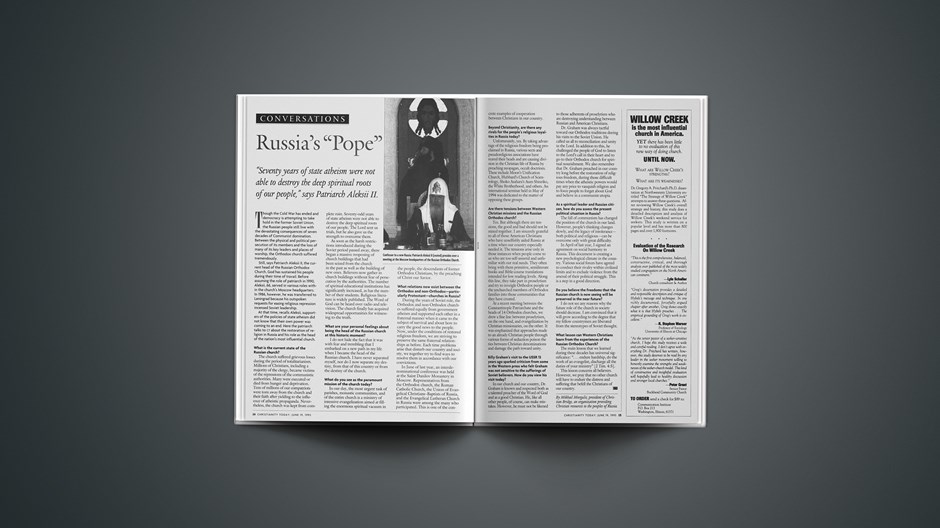
Still, says Patriarch Aleksii II, the current head of the Russian Orthodox Church, God has sustained his people during their time of travail. Before assuming the role of patriarch in 1990, Aleksii, 66, served in various roles within the church's Moscow headquarters. In 1986, however, he was transferred to Leningrad because his outspoken requests for easing religious repression incensed Soviet leadership.
At that time, recalls Aleksii, supporters of the policies of state atheism did not know that their own power was coming to an end. Here the patriarch talks to CT about the restoration of religion in Russia and his role as the head of the nation's most influential church.
WHAT IS THE CURRENT STATE OF THE RUSSIAN CHURCH?
The church suffered grievous losses during the period of totalitarianism. Millions of Christians, including a majority of the clergy, became victims of the repressions of the communistic authorities. Many were executed or died from hunger and deprivation. Tens of millions of our compatriots were torn away from the church and their faith after yielding to the influence of atheistic propaganda. Nevertheless, the church was kept from complete ruin. Seventy-odd years of state atheism were not able to destroy the deep spiritual roots of our people. The Lord sent us trials, but he also gave us the strength to overcome them.
As soon as the harsh restrictions introduced during the Soviet period passed away, there began a massive reopening of church buildings that had been seized from the church in the past as well as the building of new ones. Believers now gather in church buildings without fear of persecution by the authorities. The number of spiritual educational institutions has significantly increased, as has the number of their students. Religious literature is widely published. The Word of God can be heard over radio and television. The church finally has acquired widespread opportunities for witnessing to the truth.
WHAT ARE YOUR PERSONAL FEELINGS ABOUT BEING THE HEAD OF THE RUSSIAN CHURCH AT THIS HISTORIC MOMENT?
I do not hide the fact that it was with fear and trembling that I embarked on a new path in my life when I became the head of the Russian church. I have never separated myself, nor do I now separate my destiny, from that of this country or from the destiny of the church.
WHAT DO YOU SEE AS THE PARAMOUNT MISSION OF THE CHURCH TODAY?
In our day, the most urgent task of parishes, monastic communities, and of the entire church is a ministry of intensive evangelization aimed at filling the enormous spiritual vacuum in the people, the descendants of former Orthodox Christians, by the preaching of Christ our Savior.
WHAT RELATIONS NOW EXIST BETWEEN THE ORTHODOX AND NON-ORTHODOX-PARTICULARLY PROTESTANT-CHURCHES IN RUSSIA?
During the years of Soviet rule, the Orthodox and non-Orthodox churches suffered equally from government atheism and supported each other in a fraternal manner when it came to the subject of survival and about how to carry the good news to the people. Now, under the conditions of restored religious freedom, we are striving to preserve the same fraternal relationships as before. Each time problems arise that disturb our country and society, we together try to find ways to resolve them in accordance with our convictions.
In June of last year, an interdenominational conference was held at the Saint Danilov Monastery in Moscow. Representatives from the Orthodox church, the Roman Catholic Church, the Union of Evangelical Christians-Baptists of Russia, and the Evangelical Lutheran Church in Russia were among the many who participated. This is one of the concrete examples of cooperation between Christians in our country.
BEYOND CHRISTIANITY, ARE THERE ANY RIVALS FOR THE PEOPLE'S RELIGIOUS LOYALTIES IN RUSSIA TODAY?
Unfortunately, yes. By taking advantage of the religious freedom being proclaimed in Russia, various sects and pseudoreligious associations have reared their heads and are causing division in the Christian life of Russia by preaching neopagan, occult doctrines. These include Moon's Unification Church, Hubbard's Church of Scientology, Shoko Asahara's Aum Shinriko, the White Brotherhood, and others. An international seminar held in May of 1994 was dedicated to the matter of opposing these groups.
ARE THERE TENSIONS BETWEEN WESTERN CHRISTIAN MISSIONS AND THE RUSSIAN ORTHODOX CHURCH?
Yes. But although there are tensions, the good and bad should not be mixed together. I am sincerely grateful to all of those American Christians who have unselfishly aided Russia at a time when our country especially needed it. The tensions arise only in those instances when people come to us who are too self-assured and unfamiliar with our real needs. They often bring with them primitive, semiliterate books and Bible-course translations intended for low reading levels. Along this line, they take part in proselytism and try to inveigle Orthodox people or the unchurched members of Orthodox families into those communities that they have created.
Article continues below
At a recent meeting between the Constantinople Patriarchate and the heads of 14 Orthodox churches, we drew a fine line between proselytism, on the one hand, and evangelization by Christian missionaries, on the other. It was emphasized that approaches made to an already Christian people through various forms of seduction poison the ties between Christian denominations and damage the path toward unity.
BILLY GRAHAM'S VISIT TO THE USSR 13 YEARS AGO SPARKED CRITICISM FROM SOME IN THE WESTERN PRESS WHO FELT GRAHAM WAS NOT SENSITIVE TO THE SUFFERINGS OF SOVIET BELIEVERS. HOW DO YOU VIEW HIS VISIT TODAY?
In our church and our country, Dr. Graham is known and respected both as a talented preacher of the Word of God and as a good Christian. He, like all other people, of course, can make mistakes. However, he must not be likened to those adherents of proselytism who are destroying understanding between Russian and American Christians.
Dr. Graham was always tactful toward our Orthodox traditions during his visits to the Soviet Union. He called us all to reconciliation and unity in the Lord. In addition to this, he challenged the people of God to listen to the Lord's call in their heart and to go to their Orthodox church for spiritual nourishment. We also remember that Dr. Graham preached in our country long before the restoration of religious freedom, during those difficult times when the atheistic powers would pay any price to vanquish religion and to force people to forget about God and believe in a communist utopia.
AS A SPIRITUAL LEADER AND RUSSIAN CITIZEN, HOW DO YOU ASSESS THE PRESENT POLITICAL SITUATION IN RUSSIA?
The fall of communism has changed the position of the church in our land. However, people's thinking changes slowly, and the legacy of intolerance-both political and religious-can be overcome only with great difficulty.
In April of last year, I signed an agreement on social harmony in Russia. This document is creating a new psychological climate in the country. Various social forces have agreed to conduct their rivalry within civilized limits and to exclude violence from the arsenal of their political struggle. This is a step in a good direction.
Article continues below
DO YOU BELIEVE THE FREEDOMS THAT THE RUSSIAN CHURCH IS NOW SEEING WILL BE PRESERVED IN THE NEAR FUTURE?
I do not see any reasons why the future role of the church in society should decrease. I am convinced that it will grow according to the degree that my fellow countrymen are liberated from the stereotypes of Soviet thought.
WHAT LESSON CAN WESTERN CHRISTIANS LEARN FROM THE EXPERIENCES OF THE RUSSIAN ORTHODOX CHURCH?
The main lesson that we learned during these decades has universal significance: " … endure hardship, do the work of an evangelist, discharge all the duties of your ministry" [2 Tim. 4:5].
This lesson concerns all believers. However, we pray that no other church will have to endure the distress and suffering that befell the Christians of our country.
By Mikhail Morgulis, president of Christian Bridge, an organization providing Christian resources to the peoples of Russia.















 While we pray for peace, we need moral clarity about this war.
 As my doubts about his teachings grew, so did a secret fascination with Jesus.
 NIL deals in college athletics present new challenges—and opportunities—for colleges and students.






