CHRISTIANITY TODAY graciously offered me an opportunity to respond to John Woodbridge's lead article in the March 6 issue, entitled "Culture War Casualties: How Warfare Rhetoric Is Hurting the Work of the Church." Despite considerable disagreement with the author, my first reaction was to decline. I didn't have time to reply, and furthermore, I dislike public debates with a fellow believer who has spent a lifetime in service to the Lord. But when I saw the prominence given to Woodbridge's article and the flaws in his logic, I felt I had to reply. I do so now in a spirit of charity, despite the differing perspective from which I come.
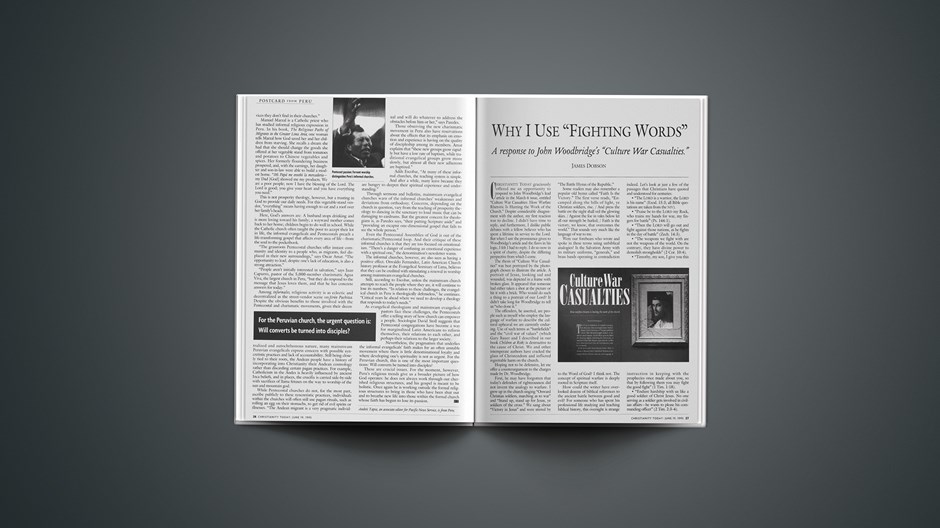
The thesis of "Culture War Casualties" was best portrayed by the photograph chosen to illustrate the article. A portrait of Jesus, looking sad and wounded, was depicted in a frame with broken glass. It appeared that someone had either taken a shot at the picture or hit it with a brick. Who would do such a thing to a portrait of our Lord? It didn't take long for Woodbridge to tell us "who done it."
The offenders, he asserted, are people such as myself who employ the language of warfare to describe the cultural upheaval we are currently enduring. Use of such terms as "battlefields" and the "civil war of values" (which Gary Bauer and I described in our book "Children at Risk") is destructive to the cause of Christ. We and other intemperate authors have cracked the glass of Christendom and inflicted regrettable harm on the church.
Hoping not to be defensive, let me offer a counterargument to the charges made by Dr. Woodbridge.
First, he may have forgotten that today's defenders of righteousness did not invent the analogy to warfare. I grew up in the church singing "Onward Christian soldiers, marching as to war" and "Stand up, stand up for Jesus, ye soldiers of the cross." We sang about "Victory in Jesus" and were stirred by "The Battle Hymn of the Republic."
Some readers may also remember a popular old hymn called "Faith Is the Victory." The first verse reads, "Encamped along the hills of light, ye Christian soldiers, rise. / And press the battle ere the night shall veil the glowing skies. / Against the foe in vales below let all our strength be hurled; / Faith is the victory, we know, that overcomes the world." That sounds very much like the language of war to me.
Were our forebears who wrote and spoke in these terms using unbiblical analogies? Is the Salvation Army with its military uniforms, "generals," and brass bands operating in contradiction to the Word of God? I think not. The concept of spiritual warfare is deeply rooted in Scripture itself.
How could the writer have overlooked dozens of biblical references to the ancient battle between good and evil? For someone who has spent his professional life studying and teaching biblical history, this oversight is strange indeed. Let's look at just a few of the passages that Christians have quoted and understood for centuries:
* "The Lord is a warrior; the Lord is his name" (Exod. 15:3; all Bible quotations are taken from the NIV).
* "Praise be to the Lord my Rock, who trains my hands for war, my fingers for battle" (Ps. 144:1).
* "Then the Lord will go out and fight against those nations, as he fights in the day of battle" (Zech. 14:3).
* "The weapons we fight with are not the weapons of the world. On the contrary, they have divine power to demolish strongholds" (2 Cor. 10:4).
* "Timothy, my son, I give you this instruction in keeping with the prophecies once made about you, so that by following them you may fight the good fight" (1 Tim. 1:18).
* "Endure hardship with us like a good soldier of Christ Jesus. No one serving as a soldier gets involved in civilian affairs-he wants to please his commanding officer" (2 Tim. 2:3-4).
If today's language of spiritual warfare has cracked the glass of Christianity, I wonder how it managed to survive the inspired militancy of the prophets and apostles. Surely Dr. Woodbridge must not have pondered his thesis before deciding to write about it. Coincidentally, I noticed that his first book was entitled "More Than Conquerors," which is ironic in itself. Is that not the language of war-and of Scripture?
Some might argue that the biblical references I have cited refer to a spiritual war rather than to the "cultural war" occurring around us. In my view, both are manifestations of the same conflict. The heated dispute over values in Western nations is simply a continuation of the age-old struggle between the principles of righteousness and the kingdom of darkness. Thus, when we oppose hardcore and violent pornography, the killing of unborn babies, the provision of immoral advice to teenagers, the threat of euthanasia, and so on, we are engaged in a battle-not primarily with our philosophical opponents-but against "Satan, who leads the whole world astray" (Rev. 12:9). As the apostle Paul expressed it, "For our struggle is not against flesh and blood, but against the rulers, against the authorities, against the powers of this dark world and against the spiritual forces of evil in the heavenly realms" (Eph. 6:12).
Article continues below
There was another major theme in Dr. Woodbridge's article that lacked substantiation. The author implied that those who use the analogy to war are pretty unpleasant people, all things considered. After having mentioned my name, he went on to write generally about Christian activists who are unloving, vindictive, and lacking in compassion. Specifically, he said they "misrepresent and caricature" their opponents, they "place themselves at the center of the moral universe," they "bear false witness," they "seek to destroy" their enemies, they "exhibit explosive reactions to anyone who criticizes or 'crosses' them," and they lower the moral tone of the debate in order to raise money. The last charge was especially hurtful, although the author may or may not have been referring to me personally.
Either way, not one scrap of evidence was cited to document these ungodly attitudes in whomever Dr. Woodbridge had in mind. It was simply assumed that those who perceive our present moral crisis as a battle between right and wrong are also vicious to those with whom they disagree. That is a serious charge. It should be incumbent upon the author to find at least one example-a single quotation-to validate his claim. He would be hard pressed to do so.
The reader of the article also gets the impression that CHRISTIANITY TODAY was in total agreement with Dr. Woodbridge's unsupported claims. For those who still have the March 6 issue at hand, look carefully at the background for the front cover. Behind the stark black and white letters of the title "Fighting Words," we can read other names used derisively, including feminazi, queer, faggot, welfare queen, bigot, and demagogue. Whom do you suppose the editors were criticizing for using that kind of language? I know of no responsible Christian writers who have spoken in such terms. Rush Limbaugh speaks of feminazis on his radio broadcast, but he does not claim to speak for evangelicals.
Of this you can be certain: those offensive and disrespectful words will not be found in any of my books, and I challenge CHRISTIANITY TODAY to find such examples in any mainline Christian literature. If, on the other hand, Dr. Woodbridge was addressing only fringe writers, he should have limited his criticism to those extremists. And if there are actually very few of them, why did the article deserve to be the cover story of one of the most prominent Christian magazines?
Article continues below
Since I was cited as one of the Christian writers who use offensive language, let me quote from "Children at Risk" in which Gary Bauer and I outlined the rationale for the analogy to warfare. Again, the following excerpt will help explain how today's culture war is a function of the age-old spiritual conflict referred to in Scripture. We wrote:
Nothing short of a great Civil War of Values rages today throughout North America. Two sides with vastly differing and incompatible world-views are locked in a bitter conflict that permeates every level of society.
Instead of fighting for territory or military conquest, however, the struggle now is for the hearts and minds of the people. It is a war over ideas. And someday soon, I believe, a winner will emerge and the loser will fade from memory. For now, the outcome is very much in doubt.
On one side of this Continental Divide are the traditionalists whose values begin with the basic assumption that "God is … " From that understanding comes a far reaching system of thought that touches every dimension of life. Their beliefs are deeply rooted in Scripture, beginning with the Ten Commandments and continuing through New Testament teachings and the gospel of Jesus Christ.
Until approximately thirty years ago, these biblically based concepts were the dominant values and beliefs in Western society. Not everyone agreed, of course, but most did. Decisions made in Congress or by the judicial system typically reflected this broad understanding. And you can be sure that the public schools also conformed to it. Parents saw to that.
Then, slowly at first, another way of looking at the world began to emerge. It evolved from the basic assumption that "God isn't … " Everything emanating from the Creator was jettisoned, including reverence for Scripture or any of the transcendent, universal truths. "Right" was determined by what seemed right at a particular time.
All the old rules and commandments had to be reconsidered. Since in their view human beings have no eternal significance, the value of life was cheapened. Our species became just another member of the animal kingdom, perhaps brighter than the rest, but of no more value. Thus, secular humanists easily embraced abortion, infanticide, and euthanasia when convenience demanded.
Historic perspectives on morality and ethics gave way to a "new morality" based on changing social attitudes. Prohibitions dissolved, rules changed, restrictions faded, and guilt subsided. Obviously, this moral free-fall was very liberating in the early days, and self-discipline and restraint yielded to a less demanding master. And it caught on like wildfire.
Article continues below
Let's subject this excerpt to the specific criticism of Dr. Woodbridge. Does it distort the position of those with whom we disagree? Does it "misrepresent and caricature" them? Does it place us at the "center of the moral universe?" Does it represent an "explosive reaction" by the writers? Are there evidences of "false witness" within the statement, and does it "seek to destroy" anyone who has the temerity to disagree? More important, does our description exaggerate the cultural upheaval we are experiencing in North America? Are we really involved in a civil war of values?
Well, let me invite you to review just a sampling of the immoral and antifamily developments that are occurring around us every day. Then I will leave it to the reader to judge the validity of our analogy.
* The Council of Ethical and Judicial Affairs, a committee of the American Medical Association, has recently announced a new policy regarding anencephalic newborns. These babies are born with the frontal lobes of their brains missing, and they usually die in a few days. The council, however, wants to cannibalize their body parts before they are spoiled by death. Henceforth, they will consider these living, breathing infants to be "dead" at birth. That will make it "ethically permissible" to dismember and kill them. Unbelievably, the doctors still refer to the little victims as organ "donors."
* Voters in Oregon last November rejected an initiative to restore the state's child pornography law, which a court had ruled unconstitutional. Because the measure lost, Oregonians currently have no law against the photographic exploitation of children. This state stands virtually alone among Western nations in not prohibiting the horrors of child sexual abuse.
* In the same election, Oregon voters approved the nation's first "euthanasia law," permitting "doctor assisted suicide." The implications of that legislation are profound, although thankfully, a temporary court injunction has kept it from going into effect.
* Last month, nine members of the Colorado State Senate (seven Democrats and two Republicans) issued a citation in honor of an abortionist, Dr. Warren Hern. They commended him for having the courage to kill babies in the eighth and ninth months of pregnancy. Fully viable infants, some only hours from delivery, are routinely murdered in Hern's Boulder Abortion Clinic. The citation reads: "One of only three physicians to perform late term abortions, Dr. Hern has been the target of adversity for more than two decades. We applaud him for his years of personal sacrifice and courage in upholding his beliefs."
Article continues below
* The United Nations Conference on Women's Issues is scheduled to be held in Beijing, China, from August 30 to September 15, 1995. What an outrage! No country on earth has abused the rights of its women more than China, which has implemented a policy of forced abortion for mothers who already have one child. This wicked program has resulted in the murders of millions of female babies by families wanting their only offspring to be male. Thus the sex ratio in large sections of China is 164 men to 100 women. In addition, 93 percent of all abortions in China are done to terminate the lives of female babies. This is the ultimate assault on the feminine gender; yet the United States is funding the lion's share of the UN conference in the country where such abuse is official policy. The purpose of the meeting will be to promote safe-sex ideology and "reproductive rights for women"-your tax dollars at work.
* New York City public schools last year invited junior-high and high-school students to a conference organized by the Gay Men's Health Crisis. There, the most vulgar and immoral materials were distributed, promoting homosexuality and other perverse behavior. For me to describe the event further would offend and sicken the most broad-minded reader, and yet it was designed for children as young as 12.
* In its effort to become "gender neutral," the United States military has instituted a series of outrageous policy changes that have largely been unreported. Among them is a requirement that some men and women deployed in Haiti be assigned to the same tents. No barrier separates them. Many of the male soldiers have wives and sweethearts at home who are left to worry about the fidelity of their husbands. And young women are subjected to the sexual pressures that are likely under those circumstances. But they dare not complain. Orders are orders, especially when endowed with political correctness.
* Television talk-show host Ricki Lake devoted her program on February 27, 1995, to teenagers who had tried to be abstinent but had decided that was a bad idea. She titled the broadcast, "Surprise! I'm a virgin and I want you to be my first." It was aired in many markets after school when a young audience would be assured.
Article continues below
Are these not clear examples of a culture at war with itself? Are these not graphic illustrations of warlike attacks on traditional Christian values? I could list thousands of equally discouraging developments if time and space permitted. Especially where children are involved, we are seeing vicious assaults every day on biblical morality and the institution of the family. Indeed, it has become extremely difficult for Christian families to shepherd their children through the teen years without having them victimized by the wickedness of television, videos, MTV, movies, illicit drugs, safe-sex ideology, and the rock music culture.
Although my kids are grown, I also feel overwhelmed at times by what might be called "protest fatigue." A person can become exhausted while trying to defend the principles of righteousness on so many fronts. That frustration is exacerbated when fellow Christians invest their energies not in the struggle itself, but in criticizing those who are putting their lives on the line to defend their beliefs.
Given that environment, perhaps the reader will forgive me for being short of patience with John Woodbridge and the editors of CHRISTIANITY TODAY, who must be aware of the moral crisis around us. Surely they have noticed the cultural upheaval I have described. I do not question their motives and am sure we share many values and perspectives. But regarding the issue at hand, we are in different worlds. Instead of decrying the evils around us, they conclude that the real problem is one of inappropriate language used by alarmed Christians. We are the problem. We have been intemperate. We have crushed the glass of Christendom. Well, their thesis seems to miss the target. Indeed, I don't understand CHRISTIANITY TODAY's decision to devote a cover story to so trivial an issue while kids are dying from sexually transmitted diseases and our entire value system is disintegrating before our eyes.
I do agree with the editors and with Dr. Woodbridge that the Lord commands us to "Love your enemies, do good to those who hate you" (Luke 6:27). Jesus expects us to be respectful of the entire human family and to seek to introduce the lost to him. That concern for others is reflected in Focus on the Family's mission statement, which is "to cooperate with the Holy Spirit in spreading the gospel of Jesus Christ to as many people as possible, and, specifically to accomplish that objective by helping to preserve traditional values and the institution of the family."
Article continues below
Our broadcast programming reflects this overriding priority, as does our annual budget. We devote 95 percent of our resources to traditional support for families and for the propagation of the gospel. Only 5 percent is spent on matters of public policy. Thus the combined effort to defend what we believe about abortion, homosexual activism, pornography, safe-sex ideology, taxation on families, the National Endowment for the Arts, and so on comprises only a small portion of our expenditures. Nevertheless, there are those who wish we would ignore the social issues altogether and seem to resent our refusal to do so.
That, in fact, may be the implication of Dr. Woodbridge's article that causes me the greatest concern. It doesn't matter what people think of me, and I have not challenged his thesis in order to defend myself. My concern is that Dr. Woodbridge may have reinforced the argument of those who do not think people of faith have a right or obligation to address issues of public policy. Many Christians, including some of their leaders, have already drawn that conclusion. They have bought the notion, propagated by the secular press and our liberal friends, that it violates the separation of church and state for believers to take a position on controversial social concerns. Since many of the problems we are facing as a nation involve governmental policies, these influential Christians consider such matters to be "political" and therefore beyond our legitimate purview.
The head of a large evangelical denomination expressed this bias recently. He said, "Evangelicals should stop trying to impose their social and political agendas on the rest of society and get on with the business of spreading the gospel. We need to divest ourselves of secondary messages. By our activism, often poorly conceived and stridently promoted, we have created an image of a rigid, prejudiced people with whom non-Christians will not want to associate."
How strongly I disagree with this man and other respected Christian leaders who want believers to become mute and passive. We are privileged to live within a representative form of government that is designed, as Abraham Lincoln said, "of the people, by the people, and for the people." How has it happened that only Christians are prohibited from participating in that system-that only nonbelievers have a constitutional right to advocate their beliefs in the marketplace of ideas? What nonsense! Whatever happened to the Christian responsibility to be "salt and light" in a fallen world? And by the way, since I am not a minister, what does "the separation of church and state" have to do with me and millions of other laymen, anyway?
Article continues below
Do we as Christians need to be liked so badly that we choose to remain silent in response to the killing of babies, the spreading of homosexual propaganda to our children, the distribution of condoms and immoral advice to our teenagers, and the undermining of marriage as an institution? Would Jesus have ignored these wicked activities? Would the One who severely threatened those who would harm a child have ignored the bloody hands of today's abortionists?
No, I am convinced that he would be the first to condemn sin in high places, and I doubt if he would have minced words in making the point. Jesus called the Pharisees and Sadducees "hypocrites" and a "generation of vipers." That is one reason his enemies wanted him crucified on a cruel Roman cross.
Following Jesus' model, the church must continue to address the great moral issues of our time. It must also focus on both the disease of sin and our desperate need for a Savior who can remedy it. If the desire for popularity and respectability ever results in the suppression of those central messages, the church will have lost its passion and purpose. God forbid that such compromise should ever happen, because the church is the last great hope of the world.
Let me conclude with a request of those who choose not to help fight the civil war of values. May I ask you to extend a little charity and grace to those of us who feel called to this cause? We are ordinary people trying to deal with incredibly powerful and dangerous institutions. We are often outgunned and undermanned. We don't have all the answers. We, like you, are simply trying to serve the Lord to the best of our ability, and sometimes we do it poorly. Sometimes in our zeal we may fail to show the love of Christ, which is central to everything we believe. You are justified in criticizing us when that occurs. But while you're there on the sidelines, I ask that you not make our task any more difficult than it already is. Please continue to pray for the people who are taking the heat in the arena of public debate. The world of the Christian activist can be a very lonely place. War is always tough on those who are called to fight it.
*************************
James Dobson is the president of Focus on the Family ministries.















 While we pray for peace, we need moral clarity about this war.
 As my doubts about his teachings grew, so did a secret fascination with Jesus.
 The Grammy-winning artist was found dead at her home in Nashville at age 47.






