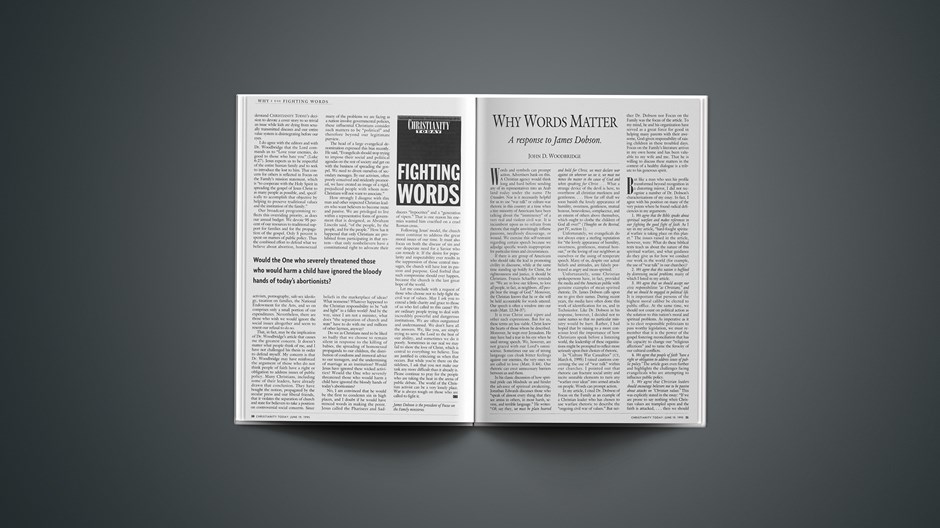
Words and symbols can prompt action. Advertisers bank on this. A Christian agency would think long and hard before sending any of its representatives into an Arab land today under the name The Crusaders. Nor is it necessarily helpful for us to use "war talk" or culture-war rhetoric in this country at a time when a tiny minority of Americans have been talking about the "imminency" of a very real and violent civil war. It is incumbent upon us to refrain from rhetoric that might unwittingly inflame passions, needlessly discourage, or wound. We exercise this self-restraint regarding certain speech because we adjudge specific words inappropriate for particular times and circumstances.
If there is any group of Americans who should take the lead in promoting civility in discourse, while at the same time standing up boldly for Christ, for righteousness and justice, it should be Christians. Francis Schaeffer reminds us: "We are to love our fellows, to love all people, in fact, as neighbors. All people bear the image of God." Moreover, the Christian knows that he or she will be held accountable for words uttered. Our speech is often a window into our souls (Matt. 12:34-37).
It is true Christ used vipers and other such expressions. But for us, these terms are less viable. Christ knew the hearts of those whom he described. Moreover, he wept over Jerusalem. He may have had a tear in his eye when he used strong speech. We, however, are not graced with our Lord's omniscience. Sometimes our use of strong language can cloak bitter feelings against our enemies, the very ones we are called to love (Matt. 5:44). Our rhetoric can erect unnecessary barriers between us and them.
In his classic discussion of how spiritual pride can blindside us and hinder the advance of spiritual awakening, Jonathan Edwards discusses those who "speak of almost every thing that they see amiss in others, in most harsh, severe, and terrible language." He writes: "Oh, say they, we must be plain hearted and bold for Christ, we must declare war against sin wherever we see it, we must not mince the matter in the cause of God and when speaking for Christ. … What a strange device of the devil is here, to overthrow all Christian meekness and gentleness. … How far off shall we soon banish the lovely appearance of humility, sweetness, gentleness, mutual honour, benevolence, complacence, and an esteem of others above themselves, which ought to clothe the children of God all over!" (Thoughts on the Revival, part IV, section 1).
Unfortunately, we evangelicals do not always enjoy a sterling reputation for "the lovely appearance of humility, sweetness, gentleness, mutual honour," or the loving of our neighbors as ourselves or the using of temperate speech. Many of us, despite our actual beliefs and attitudes, are falsely portrayed as angry and mean-spirited.
Unfortunately, some Christian spokespersons have, in fact, provided the media and the American public with genuine examples of mean-spirited rhetoric. Dr. James Dobson calls upon me to give their names. During recent years, the media have often done this work of identification for us, and in Technicolor. Like Dr. Dobson in his response, however, I decided not to name names so that no particular ministry would be hurt. Rather, I had hoped that by raising to a more conscious level the importance of how Christians speak before a listening world, the leadership of these organizations might be prompted to reflect more seriously upon their choices of rhetoric.
In "Culture War Casualties" (CT, March 6, 1995) I raised cautions concerning the use of "war talk" within our churches. I pointed out that rhetoric can fracture social unity and incite unstable elements to turn any "warfare over ideas" into armed attacks on people. Words can prompt action.
In my article, I cited Dr. Dobson of Focus on the Family as an example of a Christian leader who has chosen to use warfare rhetoric to describe the "ongoing civil war of values." But neither Dr. Dobson nor Focus on the Family was the focus of the article. To my mind, he and his organization have served as a great force for good in helping many parents with their awesome, God-given responsibility of raising children in these troubled days. Focus on the Family's literature arrives in my own home and has been valuable to my wife and me. That he is willing to discuss these matters in the context of a healthy dialogue is a tribute to his generous spirit.
But like a man who sees his profile transformed beyond recognition in a distorting mirror, I did not recognize a number of Dr. Dobson's characterizations of my essay. In fact, I agree with his position on many of the very points where he found radical deficiencies in my arguments.
1. We agree that the Bible speaks about spiritual warfare and makes references to our fighting the good fight of faith. As I say in my article, "hard-fought spiritual warfare is taking place on this planet." The issues raised in the article, however, were: What do these biblical texts teach us about the nature of this spiritual warfare, and what guidance do they give us for how we conduct our work in the world (for example, the use of "war talk" in our churches)?
Article continues below
2. We agree that this nation is buffeted by distressing social problems, many of which I listed in my article.
3. We agree that we should accept our civic responsibilities "as Christians," and that we should be engaged in political life. It is important that persons of the highest moral caliber be elected to public office. At the same time, we should not count on political action as the solution to this nation's moral and spiritual problems. As imperative as it is to elect responsible politicians to pass worthy legislation, we must remember that it is the power of the gospel fostering reconciliation that has the capacity to change our "religious affections" and to tame the ferocity of our cultural conflicts.
4. We agree that people of faith "have a right or obligation to address issues of public policy." The article goes even further and highlights the challenges facing evangelicals who are attempting to influence public policy.
5. We agree that Christian leaders should encourage believers not to be passive about attacks on "Christian values." This was explicitly stated in the essay: "If we are prone to say nothing when Christian values are trampled upon and the faith is attacked, … then we should consider whether our real passion is to receive the world's approval rather than the Lord's commendation."
On most of these important points, a general consensus exists among evangelical Christians. And we are indebted to Dr. Dobson for upholding them with such diligence.
But with regard to the wisdom of using "war talk" in the churches and in the public sphere, Christians should exercise due caution.
For more than two decades, I have studied the history of religious intolerance. My studies focused especially on the fate of the French Huguenots, a Calvinist minority, in Roman Catholic France from the 1550s through the French Revolution. The sixteenth century witnessed a series of brutal civil wars spawned by religious political hatred. Before and during these civil wars, waves of inflammatory pamphlets swept through both religious communities. Probably some of their authors never anticipated the intense hatred their rhetoric stirred; yet they created provocative contexts for later heinous acts of violence perpetrated by the various sides.
I have come to a greater appreciation of how precious is the gift of freedom of conscience and how unexpected and unhappy the results can be of using powerful rhetoric in a highly charged religious-political situation. As many parents and pastors know, not every word that can be spoken should be spoken, especially in volatile circumstances. Dr. Dobson and Gary Bauer claim that America is split between two sides caught up in a raging "Civil War of Values" between those Americans who accept the premise that "God is … " and those who presume that "God isn't … " in which "a winner will emerge and the loser will fade from memory" (the implication being that the church of Jesus Christ could be destroyed). This is a vision of America and a kind of all-or-nothing prophecy whose validity and usefulness should be reconsidered.
Article continues below
1. This winner-take-all scenario does not take into account another definition of what a Christian's "victory" might be in our culture. Throughout the centuries, and in other lands, many Christians have had a different perspective regarding the nature of Christian "victory" as they "stood up for Jesus" in their own cultural contexts. Paul's teaching in his letter to the church at Rome has served as a guide in this regard: "Do not repay anyone evil for evil. Be careful to do what is right in the eyes of everybody. If it is possible, as far as it depends on you, live at peace with everyone. Do not take revenge, my friends, but leave room for God's wrath. … If your enemy is hungry, feed him; if he is thirsty, give him something to drink. In doing this, you will heap burning coals on his head. Do not be overcome by evil, but overcome evil with good" (Rom. 12:17-21, NIV).
Indeed, it was timely comfort Paul gave. Not many years later, some of these same believers became "losers" when they died horrendous deaths during the reign of Nero. But in reality, they were "more than conquerors" since in accepting Christ's victory they could not be separated from the love of God (Rom. 8:35-38). Victory in Christ does not always look the same as what generals seek. The Reformer John Calvin wrote, "[Christians] must do good to those who injure them, and pray for those who curse them, and (this is their only victory) strive to overcome evil with good." Perhaps this vision of victory seems foreign to us, but it is biblical and worthy of our serious consideration.
2. The us-versus-them polarity does not capture the reality of American religious and political life. American society simply is not divided into clean halves between those who believe that "God is" and "God isn't." For example, the well-respected Princeton Religion Research Center provides evidence that belief in the divinity of Christ among the American public has actually increased from 78 percent in 1978 to 84 percent in 1988. Focus on the Family's own literature reports that there is a spectrum of beliefs regarding the issue of abortion. Certainly this nation is not divided religiously into two halves, or two giant phalanxes of the Right and Left engaged in a winner-take-all combat.
Article continues below
3. Finally, culture-war rhetoric can engender within us fear of our neighbors and fear within them of us. It can lead us to see our churches as bunkers rather than as havens of Christian hospitality.
I am glad Dr. Dobson mentioned the Salvation Army. It is a greatly respected organization within American society, even among non-Christians. Its reputation for compassion is so well established that the public does not identify it with religious fanaticism, despite its militaristic name. It does not promote or provoke fear.
If we choose to use any "warfare" rhetoric, it would be prudent of us to employ it in a similar way, with humility, good will, and compassion. We do not want the public to misunderstand what we are really about. We do not want to create a charged environment in which evangelicals become needlessly fearful of their neighbors or their neighbors needlessly fearful of them. We who are proponents of a gospel of reconciliation do not want ourselves to be needlessly divisive.
In this light, it would be especially regrettable if an article I wrote on the power of the gospel to bring reconciliation should turn out to be divisive. This was certainly not my intention. I am grateful to Dr. Dobson for his willingness to place this discussion under the rubric of a healthy airing of views among Christians. I hope he will see that he and I agree on many essential points.
We are living in confusing days. There is much bad news. But there is much good news. The recent student awakenings, the Promise Keepers movement, the pastoral prayer movement, and Concerts of Prayer have suggested to many that the nation may be on the verge of a spiritual awakening. At the same time, we are only too aware of tragic developments within our culture. The bombing in Oklahoma City has provided us with wrenching counterevidence to renewal.
In this conflicted society, none of us wants to hinder spiritual renewal by engaging in distracting disputes. We need to be reconciled with each other and support each other. My prayer is that the Holy Spirit will bless the ministry of Dr. James Dobson and Focus on the Family in even greater measure in days ahead.
Article continues below
Should we not all pray that the Holy Spirit will continue to work powerfully in our homes, colleges, and churches so that we might forsake our sins, exalt Christ more highly in our own lives, and love both our friends and our enemies? After all, it is through renewed Christian churches that spiritual reformation will come to this land.
**************************
John D. Woodbridge teaches church history at Trinity International University, Deerfield, Illinois, and intellectual history at Northwestern University, Evanston, Illinois.















 While we pray for peace, we need moral clarity about this war.
 As my doubts about his teachings grew, so did a secret fascination with Jesus.
 The Grammy-winning artist was found dead at her home in Nashville at age 47.






