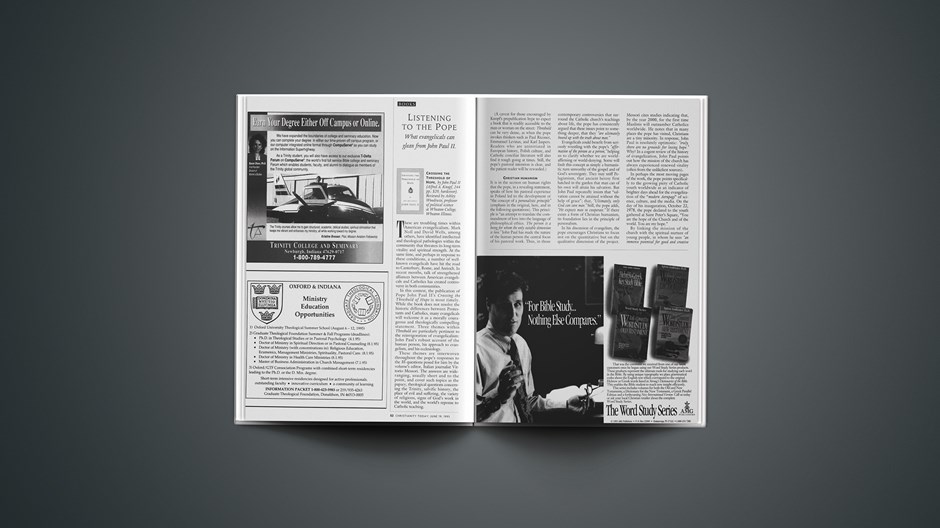
Crossing the Threshold of Hope, by John Paul II (Alfred A. Knopf, 244 pp.; $20, hardcover). Reviewed by Ashley Woodiwiss, professor of political science
at Wheaton College, Wheaton Illinois.
These are troubling times within American evangelicalism. Mark Noll and David Wells, among others, have identified intellectual and theological pathologies within the community that threaten its long-term vitality and spiritual strength. At the same time, and perhaps in response to these conditions, a number of well-known evangelicals have hit the road to Canterbury, Rome, and Antioch. In recent months, talk of strengthened alliances between American evangelicals and Catholics has created controversy in both communities.
In this context, the publication of Pope John Paul II's Crossing the Threshold of Hope is most timely. While the book does not resolve the historic differences between the Protestants and Catholics, many evangelicals will welcome it as a morally courageous and theologically compelling statement. Three themes within Threshold are particularly pertinent to the reinvigoration of evangelicalism: John Paul's robust account of the human person, his approach to evangelism, and his ecclesiology.
These themes are interwoven throughout the pope's responses to the 35 questions posed for him by the volume's editor, Italian journalist Vittorio Messori. The answers are wide-ranging, usually short and to the point, and cover such topics as the papacy, theological questions concerning the Trinity, salvific history, the place of evil and suffering, the variety of religions, signs of God's work in the world, and the world's response to Catholic teaching.
(A caveat for those encouraged by Knopf's prepublication hype to expect a book that is readily accessible to the man or woman on the street: Threshold can be very dense, as when the pope invokes thinkers such as Paul Ricouer, Emmanuel Levinas, and Karl Jaspers. Readers who are uninitiated in European history, Polish culture, and Catholic conciliar literature will also find it tough going at times. Still, the pope's pastoral intention is clear, and the patient reader will be rewarded.)
CHRISTIAN HUMANISM
It is in the section on human rights that the pope, in a revealing statement, speaks of how his pastoral experience in Poland led to the development of "the concept of a personalistic principle" (emphasis in the original, here, and in the following quotations). This principle is "an attempt to translate the commandment of love into the language of philosophical ethics. The person is a being for whom the only suitable dimension is love." John Paul has made the nature of the human person the central focus of his pastoral work. Thus, in those contemporary controversies that surround the Catholic church's teachings about life, the pope has consistently argued that these issues point to something deeper, that they "are ultimately bound up with the truth about man."
Evangelicals could benefit from seriously wrestling with the pope's "affirmation of the person as a person," helping us to clarify whether we are world-affirming or world-denying. Some will fault this concept as simply a humanistic turn unworthy of the gospel and of God's sovereignty. They may sniff Pelagianism, that ancient heresy first hatched in the garden that man can of his own will attain his salvation. But John Paul repeatedly insists that "salvation cannot be attained without the help of grace"; that, "Ultimately, only God can save man." Still, the pope adds, "He expects man to cooperate." If there exists a form of Christian humanism, its foundation lies in the principle of personalism.
In his discussion of evangelism, the pope encourages Christians to focus not on the quantitative but on the qualitative dimension of the project. Messori cites studies indicating that, by the year 2000, for the first time Muslims will outnumber Catholics worldwide. He notes that in many places the pope has visited, Christians are a tiny minority. In response, John Paul is resolutely optimistic: "truly, there are no grounds for losing hope." Why? In a cogent review of the history of evangelization, John Paul points out how the mission of the church has always experienced renewed vitality (often from the unlikeliest sources).
In perhaps the most moving pages of the work, the pope points specifically to the growing piety of Catholic youth worldwide as an indicator of brighter days ahead for the evangelization of the "modern Aeropagi" of science, culture, and the media. On the day of his inauguration, October 22, 1978, the pope declared to the youth gathered at Saint Peter's Square, "You are the hope of the Church and of the world. You are my hope."
By linking the mission of the church with the spiritual nurture of young people, in whom he sees "an immense potential for good and creative possibility," the pope indirectly raises the question for the evangelical community of what truly counts for a successful mission project, and whether it is to be analyzed quantitatively in the short term or qualitatively over time. We must wonder if evangelization without sustained catechesis will bear the fruit worthy of salvation.
Article continues below
NURTURING THE BODY
This leads to a third contribution that Threshold offers: For where is such character formation to occur but in the church? As the pope notes, "It is … necessary that the young know the Church, that they perceive Christ in the Church."
For all the evangelical talk of the church, our ecclesiology is woefully underdeveloped for the tasks we confront. We need to reestablish the church as the primary ordering institution in the life of believers. As Americans, we have prized our liberty to the point that loyalty to the church is sometimes ranked below that of commitment to our political economy, whose forces frequently subvert our churches, communities, and families. By prizing liberty over Christian solidarity, we have neglected the only institution strong enough to withstand the intense pressures of our day.
The pope brings us up short when he points out that in both the Apostles' Creed and the Nicene Creed we say, "I believe in the Church." In confessing this, he says, "we place the Church on the same level as the Mystery of the Holy Trinity and the mysteries of the Incarnation and of the Redemption."
Against the individualism that dominates American life, evangelicals must reclaim the counternarrative of the church in the world: the church that stands against the world but also for the world. This story is contained in the writings of the Fathers, demonstrated in the lives of saints and martyrs, practiced by ordering our days to a different sense of time. As evangelicals, we can learn this story by situating ourselves more broadly in the historical sweep of Christian orthodoxy and less provincially in a particular American moment. Then we can begin to rebuild communities of faith wherein there abides a truly distinctive quality to the name Christian.
Show Me God: What the Message from Space Is Telling Us About God, by Fred Heeren (Searchlight, 326 S. Wille Ave., Wheeling, IL, 60090, 800/743-7700; 336 pp.; $16.99, hardcover). "All I want is reality. Show me God. Tell me what He is really like." Those words from a 20-year-old seeker provide the title for Fred Heeren's thought-provoking book, which comes with a foreword by cosmologist George Smoot. Addressed both to skeptics and believers, Show Me God argues that evidence from modern cosmology is consistent with the biblical revelation of God and his creation. Interviews, imaginary dialogues, pithy and provocative quotes from leading scientists, and other features enliven the exposition. A discussion leader's guide ($5.99) and an audiocassette ($9.99) are also available.















 While we pray for peace, we need moral clarity about this war.
 We’ve got little information on Jesus’ appearance and personality. But that’s the way God designed it.españolFrançais
 We must always be people of the Word, but we’ll have to reimagine deep engagement with Scripture.






