Virtually Normal: An Argument About Homosexuality, by Andrew Sullivan (Alfred A. Knopf, 209 pp.; $22, hardcover); Straight and Narrow? Compassion and Clarity in the Homosexual Debate, by Thomas E. Schmidt (InterVarsity, 240 pp.; $10.99, paper); Scripture and Homosexuality: Biblical Authority and the Church Today, by Marion L. Soards (Westminster John Knox, 84 pp.; $9.99, paper).
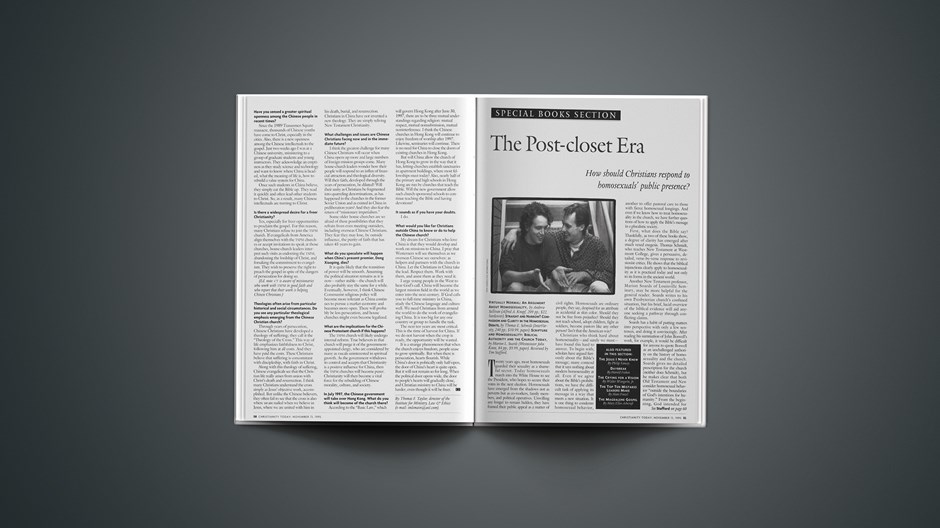
Twenty years ago, most homosexuals guarded their sexuality as a shameful secret. Today homosexuals march into the White House to see the President, who hopes to secure their votes in the next election. Homosexuals have emerged from the shadows not as perverts but as co-workers, family members, and political operatives. Unwilling any longer to remain hidden, they have framed their public appeal as a matter of civil rights. Homosexuals are ordinary people, they say, despised for an attribute as accidental as skin color. Should they not be free from prejudice? Should they not teach school, adopt children, fight as soldiers, become pastors like any other person? Isn't that the American way?
Christians who think hard about homosexuality—and surely we must—have found this hard to answer. To begin with, scholars have argued furiously about the Bible's message; many contend that it says nothing about modern homosexuality at all. Even if we agree about the Bible's prohibitions, we have the difficult task of applying its message in a way that meets a new situation. It is one thing to condemn homosexual behavior, another to offer pastoral care to those with fierce homosexual longings. And even if we know how to treat homosexuality in the church, we have further questions of how to apply the Bible's message in a pluralistic society.
First, what does the Bible say? Thankfully, as two of these books show, a degree of clarity has emerged after much vexed exegesis. Thomas Schmidt, who teaches New Testament at Westmont College, gives a persuasive, detailed, verse-by-verse response to revisionist critics. He shows that the biblical injunctions clearly apply to homosexuality as it is practiced today and not only to its forms in the ancient world.
Another New Testament professor, Marion Soards of Louisville Seminary, may be more helpful for the general reader. Soards writes to his own Presbyterian church's confused situation, but his brief, lucid overview of the biblical evidence will aid anyone seeking a pathway through conflicting claims.
Soards has a habit of putting matters into perspective with only a few sentences, and doing it convincingly. After reading his summation of John Boswell's work, for example, it would be difficult for anyone to quote Boswell as an unchallenged authority on the history of homosexuality and the church. Soards gives no detailed prescription for the church (neither does Schmidt), but he makes clear that both Old Testament and New consider homosexual behavior "outside the boundaries of God's intentions for humanity." From the beginning, God intended for sexual union to be experienced within marriage between man and woman.
It is not easy to apply such an answer today, however. Why such one-note absolutism? Why can't we simply live and let live—appreciating, as Andrew Sullivan poetically puts it, the wildflowers among our wheat?
As Schmidt sees it, these are questions born of individualism, while sexuality is a communal endeavor, with each of us bearing responsibility toward others for the way we live. Homosexual behavior undermines marriage, he says. Unlike the celibate person, who, though unmarried, testifies to the good of marriage, the active homosexual pursues sexual union according to his own private principles of individual self-fulfillment. Like adultery, homosexuality cannot be judged just by how it seems to the individuals involved. It must be considered in the broader context of what it does to the whole community's understanding of sex. Same-sex intimacy offers an alternative "good" that undermines a community's marriages, Schmidt contends.
This is an argument that Andrew Sullivan, editor of "The New Republic," takes up from the other side. It is refreshing that he even recognizes the issue of communal interests. Unfortunately, he argues the issue within strict categories of his own invention, which (while they enable him to answer every argument that he imagines) do not fit the actual content of Schmidt's (and many others') position.
Sullivan's book aims to deal with the politics of homosexuality, which he describes in four categories: Prohibitionist, Liberationist, Conservative, and Liberal. Sullivan is brilliant at many points. His recounting of how liberals have found themselves at odds with their own principles is particularly illuminating. However, his book is weakest in considering positions furthest from his own, those that would discourage rather than defend homosexual practice. For reasons unclear, Sullivan identifies the Prohibitionist position with the Catholic church and/or religious fundamentalists. To my knowledge, the modern Catholic church does not favor laws that would prosecute homosexuals; and while I do not doubt that there exist Christian fundamentalists who would seek to root out homosexuality through punishment and incarceration, Sullivan cites none and would, I suspect, have to concede that this punitive stance represents a minority view within fundamentalism rather than a consensus. Sullivan—who comes from a devout Catholic family and is himself a practicing Catholic—tries to do justice to a biblical understanding of homosexuality but is clearly out of his depth. He seems to have swallowed Boswell whole.
Article continues below
That aside, Sullivan compellingly puts forward the great fact that all of us, Christian and non-Christian alike, must confront: homosexuals exist. If they have not (Sullivan to the contrary) existed at all times and places, certainly they exist in our time and place. While all three of these authors accept that the cause of homosexuality must be more complex than a "homosexual gene," they all acknowledge that homosexuality is a condition homosexuals "find themselves in"—they do not consciously choose it.
Sullivan is very good at explaining the difficulty of the homosexual's position. Remembering his first adolescent experiences with sexual desire, he writes, "It was like getting on a plane for the first time, being exhilarated by its ascent, gazing with wonder out of the window, seeing the clouds bob beneath you, but then suddenly realizing that you are on the wrong flight, going to a destination which terrifies you. … And you cannot get off." He says that a homosexual teenager learns that "the condition of his friendships is the subjugation of himself." Sullivan hopes that a more tolerant culture may develop in America, yet he believes that homosexuality is bound to be marked by deception and hiding, simply because homosexuals are a small minority and the issue is such a fundamental one. Homosexuals, he says, can never be "just like other people."
DEEPER THAN FAIRNESS
Schmidt widens and darkens this portrait, giving a well-documented account of the experience of homosexuals. He demonstrates from a thorough review of the evidence that "Promiscuity among homosexual men is not a mere stereotype, and it is not merely the majority experience—it is virtually the only experience."
In a group of ten randomly selected homosexual men in their thirties, he summarizes, only one is faithful to his partner, and he will not be within a year. Four have never had a relationship that lasted a year, and only one has had a relationship that lasted more than three years. Six regularly have sex with strangers; three participate in orgies. Three are currently alcoholics; five have a history of alcohol abuse. Five regularly use at least one illegal drug, three are multiple drug users. Four have a history of acute depression, three have contemplated suicide, two have attempted suicide. Eight have had sexually transmitted diseases, three are HIV positive, one has AIDS.
Article continues below
This portrait, like the more personal one that Sullivan offers, should surely elicit compassion. These are sufferers. But it should also remind us that the "homosexual issue" is much deeper than a matter of "fair treatment."
Fair treatment is all that Sullivan asks for at the political level. He proposes simply that homosexuals receive equal treatment under the law—no more, no less. For him this includes—and demands—the legalization of homosexual marriage. Conservatives, he says, should face the fact that homosexuality exists and encourage steps to domesticate it. He is eloquent in describing the homosexual's longing for lasting intimacy that cannot (by society's laws) be fulfilled. He presents a wonderful vista of what marriage would offer.
But he seems not to realize that marriage is prelegal and preceremonial, that law does not create marriage but only regularizes it. Where was the law in Eden? Marriage would surely exist very much as it does whether or not it were officially recognized. Where it does not exist, the legal opportunity hardly can create it. (Today's urban ghettos are a horrid proof of that.) Homosexual marriage—exclusive and lifelong sexual relationship—is virtually nonexistent, as Schmidt's summary of the evidence shows. Homosexuality is not simply a different flavor of sexuality, it is a different type, following its own nature.
Sullivan, surprisingly, acknowledges that legalized "domestic partnerships" undermine traditional marriages, yet seriously suggests that homosexual marriages would enrich heterosexual relationships through "greater understanding of the need for extramarital outlets," by which he means adultery. Perhaps this reveals the degree to which he does not know what he is talking about when he talks of marriage. Open marriages, as studies have consistently found, are those with the bottom falling out.
If "marriage" is not an answer to homosexuality, and "fairness" is too simple a prescription, how should Christians treat homosexuality? I suspect a great many Christians wish it would simply go away. They would be happy to live and let live, so long as homosexuals stayed in the closet and left others blissfully ignorant of their condition. That, however, is not really an option for those who care about pastoral ministry.
Article continues below
People who "find themselves homosexual" need help to find a pattern of life that is fruitful and appropriate for their condition.
Surely the ancient and biblical tradition of celibacy is relevant, even if our society is reluctant to acknowledge it. (Sullivan apparently cannot even imagine it. He treats singleness as synonymous with promiscuity.) Some progress in ministry has been made, particularly by "ex-gay" groups, but in most churches, homosexuals are still invisible and uncared for.
As to public policy, Sullivan's book is an excellent spur to thinking through various issues, from gays in the military to laws against prejudice in private housing. (Sullivan is for the former, against the latter.) Sullivan's positions will be anathema to most conservatives, but he covers a range of issues acutely and, for the most part, fairly.
Christians face the problem of influencing a public order that does not necessarily share our basic values. We cannot turn America into the church, but how far can we push our sexual values, or accept others' that we believe are destructive? Conservative Christians, clinging to Scripture, have sensed that the welfare of marriage and the family is involved in the way our nation treats homosexuality. We know what the Bible teaches. We have at least some idea how homosexuality should be treated within the church. In the public sphere, we are a long way from home.















 While we pray for peace, we need moral clarity about this war.
 As my doubts about his teachings grew, so did a secret fascination with Jesus.
 Eastern Orthodox poet Scott Cairns reflects on his new collection, his journey of faith, and poetry’s capacity to apprehend inexhaustible realities.






