Will the Republican party take a strong pro-family stand? Will there be a third-party candidate? Will the economy mean as much to voters in 1996 as it did in 1992? Or will concerns about morality and family values take center stage?
These questions are but a few examples of what candidates, political activists, and voters will have answered when the 1996 presidential election occurs a year from now. For Christian conservative activists, the 1996 election provides the long-anticipated opportunity to defeat President Bill Clinton, whose politics, policies, and past have been under attack since Inauguration Day.
Although the number of candidates for the GOP presidential nomination seems to change monthly, one reality has not changed: politically conservative religious activists are solidly Republican. A recent Luntz Research poll of 1,000 members of the 1.7 million-member Christian Coalition shows that only 5 percent are Democrats, while 68 percent are Republicans.
Since the Christian Coalition strengthened its relationship with the GOP-controlled Congress in 1994, the Pat Robertson-founded group is emerging as a major force in presidential politics. No fewer than seven Republican candidates made room on their schedules to address the coalition's Road to Victory conference in September.
While many conservative Christians are thrilled at the powerful achievements of the Christian Coalition, other believers are worried about its influence, and a few actively work against the coalition's agenda.
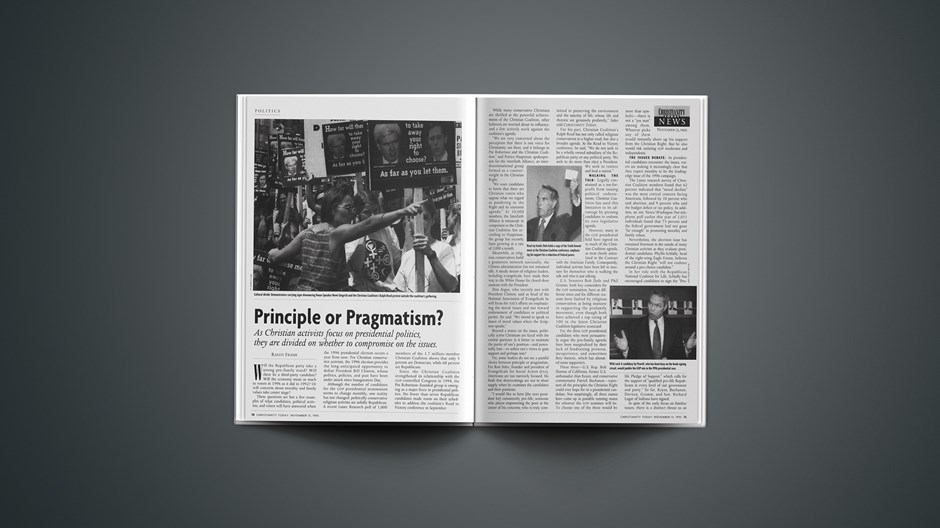
"We are very concerned about the perception that there is one voice for Christianity out there, and it belongs to Pat Robertson and the Christian Coalition," said Patrice Hauptman, spokesperson for the Interfaith Alliance, an interdenominational group formed as a counterweight to the Christian Right.
"We want candidates to know that there are Christian voters who oppose what we regard as pandering to the Right and its extremist agenda." At 10,000 members, the Interfaith Alliance is minuscule in comparison to the Christian Coalition, but according to Hauptman, the group has recently been growing at a rate of 2,000 a month.
Meanwhile, as religious conservatives build a grassroots network nationally, the Clinton administration has not remained idle. A steady stream of religious leaders, including evangelicals, have made their way to the White House for closed-door sessions with the President.
Don Argue, who recently met with President Clinton, said as head of the National Association of Evangelicals he will focus the NAE's efforts on emphasizing the moral issues and not toward endorsement of candidates or political parties. He said, "We intend to speak to issues of moral values where the Scripture speaks."
Beyond a stance on the issues, politically active Christians are faced with the central question: Is it better to maintain the purity of one's position—and potentially lose—or soften one's views to gain support and perhaps win?
Yet, some leaders do not see a painful choice between principle or pragmatism. For Ron Sider, founder and president of Evangelicals for Social Action (ESA), Americans are too narrowly focused. He finds that shortcomings are not in short supply when he examines the candidates and their positions.
"I would like to have [the next president be] consistently pro-life; someone who places empowering the poor at the center of his concerns; who is truly committed to preserving the environment and the sanctity of life; whose life and rhetoric are genuinely profamily," Sider told CHRISTIANITY TODAY.
For his part, Christian Coalition's Ralph Reed has not only called religious conservatives to a higher road, but also a broader agenda. At the Road to Victory conference, he said, "We do not seek to be a wholly owned subsidiary of the Republican party or any political party. We seek to do more than elect a President. We seek to restore and heal a nation."
WALKING THE TALK: Legally constrained as a not-for-profit from issuing political endorsements, Christian Coalition has used this limitation to its advantage by pressing candidates to endorse its own legislative agenda.
However, many in the GOP presidential field have signed on to much of the Christian Coalition agenda, as most clearly articulated in the Contract with the American Family. Consequently, individual activists have been left to measure for themselves who is walking the talk and who is just talking.
U.S. Senators Bob Dole and Phil Gramm, both key contenders for the GOP nomination, have at different times and for different reasons been faulted by religious conservatives as being insincere in supporting the profamily movement, even though both have achieved a top rating of 100 in the latest Christian Coalition legislative scorecard.
Yet, the three GOP presidential candidates who most persuasively argue the pro-family agenda have been marginalized by their lack of fundraising prowess, inexperience, and sometimes fiery rhetoric, which has alienated some supporters.
Article continues below
These three-U.S. Rep. Bob Dornan of California, former U.S. ambassador Alan Keyes, and conservative commentator Patrick Buchanan—represent all the principles the Christian Right could ever hope for in a presidential candidate. Not surprisingly, all three names have come up as possible running mates for whoever the GOP nominee will be. To choose one of the three would be more than symbolic—there is not a "yes man" among them. Whoever picks any of them would instantly shore up his support from the Christian Right. But he also would risk isolating GOP moderates and independents.
THE ISSUES DEBATE: As presidential candidates encounter the issues, voters are making it increasingly clear that they expect morality to be the leading-edge issue of the 1996 campaign.
The Luntz research survey of Christian Coalition members found that 62 percent indicated that "moral decline" was the most critical concern facing Americans, followed by 10 percent who said abortion, and 9 percent who said the budget deficit or tax policy. In addition, an ABC News/Washington Post telephone poll earlier this year of 1,011 individuals found that 73 percent said the federal government had not gone "far enough" in promoting morality and family values.
Nevertheless, the abortion issue has remained foremost in the minds of many Christian activists as they evaluate presidential candidates. Phyllis Schlafly, head of the right-wing Eagle Forum, believes the Christian Right "will not coalesce around a pro-choice candidate."
In her role with the Republican National Coalition for Life, Schlafly has encouraged candidates to sign the "Pro-life Pledge of Support," which calls for the support of "qualified pro-life Republicans at every level of our government and party." So far, Keyes, Buchanan, Dornan, Gramm, and Sen. Richard Lugar of Indiana have signed.
In spite of the early focus on familiar issues, there is a distinct threat to an issues-driven presidential campaign posed by the growing possibility that Colin Powell, the popular Persian Gulf War hero who has fared very well in recent voter polls, will step into the Republican presidential primaries.
Many could tolerate Powell's moderate positions on gun control and affirmative action if he were staunchly pro-life. But given Powell's early statements indicating his support for legal abortion, his attractiveness to Christian conservatives has been minimized.
Yet Reed, in a recent televised interview with David Brinkley, suggested he might be open to a Powell candidacy. "I think the question is 'How sharp are those differences?' " Fellow conservative William Bennett, who appeared on the same program with Reed, went further, stating, "There are pro-choice candidates I could support."
Article continues below
Other Christian conservatives are staunchly against a Powell bid. Gary Bauer, president of the Family Research Council (FRC), has expressed both dismay and confusion about the support Powell is receiving, saying in a recent newsletter that conservative support for Powell had "gone far enough."
Contending that last fall's political revolution was based on issues and values, Bauer asks, "How is it that our leaders have lost confidence this quickly in the conservative message and its appeal to the American people that was so clearly demonstrated in November of 1994?"
A MODERATE MAJORITY? In a country that is an estimated 86 percent Christian, many religious Americans are turned off by the polarizing nature of political debate, whether it involves the presidential race, Congress, or a local school board election.
This moderate bloc of voters includes many Christian evangelicals who, while disagreeing with Clinton on many concerns, are also willing to give him credit where it is appropriate.
Clinton's statements favoring the expression of religious values in public schools and his support for the Religious Freedom Restoration Act have enhanced his image in some evangelical circles. Clinton has worked to draw leading evangelicals into dialogue, having met with evangelist Billy Graham and having sent personal greetings via videotape to the twentieth anniversary celebration of Bill Hybels's Willow Creek Community Church in October.
NAE's Argue, at a September meeting with Clinton at the White House, told Clinton that many evangelicals do not feel represented by the stridency of the Christian Right. "We affirm many of the values the Christian Coalition affirms," Argue told CT. "But we are concerned about their methods and sometimes with the spirit in which they speak and act."
Evangelicals' almost unanimous opposition to the President's positions on abortion and homosexuality will prevent many of them from supporting him. But the GOP's historic advantage with evangelicals would be compromised significantly if the party opts for a presidential or vice-presidential candidate not outspokenly against abortion.
In coming months, Christian conservatives will be keeping close tabs on the emergence of vice-presidential contenders, perhaps key to revealing the GOP leadership's true colors and plans. That will greatly influence, for example, the Christian Right's assessment of front-runner Dole. The sometimes intense speculation over the possibility of a third-party candidacy could be fueled by an insufficiently conservative choice for running mate by the GOP nominee.
Article continues below
DIFFICULT CHOICES: As the primary season unfolds in coming months, conservative activists will be confronted with the hard choices concerning where to expend their scarce resources of time, dollars, and energy.
But for a handful of Christian leaders, there are concerns that transcend who wins or loses an election or primary. Argue says that for him the matter that underlies the 1996 presidential election is "the incredible decline in the moral sensitivity within the culture."
He says, "We are living in a post-Christian culture. That's a very serious new paradigm for the church. Much of the church does business as if moral absolutes are still at the basis of our culture. They are not."
From his perspective, ESA's Sider urges Christians "not to be single-issue voters, because God is not single issue." He adds, "If we ask the question, 'Is the Christian Right fully biblical?' The answer is flatly no."
Sider says, "We must have a biblically balanced agenda concerned with the range of issues God talks about in the Scriptures. As voters, we must ask which of the candidates comes closest to this biblical balance, or, to put it negatively, which is likely to do the least damage."
The FRC's Bauer echoes the view that faith is more important than partisan politics, saying, "If we ever fall into the trap of thinking that we are Republicans first and men and women of faith second, then inevitably we will fall prey to … the temptation of thinking that a balanced budget—as needed as that is—is as important as unborn children."















 While we pray for peace, we need moral clarity about this war.
 A Christian reconciliation group in Israel and Palestine warned that war would come. Now the war threatens their relevance.العربيةFrançais
 The Grammy-winning artist was found dead at her home in Nashville at age 47.






