The racial fault lines in America were brought into glaring focus with the not-guilty verdict in the O. J. Simpson murder trial and two weeks later during the "Million Man March" for black men in Washington.
For Christians working toward racial reconciliation, those fault lines are intimately familiar. "Sunday morning is still the most segregated time in America," says Chris Rice, co-editor of "Reconciliation Quarterly."
When the jury's verdict was announced that Simpson was not guilty of murdering his wife and her friend, whites and blacks had startlingly different reactions. Many blacks cheered, while many whites said a guilty man was being set free. The reactions to the verdict were no different among many Christian groups. National Council of Churches (NCC) General Secretary Joan Brown Campbell vividly remembers the responses among the members of the NCC staff the day the verdict was disclosed. At the moment the verdict was read, with few exceptions, "black staff cheered, some white women cried, and some white men said 'There is no justice.' "
She says the differences are due to a "cultural gap that exists despite the fact that the NCC has had a proracial-justice policy for over 50 years."
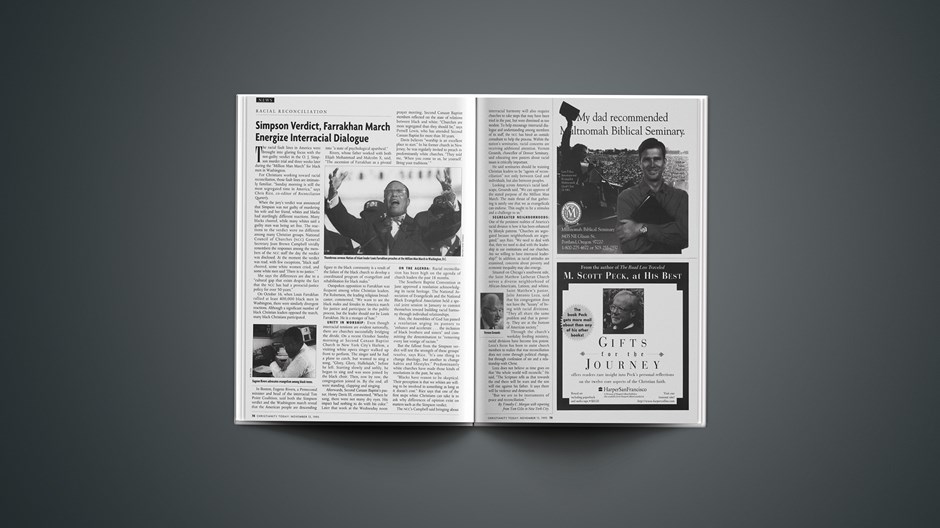
On October 16, when Louis Farrakhan rallied at least 400,000 black men in Washington, there were similarly divergent reactions. Although a significant number of black Christian leaders opposed the march, many black Christians participated.
In Boston, Eugene Rivers, a Pentecostal minister and head of the interracial Ten Point Coalition, said both the Simpson verdict and the Washington march reveal that the American people are descending into "a state of psychological apartheid."
Rivers, whose father worked with both Elijah Mohammad and Malcolm X, said, "The ascension of Farrakhan as a pivotal figure in the black community is a result of the failure of the black church to develop a coordinated program of evangelism and rehabilitation for black males."
Outspoken opposition to Farrakhan was frequent among white Christian leaders. Pat Robertson, the leading religious broadcaster, commented, "We want to see the black males and females in America march for justice and participate in the public process, but the leader should not be Louis Farrakhan. He is a monger of hate."
UNITY IN WORSHIP: Even though interracial tensions are evident nationally, there are churches successfully bridging the divide. On a recent October Sunday morning at Second Canaan Baptist Church in New York City's Harlem, a visiting white opera singer walked up front to perform. The singer said he had a plane to catch, but wanted to sing a song, "Glory, Glory, Hallelujah," before he left. Starting slowly and softly, he began to sing and was soon joined by the black choir. Then, row by row, the congregation joined in. By the end, all were standing, clapping and singing.
Afterwards, Second Canaan Baptist's pastor, Henry Davis III, commented, "When he sang, there were not many dry eyes. His impact had nothing to do with his color." Later that week at the Wednesday noon prayer meeting, Second Canaan Baptist members reflected on the state of relations between black and white. "Churches are more segregated than they should be," says Pernell Lewis, who has attended Second Canaan Baptist for more than 30 years.
Davis believes "worship is an excellent place to start." In his former church in New Jersey, he was regularly invited to preach in predominantly white churches. "They told me, 'When you come to us, be yourself. Bring your traditions.' "
ON THE AGENDA: Racial reconciliation has been high on the agenda of church leaders the past 18 months.
The Southern Baptist Convention in June approved a resolution acknowledging its racist heritage. The National Association of Evangelicals and the National Black Evangelical Association held a special joint session in January to commit themselves toward building racial harmony through individual relationships.
Also, the Assemblies of God has passed a resolution urging its pastors to "enhance and accelerate … the inclusion of black brothers and sisters" and committing the denomination to "removing every last vestige of racism."
But the fallout from the Simpson verdict will test the strength of these groups' resolve, says Rice. "It's one thing to change theology, but another to change habits and lifestyles." Predominantly white churches have made those kinds of resolutions in the past, he says.
"Blacks have reason to be skeptical. Their perception is that we whites are willing to be involved in something as long as it doesn't cost." Rice says that one of the first steps white Christians can take is to ask why differences of opinion exist on matters such as the Simpson verdict.
The NCC's Campbell said bringing about interracial harmony will also require churches to take steps that may have been tried in the past, but were dismissed as too modest. To help encourage interracial dialogue and understanding among members of its staff, the NCC has hired an outside consultant to help the process. Within the nation's seminaries, racial concerns are receiving additional attention. Vernon Grounds, chancellor of Denver Seminary, said educating new pastors about racial issues is critically important.
Article continues below
He said seminaries should be training Christian leaders to be "agents of reconciliation" not only between God and individuals, but also between peoples.
Looking across America's racial landscape, Grounds said, "We can approve of the stated purpose of the Million Man March. The main thrust of that gathering is surely one that we as evangelicals can endorse. This ought to be a stimulus and a challenge to us."
SEGREGATED NEIGHBORHOODS: One of the persistent realities of America's racial division is how it has been enhanced by lifestyle patterns. "Churches are segregated because neighborhoods are segregated," says Rice. "We need to deal with that, then we need to deal with the leadership in our institutions and our churches. Are we willing to have interracial leadership?" In addition, as racial attitudes are examined, concerns about poverty and economic inequality may also emerge.
Situated on Chicago's southwest side, the Saint Matthew Lutheran Church serves a diverse neighborhood of African-Americans, Latinos, and whites. Saint Matthew's pastor, Julio Antonio Loza, said that his congregation does not have the "luxury" of living with racial divisions. "They all share the same problem and that is poverty. They are at the bottom of American society."
Through the church's weekday feeding ministry, racial divisions have become less potent. Loza's focus has been to assist church members to realize that true reconciliation does not come through political change, but through confession of sin and a relationship with Christ.
Loza does not believe as time goes on that "the whole world will reconcile." He said, "The Scripture tells us that towards the end there will be wars and the son will rise against his father. It says there will be violence and destruction.
"But we are to be instruments of peace and reconciliation."
Timothy C. Morgan with reporting from Tom Giles in New York City.

















 While we pray for peace, we need moral clarity about this war.
 A Christian reconciliation group in Israel and Palestine warned that war would come. Now the war threatens their relevance.españolالعربيةFrançaisрусскийУкраїнська
 NIL deals in college athletics present new challenges—and opportunities—for colleges and students.






