"Material Christianity: Religion and Popular Culture in America"
By Colleen McDannell (Yale University Press, 313 pp.; $35, hardcover).
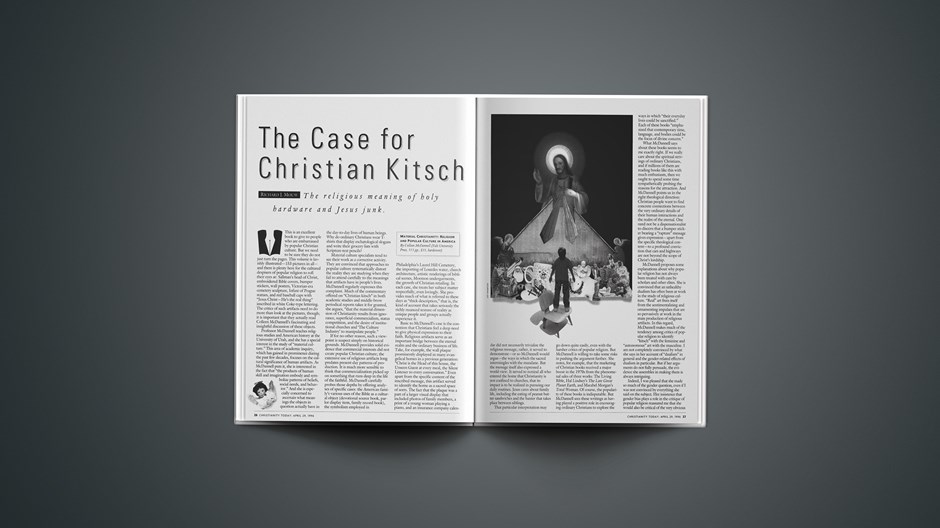
This is an excellent book to give to people who are embarrassed by popular Christian culture. But we need to be sure they do not just turn the pages. This volume is lavishly illustrated--153 pictures in all--and there is plenty here for the cultured despisers of popular religion to roll their eyes at: Sallman's head of Christ, embroidered Bible covers, bumper stickers, wall posters, Victorian-era cemetery sculpture, Infant of Prague statues, and red baseball caps with "Jesus Christ--He's the real thing" inscribed in white Coke-type lettering. The critics of such artifacts need to do more than look at the pictures, though; it is important that they actually read Colleen McDannell's fascinating and insightful discussion of these objects.
Professor McDannell teaches religious studies and American history at the University of Utah, and she has a special interest in the study of "material culture." This area of academic inquiry, which has gained in prominence during the past few decades, focuses on the cultural significance of human artifacts. As McDannell puts it, she is interested in the fact that "the products of human skill and imagination embody and symbolize patterns of beliefs, social needs, and behavior." And she is especially concerned to ascertain what meanings the objects in question actually have in the day-to-day lives of human beings. Why do ordinary Christians wear T-shirts that display eschatological slogans and write their grocery lists with Scripture-text pencils?
Material culture specialists tend to see their work as a corrective activity. They are convinced that approaches to popular culture systematically distort the reality they are studying when they fail to attend carefully to the meanings that artifacts have in people's lives. McDannell regularly expresses this complaint. Much of the commentary offered on "Christian kitsch" in both academic studies and middle-brow periodical reports takes it for granted, she argues, "that the material dimension of Christianity results from ignorance, superficial commercialism, status competition, and the desire of institutional churches and 'The Culture Industry' to manipulate people."
If for no other reason, such a viewpoint is suspect simply on historical grounds. McDannell provides solid evidence that commercial interests did not create popular Christian culture; the extensive use of religious artifacts long predates present-day patterns of production. It is much more sensible to think that commercialization picked up on something that runs deep in the life of the faithful. McDannell carefully probes those depths by offering analyses of specific cases: the American family's various uses of the Bible as a cultural object (devotional source book, parlor display item, family record book), the symbolism employed in Philadelphia's Laurel Hill Cemetery, the importing of Lourdes water, church architecture, artistic renderings of biblical scenes, Mormon undergarments, the growth of Christian retailing. In each case, she treats her subject matter respectfully, even lovingly. She provides much of what is referred to these days as "thick description," that is, the kind of account that takes seriously the richly nuanced texture of reality as unique people and groups actually experience it.
Basic to McDannell's case is the contention that Christians feel a deep need to give physical expression to their faith. Religious artifacts serve as an important bridge between the eternal realm and the ordinary business of life. Take, for example, the wall plaque prominently displayed in many evangelical homes in a previous generation: "Christ is the Head of this house, the Unseen Guest at every meal, the Silent Listener to every conversation." Even apart from the specific content of the inscribed message, this artifact served to identify the home as a sacred space of sorts. The fact that the plaque was a part of a larger visual display that included photos of family members, a print of a young woman playing a piano, and an insurance company calendar did not necessarily trivialize the religious message; rather, it served to demonstrate--or so McDannell would argue--the ways in which the sacred intermingles with the mundane. But the message itself also expressed a world-view. It served to remind all who entered the home that Christianity is not confined to churches, that its impact is to be realized in pursuing our daily routines. Jesus cares about family life, including the eating of peanut butter sandwiches and the banter that takes place between siblings.
That particular interpretation may go down quite easily, even with the harsher critics of popular religion. But McDannell is willing to take some risks in pushing the argument further. She notes, for example, that the marketing of Christian books received a major boost in the 1970s from the phenomenal sales of three works: "The Living Bible," Hal Lindsey's "The Late Great Planet Earth," and Marabel Morgan's "Total Woman." Of course, the popularity of these books is indisputable. But McDannell sees these writings as having played a positive role in encouraging ordinary Christians to explore the ways in which "their everyday lives could be sanctified." Each of these books "emphasized that contemporary time, language, and bodies could be the focus of divine concern."
Article continues below
What McDannell says about these books seems to me exactly right. If we really care about the spiritual strivings of ordinary Christians, and if millions of them are reading books like this with much enthusiasm, then we ought to spend some time sympathetically probing the reasons for the attraction. And McDannell points us in the right theological direction: Christian people want to find concrete connections between the very ordinary details of their human interactions and the realm of the eternal. One need not be a dispensationalist to discern that a bumper sticker bearing a "rapture" message gives expression--apart from the specific theological content--to a profound conviction that cars and highways are not beyond the scope of Christ's lordship.
McDannell proposes some explanations about why popular religion has not always been treated with care by scholars and other elites. She is convinced that an unhealthy dualism has often been at work in the study of religious culture. "Real" art frees itself from the sentimentalizing and ornamenting impulses that are so pervasively at work in the mass production of religious artifacts. In this regard, McDannell makes much of the tendency among critics of popular religion to identify "kitsch" with the feminine and "autonomous" art with the masculine. I am not completely convinced by what she says in her account of "dualism" in general and the gender-related effects of dualism in particular. But if her arguments do not fully persuade, the evidence she assembles in making them is always intriguing.
Indeed, I was pleased that she made so much of the gender question, even if I was not convinced by everything she said on the subject. Her insistence that gender bias plays a role in the critique of popular religion reassured me that she would also be critical of the very obvious ways in which sexism shows up in popular religion itself. And it surely is important to maintain this kind of critical perspective on the cultural perspectives of ordinary Christians. There is a real danger that the kind of case McDannell makes can get absorbed into a thoroughgoing relativism in which everything is a "text" that has equal metaphysical and aesthetic value: gravestones, heavy metal music, Haydn's masses, romance novels, Howard Stern's rantings, Shakespeare's sonnets. Such a way of viewing things has much intellectual currency these days, and it is not silly to worry that a well-intentioned defense of popular religion can be used to serve some very perverse ends.
Article continues below
There is nothing perverse in McDannell's discussion, though. She is quite aware of what she refers to as a "postmodern playfulness" that has been working to blur the boundaries between "high" and "low" cultural expressions. But that is not her project. She is not concerned to offer a blanket endorsement of popular culture as such; she is calling all of us to recognize the deep spiritual needs to which the creation of "material Christianity" is a legitimate response. To be sure, she does not go out of her way to say that Christian popular culture is not always guided by a noble desire to sanctify mundane reality. And that does need to be said. The story of the golden calf is more than ancient history. Even if all of our unhealthy philosophical dualisms were to be purged from our systems of thought, there would still be people in every class and of both genders who would regularly be tempted to follow a multitude to do evil.
But the kinds of Christian readers who work their way through McDannell's discussion have probably been long aware of the need for subjecting popular Christianity to critical scrutiny. Those readers would do well simply to linger over the pages of this fine book, allowing the author to show them how to give careful and charitable attention to an important area of human reality. Such lessons are of more than academic importance. They are vital for promoting the cause of a gospel that has much to say about the transformation of our everyday lives.
***********************
Richard J. Mouw is president of Fuller Theological Seminary and author of "Consulting the Faithful: What Christian Intellectuals Can Learn from Popular Religion" (Eerdmans).















 While we pray for peace, we need moral clarity about this war.
 We’ve got little information on Jesus’ appearance and personality. But that’s the way God designed it.españolFrançais
 The Grammy-winning artist was found dead at her home in Nashville at age 47.






