Somebody forgot to tell the kids in Lindy O'Brien's fourth-grade class that studying the Bible is supposed to be boring. When the Christian schoolteacher announces that it's time to review God's Word, 20 of her 23 students can't contain themselves, letting out whoops of glee usually reserved for recess or lunch.
That is because O'Brien uses an unconventional teaching method called HoneyWord, which uses cartoon characters and household objects to drive home complex theological concepts.
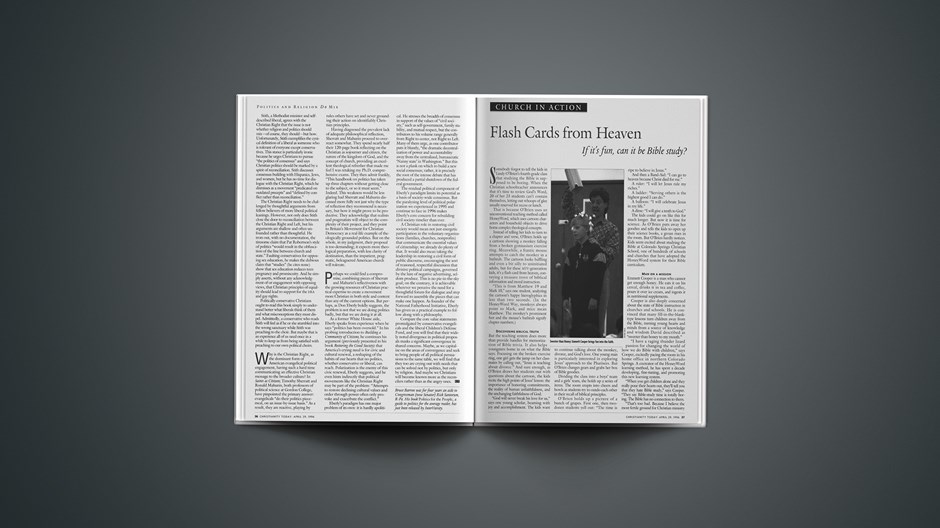
Instead of telling her kids to turn to a chapter and verse, O'Brien holds up a cartoon showing a monkey falling from a broken gymnasium exercise ring. Meanwhile, a frantic mouse attempts to catch the monkey in a bathtub. The cartoon looks baffling and even a bit silly to uninitiated adults, but for these MTV-generation kids, it's a flash card from heaven, conveying a treasure trove of biblical information and moral instruction.
"This is from Matthew 19 and Mark 10," says one student, analyzing the cartoon's happy hieroglyphics in less than two seconds. (In the HoneyWord Way, monkeys always point to Mark, and mice mean Matthew. The monkey's prominent feet and the mouse's bathtub signify chapter numbers.)
DISCOVERING BIBLICAL TRUTH
But the teaching system does more than provide handles for memorization of Bible trivia. It also helps youngsters home in on what the Bible says. Focusing on the broken exercise ring, one girl gets the jump on her classmates by calling out, "Jesus is teaching about divorce." And sure enough, as O'Brien draws her students out with questions about the cartoon, the kids recite the high points of Jesus' lesson: the importance of honoring commitments, the reality of human unfaithfulness, and the unchanging faithfulness of God.
"God will never break his love for us," says one young scholar, beaming with joy and accomplishment. The kids want to continue talking about the monkey, divorce, and God's love. One young man is particularly interested in exploring Jesus' approach to the Pharisees. But O'Brien changes gears and grabs her box of Bible goodies.
Dividing the class into a boys' team and a girls' team, she holds up a series of items. The room erupts into cheers and howls as students try to outdo each other in their recall of biblical principles.
O'Brien holds up a picture of a bunch of grapes. First one, then two-dozen students yell out: "The time is ripe to believe in Jesus."
And then a Band-Aid: "I can go to heaven because Christ died for me."
A ladder: "Serving others is the highest good I can do."
A balloon: "I will celebrate Jesus in my life."
A dime: "I will give a tenth to God."
The kids could go on like this for much longer. But now it is time for science. As O'Brien puts away her goodies and tells the kids to open up their science books, a groan rises in the room. But O'Brien hardly notices. Kids seem excited about studying the Bible at Colorado Springs Christian School, one of hundreds of schools and churches that have adopted the HoneyWord system for their Bible curriculum.
MAN ON A MISSION
Emmett Cooper is a man who cannot get enough honey. He eats it on his cereal, drinks it in tea and coffee, pours it over ice cream, and ingests it in nutritional supplements.
Cooper is also deeply concerned about the state of Bible instruction in churches and schools. He is convinced that many fill-in-the-blank-type lessons turn children away from the Bible, turning young hearts and minds from a source of knowledge and wisdom David described as "sweeter than honey to my mouth."
"I have a raging thunder lizard passion for changing the world of how we do Bible with children," says Cooper, excitedly pacing the room in his home office in northern Colorado Springs. A cocreator of the HoneyWord learning method, he has spent a decade developing, fine-tuning, and promoting this new learning system.
"When you get children alone and they really pour their hearts out, they'll tell you that they hate Bible study," says Cooper. "They say Bible-study time is totally boring. The Bible has no connection to them.
"That's too bad. Because I believe the most fertile ground for Christian ministry is children. Look at how Jesus related to children in Matthew 18. There's a window that we have of capturing the heart of a child in the elementary years that's unlike any other window."
A former investment broker, Cooper is a graduate of Dallas Theological Seminary, Colorado Christian University, and Evangelical Theological Seminary. He believes that many approaches cloud, or completely close, that window. And even though publishers produce dozens of children's Bibles with attractive covers, few children ever open these Bibles and read. "They can't articulate this, but in their guts, they feel an existential angst about the Bible."
HoneyWord has become Cooper's passion. That passion has helped him survive the slings and arrows of his one-man crusade, including a broken contract from a publisher who promised to distribute his materials, a stock market crash that wiped out money an investor was going to devote to producing materials and telemarketing, and criticism from fellow believers who question his faith or say he is trivializing God's Word.
Article continues below
"If a person really has a genuine passion for something, you can't knock him out of the game," says Cooper.
"If you're only semi-passionate, big-time obstacles can kick you out of the game. I've been rolling the entrepreneurial boulder uphill for 11 years. It's rolled back down on me a few times, but I always come back stronger through the grace of God."
LASTING RESULTS
Cooper is finally starting to get a little respect. His HoneyWord materials are being used in thousands of homes and hundreds of institutions. He is in conversation with curriculum publishers about licensing his approach. In June, Thomas Nelson will publish Making God's Word Stick, a book he coauthored with Steve Wamberg. And a literary agent is shopping a HoneyWord Bible around to various publishers.
But still, one of the things that makes Cooper happiest is talking to satisfied customers who have seen how his system works.
"The retention is what makes me happy," says Merry Gunnett, elementary assistant principal at Colorado Springs Christian School. A 21-year education veteran who has used nearly a dozen different curricula, she says HoneyWord makes the biblical message stick. "You can come back three or four months later, and the kids know what the story was about, and they can still pick up the meaning of the lesson."
Second-grade teacher Suzanne Mulcahy says, "The cartoons are just wacky enough so the children can catch on and see it." She also says she has to watch the clock, because animated student discussions often stretch her 30-minute Bible period to 40 or 50 minutes. "One day we were discussing how Jesus showed compassion on the lepers and touched them, and what that meant," she says. "And one of my kids began applying the lesson to people with AIDS."
Fourth-grader David Bennett described his enthusiasm for the system between bites of a turkey sandwich. "It's not as boring as the other stuff," he says. "And I remember the lessons." His mother has mixed feelings about David's newfound love for the Bible. "He's making unsolicited remarks about the Bible, which is something he never did before," says Sharon Bennett, "even when I taught him!"















 While we pray for peace, we need moral clarity about this war.
 A Christian reconciliation group in Israel and Palestine warned that war would come. Now the war threatens their relevance.العربيةFrançais
 Helping marine biodiversity flourish is a means of participating in God’s work, says an Indonesian theologian.






