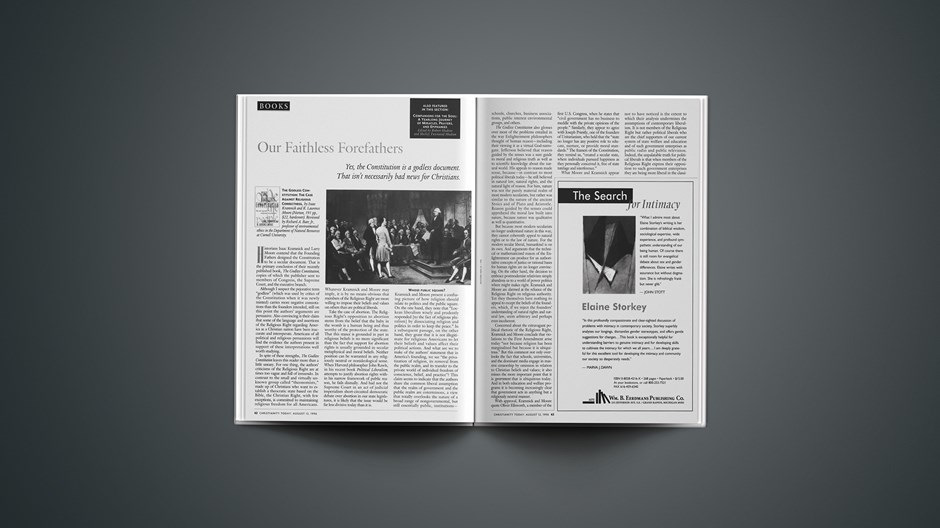
Historians Isaac Kramnick and Larry Moore contend that the Founding Fathers designed the Constitution to be a secular document. That is the primary conclusion of their recently published book, "The Godless Constitution," copies of which the publisher sent to members of Congress, the Supreme Court, and the executive branch.
Although I suspect the pejorative term "godless" (which was used by critics of the Constitution when it was newly minted) carries more negative connotations than the founders intended, still on this point the authors' arguments are persuasive. Also convincing is their claim that some of the language and assertions of the Religious Right regarding America as a Christian nation have been inaccurate and intemperate. Americans of all political and religious persuasions will find the evidence the authors present in support of these interpretations well worth studying.
In spite of these strengths, "The Godless Constitution" leaves this reader more than a little uneasy. For one thing, the authors' criticisms of the Religious Right are at times too vague and full of innuendo. In contrast to the small and virtually unknown group called "theonomists," made up of Christians who want to establish a theocratic state based on the Bible, the Christian Right, with few exceptions, is committed to maintaining religious freedom for all Americans. Whatever Kramnick and Moore may imply, it is by no means obvious that members of the Religious Right are more willing to impose their beliefs and values on others than are political liberals.
Take the case of abortion. The Religious Right's opposition to abortion stems from the belief that the baby in the womb is a human being and thus worthy of the protection of the state. That this stance is grounded in part in religious beliefs is no more significant than the fact that support for abortion rights is usually grounded in secular metaphysical and moral beliefs. Neither position can be warranted in any religiously neutral or nonideological sense. When Harvard philosopher John Rawls, in his recent book "Political Liberalism," attempts to justify abortion rights within his narrow framework of public reason, he fails dismally. And had not the Supreme Court in an act of judicial imperialism short-circuited democratic debate over abortion in our state legislatures, it is likely that the issue would be far less divisive today than it is.
WHOSE PUBLIC SQUARE?
Kramnick and Moore present a confusing picture of how religion should relate to politics and the public square. On the one hand, they note that "Lockean liberalism wisely and prudently responded [to the fact of religious pluralism] by dissociating religion and politics in order to keep the peace." In a subsequent passage, on the other hand, they grant that it is not illegitimate for religious Americans to let their beliefs and values affect their political actions. And what are we to make of the authors' statement that in America's founding, we see "the privatization of religion, its removal from the public realm, and its transfer to the private world of individual freedom of conscience, belief, and practice"? This claim seems to indicate that the authors share the common liberal assumption that the realm of government and the public realm are coterminous, a view that totally overlooks the nature of a broad range of nongovernmental, but still essentially public, institutions--schools, churches, business associations, public interest environmental groups, and others.
The Godless Constitution also glosses over most of the problems entailed in the way Enlightenment philosophers thought of human reason--including their viewing it as a virtual God-surrogate. Jefferson believed that reason guided by the senses was a sure guide to moral and religious truth as well as to scientific knowledge about the natural world. His appeals to reason made sense, because--in contrast to most political liberals today--he still believed in natural law, natural rights, and the natural light of reason. For him, nature was not the purely material realm of most modern secularists, but rather was similar to the nature of the ancient Stoics and of Plato and Aristotle. Reason guided by the senses could apprehend the moral law built into nature, because nature was qualitative as well as quantitative.
But because most modern secularists no longer understand nature in this way, they cannot coherently appeal to natural rights or to the law of nature. For the modern secular liberal, humankind is on its own. And arguments that the technical or mathematicized reason of the Enlightenment can produce for us authoritative concepts of justice or rational bases for human rights are no longer convincing. On the other hand, the decision to embrace postmodernist relativism simply abandons us to a world of power politics where might makes right. Kramnick and Moore are alarmed at the reliance of the Religious Right on religious authority. Yet they themselves have nothing to appeal to except the beliefs of the founders, which, if we reject the founders' understanding of natural rights and natural law, seem arbitrary and perhaps even incoherent.
Article continues below
Concerned about the extravagant political rhetoric of the Religious Right, Kramnick and Moore conclude that violations to the First Amendment arise today "not because religion has been marginalized but because it is ubiquitous." But this comment not only overlooks the fact that schools, universities, and the dominant media engage in massive censorship by omission in relation to Christian beliefs and values; it also misses the more important point that it is government that is ubiquitous today. And in both education and welfare programs it is becoming increasingly clear that government acts in anything but a religiously neutral manner.
With approval, Kramnick and Moore quote Oliver Ellsworth, a member of the first U.S. Congress, when he states that "civil government has no business to meddle with the private opinions of the people." Similarly, they appear to agree with Joseph Priestly, one of the founders of Unitarianism, who held that the "state no longer has any positive role to educate, nurture, or provide moral standards." The framers of the Constitution, they remind us, "created a secular state, where individuals pursued happiness as they personally conceived it, free of state tutelage and interference."
What Moore and Kramnick appear not to have noticed is the extent to which their analysis undermines the assumptions of contemporary liberalism. It is not members of the Religious Right but rather political liberals who are the chief supporters of our current system of state welfare and education and of such government enterprises as public radio and public television. Indeed, the unpalatable truth for political liberals is that when members of the Religious Right express their opposition to such government enterprises they are being more liberal in the classical sense of the term than are professors Moore and Kramnick.
SECULARISM AS CIVIL RELIGION
Take the case of public education. Most liberals--and indeed some conservatives--remain blind to the many ways in which government public schools today routinely violate the religious freedom of millions of Americans. They fail to understand that public education has always imposed a world-view on students. That this world-view was once basically religious and now is largely secular is less important than the fact that it functions as a kind of established civil religion.
Article continues below
Indeed, "The Godless Constitution" fails to mention the point (argued convincingly by Robert Healey in his 1962 monograph Jefferson on Religion in Public Education) that neither Thomas Jefferson nor Horace Mann (one of the founders of the common school) opposed the teaching of religion in public education. What they resisted was the teaching of what they labeled "sectarian" religion, namely the religion of orthodox Christians. They considered their own Unitarian-Deistic theology and morality entirely appropriate, indeed essential, for public education.
What has changed in our own day is that establishment educators now oppose the teaching of all normative religion in government public schools and universities, not just the "wrong kind" of religion. Religion in toto is now seen as sectarian and thus inappropriate for public education--unless presented in a purely descriptive, allegedly objective fashion. But because most liberals consider what is secular to be "nonsectarian," public-school teachers and university professors are permitted to inculcate in students a broad range of secular beliefs and values.
But this leaves us with a problematic and unstable state of affairs, for secular beliefs and values inevitably function in public education in an essentially religious fashion, directly competing with and undermining traditional (supernatural) religious beliefs and values. Thus, rather than viewing public education as excluding normative religious beliefs and values, it would be more accurate to see it as utterly pervaded with normative religion, but of a secular, humanistic variety.
Liberals typically ridicule the claim that secular humanism is a religion (or is religious), but they fail to understand that this claim was made originally, not by Christians, but by humanists, including prominent thinkers like John Dewey. And they simply ignore the views of scholars like Emile Durkheim and Reinhold Niebuhr, both of whom argued that secular beliefs and values can function exactly like supernatural beliefs and values.
When public schools teach children (as they routinely do) that life is about satisfying one's own desires and fulfilling oneself, or when they inculcate moral relativism in students (which they also routinely do), they are directly competing with traditional Christian beliefs. The state thereby violates the First Amendment's guarantees of religious freedom. The same dynamic is present at the college level in programs such as Human Development and Family Studies in Cornell University's state-funded College of Human Ecology, where students are exposed to a narrow range of secular, politically liberal (if not radical) views of the family, marriage, human sexuality, abortion, euthanasia, and other sensitive social issues. Christian perspectives on these controversial topics are, for the most part, either caricatured or ignored entirely.
Article continues below
The cause of the Religious Right would best be served by openly accepting the secularity of the Constitution. School prayer may have symbolic importance for many Christians. But if members of the Religious Right were able to take more seriously the arguments against a secular "religious" establishment that Rockne M. McCarthy, James W. Skillen, and William A. Harper make in their landmark 1982 book "Disestablishment a Second Time," they would turn their energies elsewhere. They would devote their time to the immeasurably more important goal of completing the revolution the founders started 200 years ago--this time by disestablishing what has over the past 50 years become the de facto official religion in America.
Among other things, such a move would entail enthusiastic support for legislation that permitted school choice and that prohibited discrimination against religious providers of social services. For the Religious Right to support political initiatives of this sort would be to treat the concept of a religiously neutral, secular state with full seriousness, indeed, far more so than Moore and Kramnick do in The Godless Constitution.















 While we pray for peace, we need moral clarity about this war.
 A Christian reconciliation group in Israel and Palestine warned that war would come. Now the war threatens their relevance.العربيةFrançais
 When I married into a Jewish family, antisemitism hit home. Now, the holy day reminds me of our future hope.






