Programming changed, too. In 1981 the network, which had always broadcast a high percentage of "family-oriented" material, eliminated all weekly religious broadcasts except the 700 Club. Reruns of popular shows such as Gunsmoke took their place. By 1982, CBN had enough advertising revenues to make a profit. By 1987, it could begin charging cable networks for its broadcasts. Eventually, the cable operation made so much money it endangered the tax-exempt status of CBN and was spun off as International Family Entertainment, a separate corporation, which owns the Family Channel with a contractual commitment to broadcast the 700 Club daily. (In the process of this transition, Robertson personally made millions of dollars, much of which he has donated to his various ministries.)
The secularization of programming dismayed many Robertson followers. In reality, it reflected Robertson's original concern for reaching the irreligious. Several published critiques had severely questioned the audience claims of religious television. CBN took them seriously. "What impact are we really making in response to the Great Commission?" was the question raised, according to Michael Little. They were ready for radical change in order to reach the lost.
It's a great story, how Robertson took a defunct TV station and by faith created the thing we call "religious television." It's also a retelling, with different technology, of the story told again and again in evangelical history. In the 1820s, Charles Finney rewrote the rules of revivals, with extraordinary results. Billy Sunday, D. L. Moody, Billy Graham did the same in their own ways. Still, you are left with a nagging doubt: What does it amount to? Certainly it comes to less than Robertson dreamed in the beginning.
"Frankly, only a masochist would want to watch religious shows all day long," Robertson told CHRISTIANITY TODAY last year. To attract wider audiences, CBN produced soap operas, game shows, and tried to start a worldwide news network. But costs were high, and none of the shows proved sustainable. The television market, Little emphasizes, has fractionalized into niche markets, and it is very difficult to gain enough advertising revenue to pay for original programming.
The 700 Club is now almost the only regular program CBN produces for the United States. Its ratings are down. Income from cash donations has plateaued at just over $100 million. (High-water mark was in 1987, when cbn took in gifts of $135 million.) The show is well made, it covers a wide variety of topics, it is not relegated to believers-only times and channels, but it nonetheless serves a religious niche market. Consequently, the evangelistic focus of CBN has turned overseas, where Robertson hopes to see 500 million conversions before the year 2000.
"In the last couple of years I'm shifting emphasis," Robertson told me. "I don't think America is going to have a revival. I just don't see us turning away from the wholesale slaughter of young people, of unborn babies, some of the bizarre sex of the motion pictures;
I don't think we're going to see it. I think there'll be revival in church, but I think that we're going to see essentially two cultures."
Robertson described some hopeful signs among American Christians, but when I asked him to compare these with his experiences as a seminarian in New York, he said, "I don't see the desperation. Frankly, the church has too much today. We're just too comfortable. The concept of staying at ease in Babylon is very real, and all of us have become extremely materialistic. We are so wealthy, our nation is so wealthy, and the churches are so wealthy. It's very hard in the midst of that just to say, 'God, we're desperate.' "
Robertson has prospered as much as anyone, of course. He lives in a spacious, gated compound of the CBN campus, with plenty of room for his horses. He walks to his work via a private tunnel. Millions of dollars are at his disposal, and he wields great influence in Washington.
In the meantime, CBN counts millions of conversions that have come through its broadcasts. (The day I interviewed him, Robertson estimated they would hear from 1,200 people who had prayed for salvation that day as a result of watching the 700 Club.) Christian programs, once a Sunday-morning-only phenomenon, can be located on most cable systems at almost any time, and millions find in them daily hope and inspiration. In untold ways, churches have been influenced by programs like the 700 Club--in their style of worship and in their sense of ecumenical unity with Christians they see on TV. Such achievements are not to be sneezed at, even though they fall far short of the dreams of those prayerful New York seminarians who said, "Without revival, there's nothing. There's no hope."
Robertson brought evangelicals back into the mainstream as a potent political force. Robertson grew up in a highly political family, but all political ambitions disappeared when he was converted. To a newborn evangelical Christian, politics seemed to lack spiritual value. When his father faced a tough reelection campaign, Robertson felt he could have swung support to him, but "the Lord refused to give me liberty. 'I have called you to my ministry,' he spoke to my heart. 'You cannot tie my eternal purposes to the success of any political candidate . . . not even your own father.' " His father lost.
Article continues below
Like many Christians, Robertson was deeply concerned by the moral decline of the United States. Only gradually, however, did he come to think of it in political terms. The Supreme Court played a major role in this swing, first in its school prayer decisions, and then, most dramatically, in the Roe v. Wade decision that legalized abortion. Jerry Falwell led fundamentalists into re-engagement through the Moral Majority. Robertson was supportive though never fully identified.
As Robertson tells it, Jimmy Carter's election pushed him into full-scale commitment. At first he was enthusiastic that an openly Christian politician might be President. He even played a minor behind-the-scenes role in helping Carter win the Pennsylvania primary. He was appalled, however, by the officials President Carter brought into office with him.
Robertson began to build his own politically motivated organizations. A 1980 rally, Washington for Jesus, attracted 500,000 marchers (by the organizers' count) and provided a vision of political and religious unity. Robertson worked closely with evangelicals, most notably Bill Bright of Campus Crusade for Christ. Nevertheless, a run for President seemed unlikely. John Gimenez, who had first envisioned Washington for Jesus, remembers prophesying on the 700 Club that Robertson would someday run for President. "Brother, that's a demotion, not a promotion," Robertson replied.
Pat Robertson has lived an improbable life, yet nothing he ever did seemed less likely than his run for President in 1988. No one professionally involved with religion--no priest or minister--had ever before been a serious candidate for the presidency. Hardly any reputable political pundit considered Robertson a presidential possibility. Yet for a fleeting moment in the primary season--he won the Michigan straw poll and placed second in the Iowa caucus--he seemed to have an honest chance.
Within weeks he was out of the race. The reasons candidates fail to attract support are complex, but Robertson couldn't quiet doubts about electing a candidate with such a strong religious vision, and (related to it) the concern that he was a nut. Those concerns continue today as Republicans debate the role of the Religious Right.
Article continues below
"Robertson's candidacy threatens the pluralism that is critical to holding our society together," wrote Elizabeth Drew in the "New Yorker" during the 1988 primaries. Presumably she had in mind the common idea that politics and religion should not mix, that Robertson had faith convictions far too strong to allow him to be President for all the varied people of America.
The "nut" charge probably worried voters more. Most Americans don't trust, for President, a man who hears God's voice telling him what to do. A lot was made of Robertson's belief that prayer had caused Hurricane Gloria to swerve away from Virginia Beach. (Instead, noted Christopher Buckley in the "New York Times Book Review," it destroyed Calvin Klein's summer home on Fire Island.)
His run was superficially a failure. The 700 Club suffered dramatic losses in income and audience during his long absence. Large staff layoffs resulted. Yet today at CBN the common assessment of his candidacy is upbeat. Robertson emerged from the battle with a long list of supporters and a strong sense of the need for grassroots organizing. He hired young Ralph Reed to run the Christian Coalition and soon it grew into a national political force. "Now we are a force to be reckoned with," says Vinson Synan. "No one runs for President without taking evangelicals into account. Robertson brought that about more than any other person."
But, one might ask again, so what? The legal status of abortion remains unchanged, TV and movies are as bad as or worse than ever, public schools are not markedly more conducive to faith. Re-engaging conservative Christians in the political process is an enormous accomplishment. Whether those Christians can change the direction of society, however, remains to be seen. As with the charismatic movement, as with Christian TV, Robertson's political legacy remains ambivalent.
In 1607, Pat Robertson likes to point out, the first permanent English settlers in America landed at Cape Henry, now part of Virginia Beach, and erected a seven-foot cross. There they knelt and, according to Robertson in his book "The New Millennium," "claimed this new nation for the glory of God and His Son Jesus Christ. In God's eyes the United States of America did not begin on July 4, 1776, but on April 29, 1607."
Robertson is intrigued by the fact that his ministry has grown near the site of that prayer, and that in the year 2007 "by some amazing coincidence--or might we not say foresight of God--the 400th anniversary of the greatest Gentile power that the world has ever known coincides precisely with the 40th year conclusion of the generation of the 'end of the Gentile power' "--that is, Israel's capture of Jerusalem in the Six Day War. In The New Millennium, Robertson adds that "this observer of events will have turned exactly 77 years old" in that same year.
Article continues below
Robertson is coy as to exactly what to make of such coincidences, but he hints broadly that these dates might be associated with the end times. "Might it be" (a phrase Robertson often uses in end-times speculation) that he and his ministry will have an important role to play?
"Possibility thinking" enabled Robertson to launch innovative organizations and to run for President. Yet it is also this mental fertility that raises doubts about his intentions. If the real United States began in 1607 with a prayer, then is the "real" U.S. a theocentric nation? Should its laws be taken from the Bible? Are non-Christians qualified to hold office? These are a few of the suspicious questions posed to Robertson, and while he is capable of giving nuanced and thoughtful answers, he has written and spoken without such nuances often enough to make people doubt just what is truly in his mind.
The fear that Robertson's goal is a theocratic, for-Christians-only America is misplaced, I am quite sure. (He has written sloppily enough about a Christian America to allow such a fear to be credible.) Robertson, no systematic thinker, doesn't seem to have any really clear picture of what should and should not be Christian about America. His friend Bob Slosser has it about right: "He was probably more concerned for what he didn't want America to look like than what he did want it to look like." It was the evils of drugs and promiscuity and disrespect for God that moved Pat Robertson to political engagement, not a worked-out political philosophy.
Certainly he has a weakness for apocalyptic speculation. His recent novel "The End of the Age" is only the latest of many Robertson flirtations with end-times scenarios. In it the final battle between good and evil is launched after a prophecy-fulfilling meteor lands in the Pacific Ocean and destroys California.
He also has a weakness for conspiracy theories. Writer Michael Lind caused quite a flap when he reviewed Robertson's 1991 book "The New World Order," drawing attention to its sources in paranoid anti-Semitic literature. Robertson was highly indignant, and certainly all evidence suggests that he is anything but anti-Semitic. (Some of the sources Robertson drew on do appear to be at least covertly so.) The deeper problem is that some of the "could-be" conspiracies that Robertson flirts with are downright weird. Perhaps it is not unusual that Robertson mistrusts the Ford Foundation, the Federal Reserve, and the Council on Foreign Relations, to name just three of his betes noires. But he goes considerably further.
Article continues below
"Indeed, it may well be that men of goodwill like Woodrow Wilson, Jimmy Carter, and George Bush, who sincerely want a larger community of nations living at peace in our world, are in reality unknowingly and unwittingly carrying out the mission and mouthing the phrases of a tightly knit cabal whose goal is nothing less than a new order for the human race under the domination of Lucifer and his followers." He traces this "tightly knit cabal" back to the eighteenth-century Illuminati and writes, "I am equally convinced that for the past two hundred years the term new world order has been the code phrase of those who desired to destroy the Christian faith and . . . replace it with an occult-inspired world socialist dictatorship."
This is strange stuff, and there is a great deal more of it in "The New World Order." (It surfaces much less often in his other books, although, for example, in "The New Millennium" Robertson asserts that the Vietnam War was lost by the United States through a "deliberate, calculated plan . . . put in place by those holding the ultimate power in our society, and fully supported by a leftist press." That plan was the Cold War, a stalemate engineered so that "roughly 10 percent of our output could be wasted each year" to accomplish full employment.) Hurricane Gloria was not the half of Robertson's problem in making himself out to be a mainstream thinker. And the fact that hundreds of thousands of supporters who read his books found in them nothing worrisome suggests one reason why evangelicals have had limited success thus far in American politics. Many evangelicals hold ideas that their neighbors find strange, and evangelicals don't scrutinize their leaders in the way that Americans do presidential candidates.
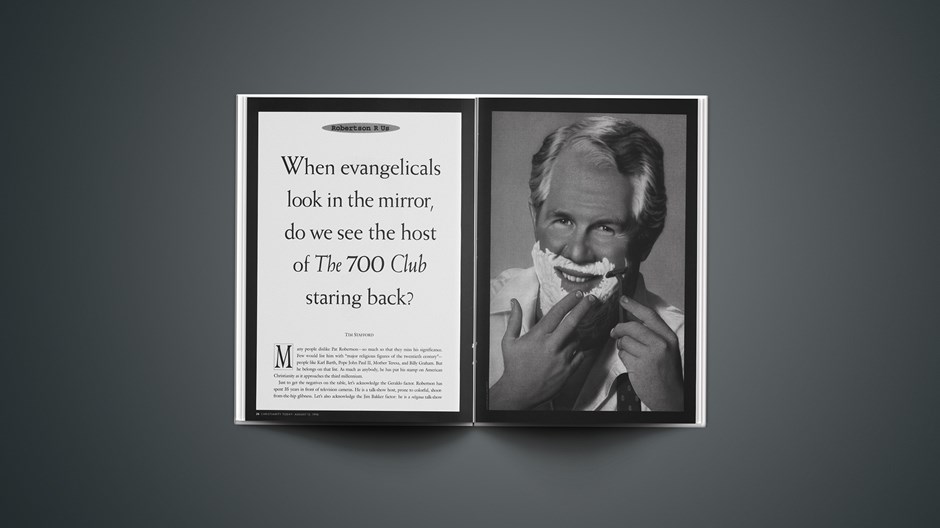
Robertson is an important figure in himself, but he is important for another reason. It's positively eerie how Pat Robertson makes a shadow picture of evangelicalism, duplicating and enlarging its strengths and weaknesses. Entrepreneurial, energetic, media savvy, he is a key religious leader for our times. Yet he (and evangelicalism, which is similarly potent) does not get much respect. He is intelligent and well educated, but he holds some strange ideas. He has written half a dozen bestsellers, yet not one rewards rereading. There is real passion for God and a willingness to thrive on the unpredictable, the affective, the supernatural. Like evangelicalism, he has all but bypassed the establishment, appealing to the common man and building new institutions from scratch. Evangelicalism shares his passion and his pragmatism. Yet his greatest successes (and evangelicalism's) come overseas in nations where people are desperately poor. In his own wealthy nation, with its great Christian heritage, he is relegated to a broadcast ghetto he can't break out of. So, to some extent, is evangelicalism, which thrives in Houston but can't get to first base in Manhattan or Hollywood.
Article continues below
Like evangelicalism, Robertson at first gave up his political heritage because it was not sufficiently "spiritual." America's moral decay brought him back, just as it brought back (with Robertson's help) much of the evangelical movement. Yet Robertson could not get elected, and the Religious Right has made little progress toward its goals.
That is why it is so hard to put him on the list of major religious figures of the twentieth century. For sheer vitality, he belongs. But will anyone remember him 20 years from now? Will he leave anything behind that matters?
Maybe. Robertson's visible accomplishments are remarkable. I have hardly mentioned organizations he started, like Operation Blessing, which dispenses emergency help to the poor, or Regent University, which offers accredited graduate programs in communications and the arts (including journalism and film), business, counseling, divinity, education, government, and law. (These reflect Robertson's own varied interests.) Through his television ministries, Robertson has seen millions of conversions, and today, in overseas venues, he is seeing a far greater harvest than ever before. ("Our organization, CBN, over thirty years of ministry had about 2 million people that came to the Lord. In the last five years we've had 52 million decisions in Russia, Romania, the Philippines, Latin America. . . .") His public-interest law firm, the American Center for Law and Justice, has won important religious-liberties cases before the Supreme Court. Robertson is a respected senior figure among charismatics and Pentecostals, often asked to address large gatherings of pastors in the Third World. He almost singlehandedly built one of the larger television cable networks in the world and has invented and maintained a popular daily television program for 35 years. ("I've outlasted Johnny Carson.") He created one of the most powerful grassroots political organizations in America, playing a major role in drawing conservative Christians back into political involvement.
Article continues below
That's a lot. Maybe he has "stopped the bulldozer" (as he puts it) of liberalism, limiting its destruction of values Robertson holds precious. Certainly he has carved out a niche in public life (and in broadcasting) that earns grudging respect. That, however, was not his original hope. He wanted to transform America. Robertson is too evangelical and too charismatic to be satisfied with a stalemate. His lifelong driving passion is for revival. (And politics is part of that. He wants moral reformation and knows that the righteousness of a people is a political subject.)
As his friends said long ago, he might still say today: "Without revival, there's nothing. There's no hope."
Like all evangelicals, Robertson is stuck between the hope of full redemption and the need to do something hopeful in an intractable world. Sometimes, maybe often, his own mixture of strengths and weaknesses helps keep him stuck there.















 While we pray for peace, we need moral clarity about this war.
 We’ve got little information on Jesus’ appearance and personality. But that’s the way God designed it.españolFrançais
 After lobbying from fellow Southern Baptists and Christians affected by the war, the House speaker moves a package forward.






