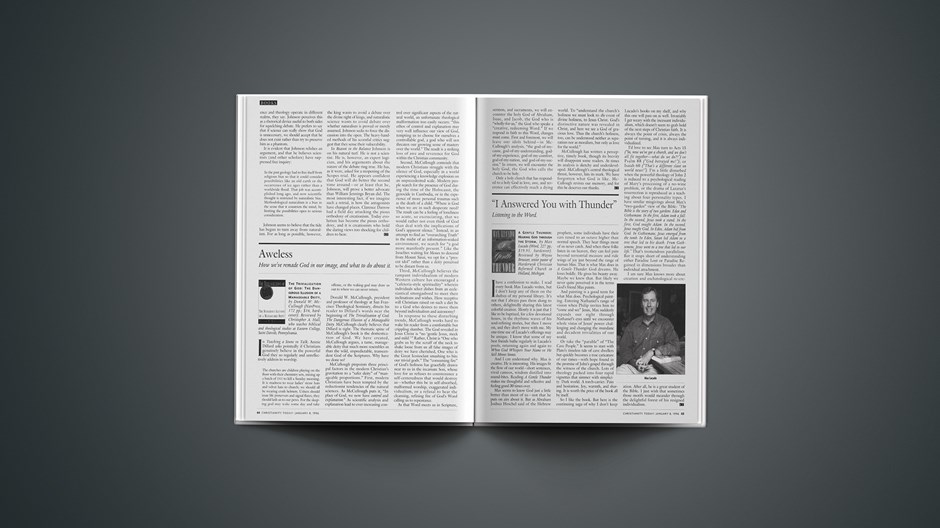
"The Trivialization of God: The Dangerous Illusion of a Manageable Deity," by Donald W. McCullough (NavPress, 172 pp.; $16, hardcover). Reviewed by Christopher A. Hall, who teaches biblical and theological studies at Eastern College, Saint Davids, Pennsylvania.
In "Teaching a Stone to Talk," Annie Dillard asks pointedly if Christians genuinely believe in the powerful God they so regularly and unreflectively address in worship.
The churches are children playing on the floor with their chemistry sets, mixing up a batch of TNT to kill a Sunday morning. It is madness to wear ladies' straw hats and velvet hats to church; we should all be wearing crash helmets. Ushers should issue life preservers and signal flares; they should lash us to our pews. For the sleeping god may wake some day and take offense, or the waking god may draw us out to where we can never return.
Donald W. McCullough, president and professor of theology at San Francisco Theological Seminary, directs his reader to Dillard's words near the beginning of "The Trivialization of God: The Dangerous Illusion of a Manageable Deity." McCullough clearly believes that Dillard is right. The thematic spine of McCullough's book is the domestication of God. We have created, McCullough argues, a tame, manageable deity that much more resembles us than the wild, unpredictable, transcendent God of the Scriptures. Why have we done so?
McCullough pinpoints three principal factors in the modern Christian's gravitation to a "safer deity" of "manageable proportions." First, modern Christians have been tempted by the reductionist tendencies of the natural sciences. As McCullough puts it, "In place of God, we now have control and explanation." As scientific analysis and explanation lead to ever-increasing control over significant aspects of the natural world, an unfortunate theological malformation too easily occurs: "this ethos of control and explanation may very well influence our view of God, tempting us to choose for ourselves a controllable god, a god who will not threaten our growing sense of mastery over the world." The result is a striking loss of awe and reverence for God within the Christian community.
Second, McCullough contends that modern Christians struggle with the silence of God, especially in a world experiencing a knowledge explosion on an unprecedented scale. Modern people search for the presence of God during the time of the Holocaust, the genocide in Cambodia, or in the experience of more personal traumas such as the death of a child. "Where is God when we are in such desperate need? The result can be a feeling of loneliness so acute, so excruciating, that we would rather not even think of God than deal with the implications of God's apparent silence." Instead, in an attempt to find an "overarching Truth" in the midst of an information-soaked environment, we search for "a god more manifestly present." Like the Israelites waiting for Moses to descend from Mount Sinai, we opt for a "present idol" rather than a deity perceived to be distant from us.
Third, McCullough believes the rampant individualism of modern Western culture has encouraged a "cafeteria-style spirituality" wherein individuals select dishes from an ecclesiastical smorgasbord to meet their inclinations and wishes. How receptive will Christians raised on such a diet be to a God who desires to move them beyond individualism and autonomy?
In response to these disturbing trends, McCullough works hard to wake his reader from a comfortable but crippling slumber. The God revealed in Jesus Christ is "no 'gentle Jesus, meek and mild.' " Rather, Christ is "One who grabs us by the scruff of the neck to shake loose from us all false images of deity we have cherished, One who is the Great Iconoclast smashing to bits our trivial gods." The "consuming fire" of God's holiness has gracefully drawn near to us in the incarnate Son, whose love for us refuses to countenance a self-centeredness that would destroy us--whether this be in self-absorbed, malformed worship, exaggerated individualism, or a refusal to hear the cleansing, refining fire of God's Word calling us to repentance.
As that Word meets us in Scripture, sermon, and sacraments, we will encounter the holy God of Abraham, Isaac, and Jacob, the God who is "wholly-for-us," the God who speaks a "creative, redeeming Word." If we respond in faith to this Word, changes must come. First and foremost, we will leave our idols behind--in McCullough's analysis, "the god-of-my-cause, god-of-my-understanding, god-of-my-experience, god-of-my-comfort, god-of-my-nation, and god-of-my-success." In return, we will encounter the holy God, the God who calls the church to be holy.
Only a holy church that has responded to a holy God in love, awe, and reverence can effectively reach a dying world. To "understand the church's holiness we must look to the event of divine holiness, to Jesus Christ. God's distinctive nature was revealed in Christ, and here we see a God of gracious love. Thus the church's holiness, too, can be understood neither as separatism nor as moralism, but only as love for the world."
McCullough has written a perceptive, timely book, though its brevity will disappoint some readers. At times its analysis is sketchy and underdeveloped. McCullough's central theological thrust, however, hits its mark. We have forgotten what God is like. McCullough revives our memory, and for this he deserves our thanks.















 While we pray for peace, we need moral clarity about this war.
 We’ve got little information on Jesus’ appearance and personality. But that’s the way God designed it.españolFrançais
 Eastern Orthodox poet Scott Cairns reflects on his new collection, his journey of faith, and poetry’s capacity to apprehend inexhaustible realities.






