Christians, both conservative and liberal theologically, are showing an increased boldness in taking on corporate America's internal policies, charging they are unethical, antifamily, or anti-Christian.
Through the use of product boycotts, shareholder campaigns, and public shaming, Christian activists aim to motivate corporate executives to be more family-friendly, scrupulous, and responsible.
Two decades ago, concerned Christians focused their efforts on getting sexually explicit magazines off the shelves of convenience stores. Today, religious activists have stepped up their efforts by taking on some of America's largest corporations. These moral conservatives have also broadened their emphasis, going beyond such products as books, films, cigarettes, and alcoholic beverages to companies' internal policies and business practices.
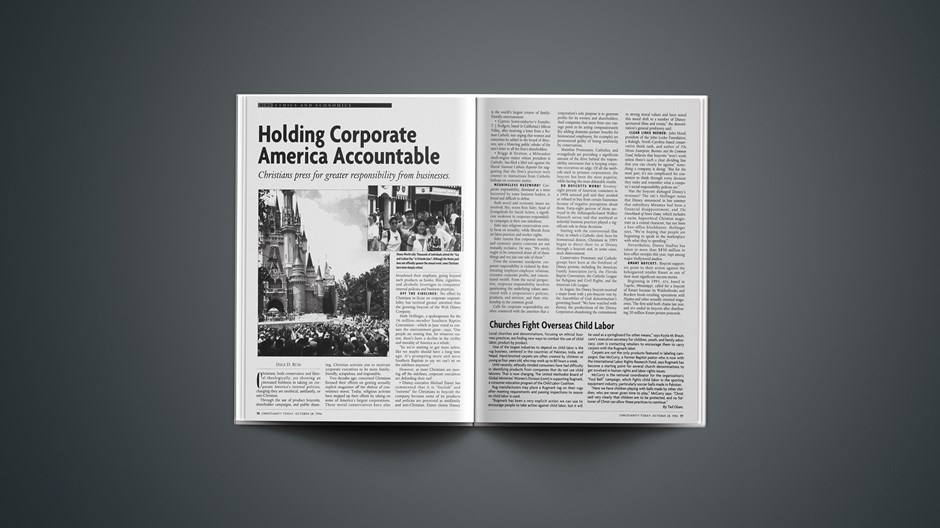
OFF THE SIDELINES: No effort by Christians to focus on corporate responsibility has received greater attention than the growing boycott of the Walt Disney Company.
Herb Hollinger, a spokesperson for the 16 million-member Southern Baptist Convention—which in June voted to censure the entertainment giant—says, "Our people are sensing that, for whatever reason, there's been a decline in the civility and morality of America as a whole.
"So we're starting to get more active, like we maybe should have a long time ago. It's prompting more and more Southern Baptists to say we can't sit on the sidelines anymore."
However, as more Christians are moving off the sidelines, corporate executives are defending their turf:
—Disney executive Michael Eisner has commented that it is "foolish" and "extreme" for Christians to boycott the company because some of its products and policies are perceived as antifamily and anti-Christian. Eisner claims Disney is the world's largest creator of family-friendly entertainment.
—Cypress Semiconductor's founder, T. J. Rodgers, based in California's Silicon Valley, after receiving a letter from a Roman Catholic nun urging that women and minorities be added to the board of directors, sent a blistering public rebuke of the nun's letter to all the firm's shareholders.
—Briggs & Stratton, a Milwaukee small-engine maker whose president is Catholic, has filed a libel suit against the liberal National Catholic Reporter for suggesting that the firm's practices were counter to instructions from Catholic bishops on economic justice.
MEANINGLESS BUZZWORD? Corporate responsibility, dismissed as a mere buzzword by some business leaders, is broad and difficult to define.
Both social and economic issues are involved. But, warns Ron Sider, head of Evangelicals for Social Action, a significant weakness in corporate-responsibility campaigns is their one-sidedness.
Sider says religious conservatives overly focus on sexuality, while liberals focus on labor practices and worker rights.
Sider reasons that corporate morality and economic justice concerns are not mutually exclusive. He says, "We surely ought to be concerned about all of those things and not just one side of them."
From the economic standpoint, corporate responsibility is violated by deteriorating employer-employee relations, excessive corporate profits, and concentrated wealth. From the social perspective, corporate responsibility involves questioning the underlying values associated with a corporation's policies, products, and services, and their relationship to the common good.
Calls for corporate responsibility are often countered with the assertion that a corporation's sole purpose is to generate profits for its owners and shareholders. And companies that seem from one vantage point to be acting compassionately (by adding domestic-partner benefits for homosexual employees, for example) are pronounced guilty of being antifamily by conservatives.
Mainline Protestants, Catholics, and evangelicals are providing a significant amount of the drive behind the responsibility movement that is keeping corporate executives on edge. Of all the methods used to pressure corporations, the boycott has been the most populist, while having the most debatable results.
DO BOYCOTTS WORK? Seventy-eight percent of American consumers in a 1994 national poll said they avoided or refused to buy from certain businesses because of negative perceptions about them. Forty-eight percent of those surveyed in the Indianapolis-based Walker Research survey said that unethical or unlawful business practices played a significant role in those decisions.
Starting with the controversial film Priest, in which a Catholic cleric faces his homosexual desires, Christians in 1995 began to direct their ire at Disney through a boycott and, in some cases, stock disinvestment.
Conservative Protestant and Catholic groups have been at the forefront of Disney protests, including the American Family Association (AFA), the Florida Baptist Convention, the Catholic League for Religious and Civil Rights, and the American Life League.
In August, the Disney boycott received a major boost with a pro-boycott vote by the Assemblies of God denomination's governing board. "We have watched with dismay the productions of the Disney Corporation abandoning the commitment to strong moral values and have noted this moral shift in a number of Disney-sponsored films and events," the denomination's general presbytery said.
Article continues below
CLEAR LINES NEEDED: John Hood, president of the John Locke Foundation, a Raleigh, North Carolina-based conservative think tank, and author of The Heroic Enterprise: Business and the Common Good, believes that boycotts "won't work unless there's such a clear dividing line that you can clearly be against" something a company is doing. "But for the most part, it's too complicated for consumers to think through every decision they make and remember what a company's social-responsibility policies are."
Has the boycott damaged Disney's revenues? The SBC's Hollinger notes that Disney announced in late summer that subsidiary Miramax had been a financial disappointment, and The Hunchback of Notre Dame, which includes a racist, hypocritical Christian magistrate as a central character, has not been a box-office blockbuster. Hollinger says, "We're hoping that people are beginning to speak in the marketplace with what they're spending."
Nevertheless, Disney Studios has taken in more than $850 million in box-office receipts this year, tops among major Hollywood studios.
KMART BOYCOTT: Boycott supporters point to their action against the beleaguered retailer Kmart as one of their most significant success stories.
Beginning in 1991, AFA, based in Tupelo, Mississippi, called for a boycott of Kmart because its Waldenbooks and Borders book-retailing operations sold Playboy and other sexually oriented magazines. The firm sold both chains last year, and afa ended its boycott after distributing 20 million Kmart protest postcards.
Kmart declines to admit that the boycott worked, although the retailer posted 11 consecutive quarters of disappointing results during the span. "We sold Waldenbooks and Borders for business reasons," says a Kmart spokesperson. "There's no way to measure any effect from the boycott. We haven't seen a huge increase in Kmart's sales since the boycott ended, either."
While the precise economic impact of boycotts may be next to impossible to determine, they succeed in part by putting a corporation on a defensive footing, generating potentially damaging publicity, and giving its competitors an unearned opportunity.
Randall Murphee, an AFA spokesperson, says boycotts are an important strategy for Christians but should not be the first option used to influence corporations.
Article continues below
"We think they're effective when they're well executed." He claims boycotts against Clorox and Burger King motivated the firms to change advertising policies in order to avoid morally questionable network television programs. Murphee says, "Boycotts are effective because they make consumers think about where they're spending their money. It becomes a stewardship question."
HOMOSEXUAL RIGHTS: For conservative Christians, the growing number of companies, agencies, and organizations—now exceeding 450—extending benefits packages to the domestic partners of homosexual employees is of uppermost concern.
William Mattox, a senior policy analyst at the Family Research Council in Washington, D.C., says, "You're hard-pressed to find corporations these days that have stood up to the gay lobby.
"Some of them are actually becoming advocacy arms for the gay lobby." Disney's move to offer benefits to domestic partners was a major consideration in the SBC resolution to censure the company.
AT&T has likewise become the target of conservatives' concern. Focus on the Family, the Colorado Springs-based ministry headed by James Dobson, is considering a switch in long-distance carriers because of complaints from supporters about AT&T's support of homosexual rights.
AT&T's top public-affairs executive, Hal Burlingame, even came to Colorado Springs to visit with Dobson and other Focus executives to discuss the nation's leading long-distance company's soon-expiring contract.
"He expressed empathy and said he'd look into it," recalls Paul Hetrick, Focus's vice president of communications. "But he also said he'd be going to San Francisco to address a gay [AT&T] employees' group."
And when Burlingame sent Focus a video of the speech he delivered in San Francisco, says Hetrick, "It looked like it had been edited in about 13 places. It was obvious that AT&T didn't want us to know what Burlingame really said to them."
For its part, AT&T "can't imagine why in the world we'd agree to give an internal tape of a meeting to anyone," says spokesperson Burke Stinson. But he acknowledged that AT&T investigated Focus's concerns and discovered that "some instructors whom we paid to come on the premises to help educate people were going too far."
This isn't the first time AT&T has felt whipsawed by competing social concerns. A few years ago, yielding to pro-lifers' protests, the company cut off funding of Planned Parenthood. But then it faced massive objections from Planned Parenthood and its supporters.
Article continues below
"Even if you side with a pressure group in principle, you can nonetheless find yourself being castigated because you're not 100 percent in sync with what they believe you should be doing," Stinson says.
For AT&T and other American corporations, doing the right thing by all sides on homosexual issues is only going to become more difficult.
One reason is that homosexual groups are starting to part ways with other groups that have been their stalwart supporters. As some researchers have begun using animals to help develop AIDS vaccines, the outspoken People for the Ethical Treatment of Animals has objected, causing direct conflict with homosexuals pressing for an AIDS cure.
Meanwhile, AT&T's problems have become opportunities for entrepreneurs focused on serving the Christian niche market. Lifeline, a long-distance phone service provider based in Oklahoma City, began in 1990 as "an alternative that stands for biblical values." Although it is a tiny slice of the market, Lifeline now services more than 900,000 customers. Their service now bills more than $14 million a month.
DEFINING RESPONSIBILITY: The debate over corporate responsibility is shaped by competing ideas concerning the role and function of corporations.
"The American corporation is a phenomenally successful social institution precisely because of its focus on profit, which puts scarce economic resources to their most productive use," says the Locke Foundation's Hood.
"When a firm finds ways to produce the same or even better goods and services at lower labor costs, it has a social responsibility to do so, no matter whether its work force shrinks."
But a competing view of corporate responsibility asserts that corporations function not solely for owners, but also for "stakeholders," including owners, shareholders, workers, customers, and the community.
These divergent views of corporate responsibility were evident earlier this year in the public tiff between Cypress Semiconductor and the share-holding nun from Philadelphia.
When Cypress president T. J. Rodgers rebuked Sister Doris Gormley, the Franciscan nun who had criticized his company's board of directors as being too white and too male, his scorching letter sounded a clarion call to resentful executives across America.
"We want our freedom," says Rodgers, whose company is based in San Jose, California. "Those who would take it from us have a false morality that is both socialistic and arrogant."
Article continues below
Others see his broadside as out of date. "He's the last of a dying breed," says Diane Bratcher of the Interfaith Council on Corporate Responsibility, a New York-based watchdog group. Rodgers is "a throwback," says William J. Byron, a business-ethics expert at Georgetown University in Washington, D.C.
Byron says the concept of "maximizing profits" as the sole responsibility of corporations has been discredited. "We're not moral nomads. There has to be some sensitivity for helping people absorb the blows. No one says you have to guarantee jobs forever."
Nell Minow, principal of Lens Inc. and author of a new book, Watching the Watchers: Corporate Governance for the Nineties, says in some cases an employee's own pension fund, holding valuable stock positions, may press for layoffs, in spite of being managed for workers.
THE BALANCING ACT: Minow notes that even companies that have developed stellar reputations are not immune to difficulties. Earlier this decade, Arnold Hiatt, former chair of Stride Rite Corporation, founded Businesses for Social Responsibility with 54 other companies, saying, "If you're probusiness, you also have to be concerned about things like jobs in the inner city."
The shoe manufacturer has received more than a dozen public-service awards in the past three years alone. But recently, Stride Rite has begun moving shoe-making jobs out of the slums of Boston to foreign countries where employment costs are significantly lower. "If it's at the expense of your business," Hiatt explained, "I think you can't forget that your primary responsibility is to your stockholders."
The fractious corporate-responsibility debate can end up in court. Earlier this year, Briggs & Stratton sued the National Catholic Reporter for a 1994 article in which the Kansas City, Missouri-based newsweekly predicted ill effects on Briggs employees of a planned move of 2,000 unionized jobs to nonunion plants in the South. The paper's editor asserted that Briggs executives—among them "Catholics educated in Catholic institutions"—lived "in either denial or moral blindness" when they made such decisions.
Briggs executives accused the newspaper of an "extraordinarily mean-spirited and defamatory attack."
"The nub of this case isn't politics, it's religion," says Robert Sutton, chief counsel for the plaintiffs. "We'll find out in this lawsuit if there are any limits to what the media can say."
Article continues below
SOCIAL INVESTING: Independent of public protests and boycotts, ethical investing has emerged as a ready means for individuals and groups to support socially responsible firms.
There are tradeoffs, however. A recent Fortune analysis determined that ethical mutual funds produced an 18.2 percent return during a one-year period that ended last spring, while Standard & Poor's index of 500 major stocks returned 27.2 percent.
But the socially conscious investing trend shows no sign of slacking. Recently, in a major nod to backers of corporate responsibility, the California public employees' pension fund, which has $100 billion in assets, said it would begin analyzing job cuts at the companies in its portfolio.
Also, the SBC's Hollinger said the Southern Baptists are considering adding responsibility criteria to the investment decisions made by the body's pension funds.
A Christian investment company started in 1994, the Timothy Plan, based in Winter Park, Florida, screens out any funds involved in abortion, pornography, alcohol, tobacco, or casino gambling. The company manages a $10 million portfolio.
Such investing is not a burden on Christians, according to Steve Ally, son of Timothy Plan founder Arthur Ally. "Out of the 7,000 securities on the market we only have to avoid 300 at any one time," he says.
A RELATIONAL ALTERNATIVE: Ted Baehr, head of the Christian Film and Television Commission, is exploring a different avenue of approach in influencing the corporate world.
Baehr recently relocated his interdenominational film-rating and industry-monitoring group to North Hollywood from Atlanta in order to develop a "relational" model of ministry.
"It's the most effective model," he says. "Since the victory was won on the cross, we don't have to be fighting the battle all over again. We just have to be ambassadors for the truth."
Baehr, whose organization also publishes the magazine MovieGuide, spends much of his time meeting with film producers and studio executives, helping them understand how to reach the Christian audience. He believes some Christian activists have undercut their own efforts by their aggressive attacks on the entertainment industry.
Baehr sees a basic difficulty with consumer boycotts sponsored by Christians. "When you boycott too broadly, it becomes misfocused and misinterpreted, and eventually it will hurt everybody.
"People who are Christian in Hollywood like [Christy executive producer] Ken Wales will get the backlash. People will say, 'Well, you're one of those, and we don't want to work with you.' "
Christians hoping to change the entertainment industry, Baehr says, would have better success if they focused first on developing family-friendly standards with film and television producers. Then, they should hold the industry accountable when it violates them.















 While we pray for peace, we need moral clarity about this war.
 A Christian reconciliation group in Israel and Palestine warned that war would come. Now the war threatens their relevance.العربيةFrançais
 The Grammy-winning artist was found dead at her home in Nashville at age 47.






