The story reads a lot like Waco and the Branch Davidians in 1993, only it was the spring of 1534 in the city of Münster (located in what is today the west-central region of modern Germany). Hundreds of Dutch-speaking Anabaptists-mainly artisans, peasants, and shopkeepers-converged on the city. They were united by their common opposition to infant baptism and the sacraments. But they were also driven by a primal fear forged on the anvil of torture and by an eschatalogical conviction that Münster was to become the New Jerusalem, the site chosen by God for the re-establishment of his kingdom on earth.
In the months that followed, the so-called Anabaptist Kingdom of Münster quickly degenerated into a morass of religious fanaticism and excess. Jan van Leyden-the David Koresh of the sixteenth century-appointed himself the king. He instituted a reign of terror that included polygamy (he took for himself no fewer than 12 wives), the elimination of private property, forced baptisms of the city's non-Anabaptist inhabitants, and armed preparations for a glorious final battle in which the elect gathered in Münster would vanquish the godless.
But in the summer of 1535, the New Jerusalem of Münster met with a violent demise. Armies of the Catholic Bishop von Waldeck first besieged, then stormed the city, and the sordid affair came to a bloody and violent conclusion.
For most North Americans, Waco-type images are not their first impression of today's Mennonites, the spiritual heirs to the early Anabaptists. Instead, when most of us think of Mennonites, images of their Amish cousins come to mind: a hardworking, honest, and rural people, committed to a quiet sober life of humility, simplicity, service and, above all, to Christian pacifism; they shun politics-and sometimes each other as a matter of church discipline-and emerge in the public eye only for massive quilt auctions to support overseas relief work or to clean up after natural disasters.
The contrast between this idealized image of contemporary Mennonites and the Münsterites of the sixteenth century could hardly be more striking. Who intervened to accomplish this amazing turnaround?
The answer is Menno Simons. Out of the ashes of Münster, a new Anabaptist group emerged, led by Menno Simons (1496-1565), a Catholic priest turned radical reformer. Menno restored stability to a group in which some had broken loose from their theological moorings. His leadership sought to balance the eschatological impulses of a persecuted sect with the model of a disciplined, visible church ruled by the authority of Scripture. To a movement of uneducated artisans, deeply suspicious of trained "school theologians" (Schriftgelehrten ), Menno brought a measure of theological sophistication that blended central themes of orthodox Christianity with the distinctive nuances of the radical reformation. Later known as the Mennonites, the group that gathered around his leadership espoused a biblicism shorn of private visions and advocated a sober discipline of its members, which eventually earned them the sobriquet of "the quiet in the land." They explicitly renounced violence and political power. To be sure, well before Menno emerged as a leader, there were other Anabaptist groups who were committed to biblical pacifism.
On the occasion of his five-hundredth birthday, the career and thought of Menno Simons merits renewed consideration. Deeply biblical, thoroughly Christocentric, steeped in the evangelical language of the New Birth and the Great Commission, Menno offers modern evangelicals an inspiring example of leadership that balances zeal and discipline, piety and theological depth, courage and wisdom.
Reformer on the run
Menno was born sometime in 1496 in the small Friesen town of Witmarsum in the north of the Netherlands. The son of a farmer, he attended grammar school at a monastery, where he likely learned Latin and gained some acquaintance with the church fathers. At the age of 15, Menno entered a novitiate and five years later became a deacon in the Catholic church.
At the time of his ordination to the priesthood, the Reformation in the Netherlands had found expression primarily in the form of local resistance to the sacraments. Indeed, soon after he began his first assignment as a vicar in his father's native village of Pingjum, Menno himself experienced doubts about the "real presence" of Christ in the sacrament of Communion. Initially, he had ignored these doubts and, by his own account, gave himself over to "playing cards, drinking, and frivolities of all sorts." But in 1531, the martyrdom of Sicke Freeriks Snijder-"a godfearing, pious hero" in nearby Leeuwarden, beheaded by state authorities for the crime of rebaptism-prompted Menno to embark on a fresh and systematic reading of the Bible.
"I examined the scriptures diligently," he wrote in his autobiographical Departure from the Papacy, "and pondered them earnestly, but could find no report of infant baptism." Still, he vacillated. Though intrigued by the staunch biblicism of the Anabaptist movement, he nonetheless accepted a promotion as a priest in his home church at Witmarsum in 1531 and continued to carry out the duties of his office for the next three years, all the while struggling with the tension between his understanding of Scripture and received Catholic tradition.
Article continues below
In the end, it was not a new intellectual insight that led Menno to break with the old church, but rather the fanatical excesses of the Anabaptist movement itself. In the spring of 1535, as the horrors of the Münsterite kingdom unfolded, Menno penned his first surviving tract, a polemic against Jan of Leyden, in which he denounced the private visions and impatient violence of the Münsterites and laid the groundwork for a biblical hermeneutic based firmly on the teachings of Christ.
For the next nine months, Menno attempted to preach his new message of evangelical reform from the pulpit of his parish church in Witmarsum. But finally, on January 20, 1536-precisely when public sentiment against the Anabaptists had reached a crescendo-Menno resigned his priestly office, gave up the salary, status, and security of his former identity, and publicly aligned himself with the Anabaptist cause. "Without constraint," he wrote, "I renounced all my worldly reputation, name and fame, my unchristian abominations, my masses, my infant baptism, and my easy life, and I willingly submitted to distress and poverty under the heavy cross of Christ."
Shortly thereafter Obbe Philips, leader of the beleaguered pacifist remnant of Dutch Anabaptism, ordained Menno as an Anabaptist pastor. Immediately Menno set about to rebuild the scattered and dispirited brotherhood. For the next three years, he traveled almost constantly-preaching, baptizing, instructing new believers in the faith, denouncing the apocalyptic remnants of the Münsterite kingdom-while simultaneously writing a flurry of apologetic treatises, including The Spiritual Resurrection (1536), Meditation on the Twenty-Fifth Psalm (1537), The New Birth (1537), Christian Baptism (1539), and his most influential work, Foundation of the Christian Doctrine (1539-40).
By 1542, Dutch authorities in Leeuwarden publicized a reward of 500 guilders for Menno's capture. Remarkably, he eluded arrest for the next two decades. Traveling with his wife, Gertrude, and their three children, Menno lamented in 1544 that he "could not find in all the countries a cabin or hut in which [we] could be put up in safety for a year or even a half a year." Although he successfully eluded arrest, numerous tales circulated of his narrow escapes from the authorities.
Article continues below
One oft-repeated, though likely apocryphal, story recounts how Menno was once traveling by stagecoach when a group of armed horsemen, carrying a warrant for Menno's arrest, overtook the carriage. As it happened, Menno was seated outside next to the driver. When the soldiers asked him whether Menno Simons was in the carriage, Menno leaned into the coach and said, "They want to know if a Menno Simons is in there." When the occupants said no, Menno answered his pursuers: "They say he is not in there." The horsemen continued on their way.
Menno preached a gospel of the New Birth, giving prominent attention to distinctive Anabaptist convictions regarding adult baptism, the priesthood of all believers, pacifism, and a rejection of the oath and magisterial offices. During the last period of his life, Menno's writings took on an increasingly polemical character as he defended the Anabaptists from attacks from without (against Reformed theologians such as John ü Lasco, Martin Micron, and Adam Pastor) and heresy from within (against fellow Anabaptist David Joris, for example, on the question of prophetic visions). Menno died on January 31, 1561, at the age of 65 in Fresenberg, a haven of refuge in north Germany and site of the press that printed many of his later works.
The followers he left behind-known as Mennists or Mennonites as early as 1542-were not altogether unified. But his legacy as a prolific writer, a theologian, and a polemicist lived on in the broader Anabaptist tradition. A recent bibliography of his published writings runs to 200 entries in Dutch, German, English, and Spanish. On the occasion of his five-hundredth birthday, nearly a million Mennonites, scattered in six continents and over 60 countries around the world, are paying him special honor.
No other foundation
It would be presumptuous to suggest that Menno was a reformer on a par with Luther or Zwingli, or that his Foundation of Christian Doctrine could be read as a parallel to Melancthon's Loci Communes or Calvin's Institutes of the Christian Religion. Menno never enjoyed the leisure to reflect systematically on his theology, and his emphasis on practical holiness did not harmonize well with abstract theological argumentation. Written in the white-heat of debate, Menno's writings today sound somewhat defensive in tone. He can be repetitious, even bombastic, overwhelming opponents as much with a flurry of scriptural references as with carefully nuanced argument.
Article continues below
That said, however, Menno deserves a fresh reading today by those in the broader evangelical tradition who will find in his writings some surprisingly familiar themes.
Modern evangelicals will be impressed with Menno's command of Scripture and the way in which all of his thought is suffused in biblical language and imagery. Wary of his contemporaries who had allowed personal revelations and visions to transcend the authority of the written Word, Menno continuously defended Scripture as the foundation of the Christian life.
Contemporary readers will undoubtedly appreciate Menno's high view of Christ and his repeated insistence that the inner transformation of the Christian into a "new creature" is made possible only by the blood of Christ's atoning sacrifice. So central was the saving work of Christ to Menno's thought that he included on the title page of every book he published the Pauline text: "For no one can lay any foundation other than the one already laid, which is Jesus Christ" (1 Cor. 3:11, niv). Menno also emphasized the active and empowering presence of the Holy Spirit in the life of the believer and the centrality of missions.
But Menno's writings also deserve a fresh reading because they offer a challenge-and even a helpful corrective-to contemporary evangelical theology. Consider, first, Menno's understanding of salvation. Few reformers emphasized the centrality of the New Birth more than Menno; indeed, he devoted a lengthy treatise to the theme in 1537 in which the themes of grace, repentance, and faith so central to the Protestant Reformation find eloquent expression.
But Menno stubbornly insisted that the New Birth was more than simply the inner experience of forgiveness of sins. He emphasized the link between the New Birth and the life of the "new creature," a life of Christian discipleship that gave tangible evidence of the gift of grace. It will not "help a fig," Menno insisted, "to boast of the Lord's blood, death, merits, grace or gospel if the believer is not truly converted from his sinful life."
To be sure, the believer never is fully freed from the taint of original sin-Menno did not preach perfectionism-but he had no patience for the popular appropriation of Luther's doctrine of justification that seemed to promote a casual approach to Christian ethics. The regenerate "live no longer after the old corrupted nature of the earthly Adam, but after the new upright nature of the new and heavenly Adam, Christ Jesus." Becoming "like minded with Jesus" meant actually to live like Jesus. "True evangelical faith," Menno wrote, "cannot lie dormant. It clothes the naked, it feeds the hungry, it comforts the sorrowful, it shelters the destitute, it serves those that harm it, it binds up that which is wounded, it has become all things to all people." Menno challenges our temptation to preach a gospel of saving grace shorn of a gospel of empowering grace.
Article continues below
Menno's emphasis on a life of practical holiness was closely tied to his understanding of the church. "They verily are not the true congregation of Christ who merely boast of his name," Menno wrote, "but they are the true congregation of Christ who are truly converted, who are born from above of God, who are of a regenerate mind by the operation of the Holy Spirit through the hearing of the Divine Word, and have become children of God, have entered into obedience to him, and live unblamably in his holy commandments."
Many of his writings sought to define the character of the true church in contrast to the state-dominated official churches of his day. According to Menno, the true church was found in the local body of adult believers who voluntarily gathered to study the Word and pledged themselves to lives of discipleship and mutual aid one for the other. This community was an alternative society where violence and coercive force had no place, a setting where nurture in the faith and mutual discipline according to the teaching of Jesus in Matthew 18 could happen in Christian love. Menno's emphasis on the church as a deeply committed fellowship challenged the Protestant temptation to regard the church as an institution closely allied with the state, charged with the task of maintaining the status quo, with an identity virtually independent of the lives of individual believers. Menno's view of the church necessarily implies an ongoing corporate discernment of the meaning of the gospel in a changing culture. Menno's understanding of the church as a voluntary gathering has become the Protestant norm in America.
But Menno's understanding of the church is also in tension with the modern impulse to view the church primarily in individualistic terms, as a setting in which to discover one's private understanding of faith. Baptism, in Menno's view, symbolized a new life in Christ as lived in the nurturing fellowship of other believers. Baptism marked a public statement of incorporation into a new body, the church. Called to present itself as the bride of the risen Christ-"without spot or wrinkle"-the church offers a collective and visible witness to the world as a redeemed community.
Article continues below
But the church can only maintain this character if its members actively discern the will of God in their lives and willingly exercise church discipline as an act of Christian charity and love to the struggling or fallen believer. This view of the church assumes that a commitment to the larger body of believers will necessarily qualify individual freedoms to live faith strictly in accordance with personal inclination. In light of the ongoing highly publicized moral failures of prominent church leaders, modern evangelicals will find in Menno fresh insights on the questions of accountability and discipline.
Called to peace
Perhaps most radical of all, Menno's writings challenge contemporary evangelicals to rethink the question of Jesus' teachings on peace, and particularly the easy alliance modern Christians have made with the political order.
In our own time, the graphic accounts of bloody massacres and human atrocities committed against each other by the Hutus and Tutsis in Rwanda have all but disappeared from the headlines these days. Yet, for evangelical Christians, there is an element to the Rwanda story that should haunt our conscience for a long time: 90 percent of Rwanda's people are professed Christians.
To the African church, Rwanda had been a success story. Yet, according to an InterVarsity leader in the region, missionaries preached a gospel about having a right relationship with God but not necessarily right relationships with one other. "This is why we can be 90 percent Christian yet kill in the name of ethnicity," he says.
Preaching a gospel that separates relationship with God from human relations was anathema to Menno Simons. Worse, the haunting specter of Christians killing Christians was completely unthinkable. In his refutation of the violence at Münster, Menno recognized the profound danger of mixing zealous Christian convictions with the coercive power of the sword.
At the heart of the New Birth, he insisted, was a recognition that God granted us his gift of forgiveness and love while we were still sinners alienated from him-indeed, while we were yet enemies of God. God's gift of salvation through Christ has world-transforming power precisely because it offers followers of Jesus a concrete model for love expressed in daily life. Because we have been saved and transformed by grace, we too will embody that same grace-filled love with all relationships, including-indeed, especially-those who might be considered our enemies.
Article continues below
"The Prince of Peace," wrote Menno, "is Jesus Christ. We who were formerly no people at all, and who knew of no peace, are now called to be … a church … of peace. True Christians do not know vengeance. They are the children of peace. Their hearts overflow with peace. Their mouths speak peace, and they walk in the way of peace" (Reply to False Accusations ).
Living in accordance with this forgiving, gracious peace of God may well entail suffering. In the sixteenth century the cost was social and economic marginalization, torture, and sometimes even death. But such suffering also offers a profound opportunity for witness to the love of God in the midst of a violent, hate-filled culture.
The prospect of suffering rather than retaliating with violence is certainly alien to modern notions of self-esteem; it is also alien to contemporary expressions of North American Christianity, whether on the Right or the Left, that seek to impose their visions of a godly society upon others. Which, in a roundabout way, brings us back to the story of the ill-fated Anabaptist kingdom of Münster.
Christians have always been tempted to take control of history; to seize the levers of temporal power and make history come out "right," to try to align the kingdoms of this world with the kingdom of God. To be sure, the temptations of violence today are rarely as blatant or extreme as that of Jan van Leyden-or even that of Rwanda. But a Christianity that aligns itself with a culture of violence-from the Left or the Right-seems to make a mockery of the grace it proclaims as its gift to the nonbelieving world.
Menno would argue that violence of any sort in the name of Christ is blasphemy, which calls for repentance. His writings call upon Christians to resist the seduction of a violent culture (even when that violence is sanctioned by the state). As a whole, evangelicals will probably not be convinced of Menno's arguments for Christian pacifism; but at the very least we should have an uneasy conscience about our too-easy rationalizations.
Regardless of one's understanding of Christian pacifism, in a profound way we are all heirs of Menno. The principles of religious voluntarism and a disestablished church-principles for which the sixteenth-century Anabaptists paid with their lives-are now assumed. Even though not a systematic theologian, Menno Simons's vision of reborn Christians living in a disciplined and visible church, and embodying in their daily lives the loving peace of God's grace, still has the power to inspire Christians today. On the five-hundredth anniversary of his birth, evangelicals of all stripes-including Mennonites-would do well to blow the dust off Menno's writings and read them afresh.
Article continues below
John D. Roth is professor of history at Goshen (Ind.) College and editor of the Mennonite Quarterly Review.
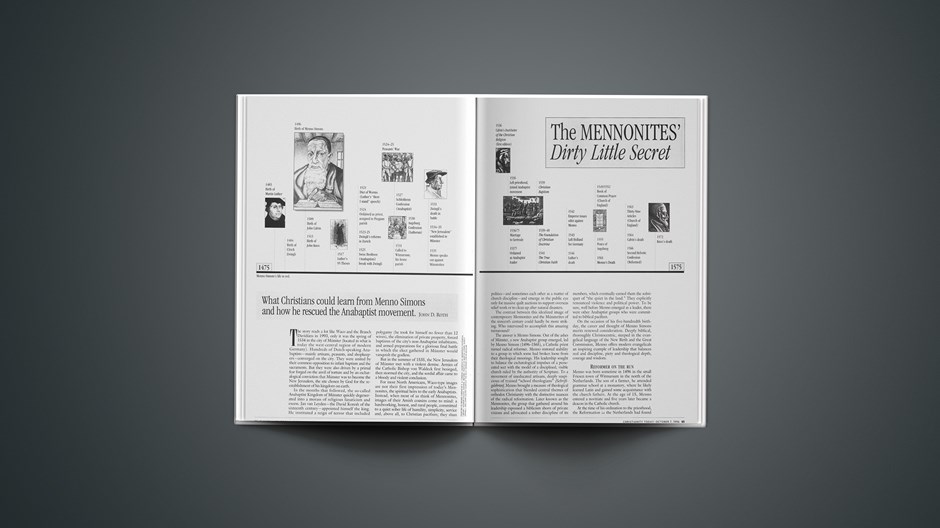
TIME LINE
1483
Birth of Martin Luther
1484
Birth of Ulrich Zwingli
1496
Birth of Menno Simons
1509
Birth of John Calvin
1513
Birth of John Knox
1517
Luther's 95 Theses
1521
Diet of Worms (Luther's "Here I stand" speech)
1523-25
Zwingli's reforms in Zurich
1524 *
Ordained as priest, assigned to Pingjum parish
1524-25
Peasants' War
1525
Swiss Brethren (Anabaptists) break with Zwingli
1527
Schleitheim Confession (Anabaptist)
1530
Augsburg Confession (Lutheran)
1531 *
Called to Witmarsum, his home parish
1531
Zwingli's death in battle
1534-35
"New Jerusalem" established in Münster
1535 *
Menno speaks out against Münsterites
1536
Calvin's Institutes of the Christian Religion (first edition)
1536 *
Left priesthood, joined Anabaptist movement
1536/7? *
Marriage to Gertrude
1537? *
Ordained as Anabaptist leader
1539 *
Christian Baptism
1539-40 * The Foundation of Christian Doctrine
1541 * The True Christian Faith
1542 *
Emperor issues edict against Menno
1543 *
Left Holland for Germany
1546
Luther's death
1549/1552
Book of Common Prayer (Church of England)
















 While we pray for peace, we need moral clarity about this war.
 A Christian reconciliation group in Israel and Palestine warned that war would come. Now the war threatens their relevance.العربيةFrançais
 The Grammy-winning artist was found dead at her home in Nashville at age 47.






