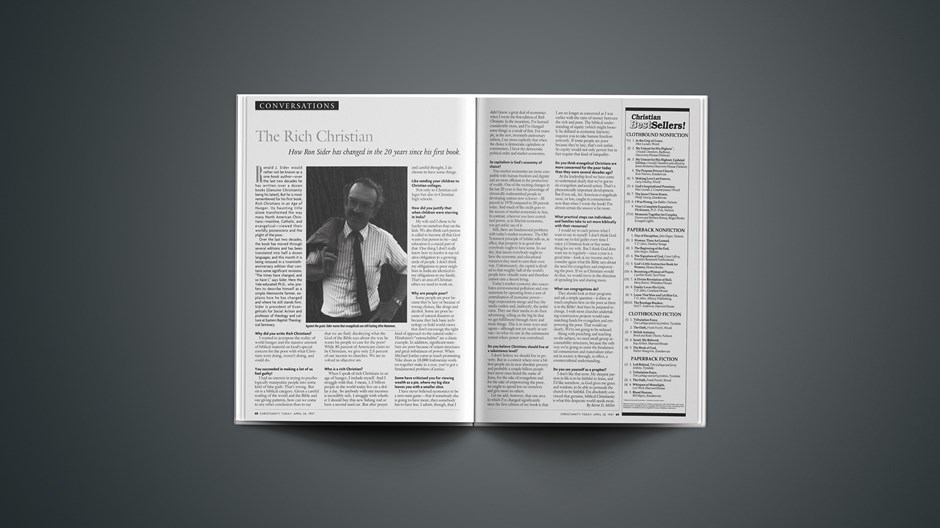
Ronald J. Sider would rather not be known as a one-book author—over the last two decades he has written over a dozen books (Genuine Christianity being his latest). But he is most remembered for his first book, Rich Christians in an Age of Hunger. Its haunting title alone transformed the way many North American Christians—mainline, Catholic, and evangelical—viewed their worldly possessions and the plight of the poor.
Over the last two decades, the book has moved through several editions and has been translated into half a dozen languages, and this month it is being reissued in a twentieth-anniversary edition that contains some significant revisions. “The times have changed, and so have I,” says Sider. Here the Yale-educated Ph.D., who prefers to describe himself as a simple Mennonite farmer, explains how he has changed and where he still stands firm. Sider is president of Evangelicals for Social Action and professor of theology and culture at Eastern Baptist Theological Seminary.
Why did you write Rich Christians?
I wanted to juxtapose the reality of world hunger and the massive amount of biblical material on God’s special concern for the poor with what Christians were doing, weren’t doing, and could do.
You succeeded in making a lot of us feel guilty!
I had no interest in trying to psychologically manipulate people into some kind of false guilt. That’s wrong. But sin is a biblical category. Given a careful reading of the world and the Bible and our giving patterns, how can we come to any other conclusion than to say that we are flatly disobeying what the God of the Bible says about the way he wants his people to care for the poor? While 85 percent of Americans claim to be Christians, we give only 2.5 percent of our income to churches. We are involved in objective sin.
Who is a rich Christian?
When I speak of rich Christians in an age of hunger, I include myself. And I struggle with that. I mean, 1.3 billion people in the world today live on a dollar a day. So anybody with our incomes is incredibly rich. I struggle with whether I should buy this new fishing rod or have a second used car. But after prayer and careful thought, I do choose to have some things.
Like sending your children to Christian colleges.
Not only to Christian colleges but also to Christian high schools.
How did you justify that when children were starving in India?
My wife and I chose to be harder on ourselves than on the kids. We also think each person is called to become all that God wants that person to be—and education is a crucial part of that. One thing I don’t really know how to resolve is our relative obligation to a growing circle of people. I don’t think my obligations to poor neighbors in India are identical to my obligations to my family. That’s an area of Christian ethics we need to work on.
Why are people poor?
Some people are poor because they're lazy or because of wrong choices, like drugs and alcohol. Some are poor because of natural disasters or because they lack basic technology or hold world-views that don't encourage the right kind of approach to the natural order—Hinduism’s “untouchables” are a classic example. In addition, significant numbers are poor because of unjust structures and great imbalances of power. When Michael Jordan earns as much promoting Nike shoes as 18,000 Indonesian workers together make in a year, you’ve got a fundamental problem of justice.
Some have criticized you for viewing wealth as a pie, where my big slice leaves you with a smaller slice.
I have never believed economics to be a zero-sum game—that if somebody else is going to have more, then somebody has to have less. I admit, though, that I didn’t know a great deal of economics when I wrote the first edition of Rich Christians. In the meantime, I’ve learned considerably more, and I’ve changed some things as a result of that. For example, in the new, twentieth-anniversary edition, I say more explicitly that when the choice is democratic capitalism or communism, I favor the democratic political order and market economies.
So capitalism is God’s economy of choice?
Free-market economies are more compatible with human freedom and dignity and are more efficient in the production of wealth. One of the exciting changes in the last 20 years is that the percentage of chronically malnourished people in developing nations now is lower—35 percent in 1970 compared to 20 percent today. And much of the credit goes to the success of market economies in Asia. In contrast, wherever you have centralized power, as in Marxist economies, you get unfair use of it.
Still, there are fundamental problems with today’s market economy. The Old Testament principle of Jubilee tells us, in effect, that property is so good that everybody ought to have some. In our day, that means everybody ought to have the economic and educational resources they need to earn their own way. Unfortunately, the capital is divided so that roughly half of the world’s people have virtually none and therefore cannot earn a decent living.
Article continues below
Today’s market economy also exacerbates environmental pollution and consumerism by operating from a sort of centralization of economic power—large corporations merge and buy the media outlets and, indirectly, the politicians. They use their media to do their advertising, telling us the big lie that we get fulfillment through more and more things. This is in some ways analogous—although not yet nearly as serious—to what we saw in the communist system where power was centralized.
Do you believe Christians should live at a subsistence level?
I don’t believe we should live in poverty. But in a context where over a billion people are in near absolute poverty and probably a couple billion people have never once heard the name of Jesus, for the sake of evangelism and for the sake of empowering the poor, we ought to spend less on ourselves and give more to others.
Let me add, however, that one area in which I’ve changed significantly since the first edition of my book is that I am no longer as concerned as I was earlier with the ratio of money between the rich and poor. The biblical understanding of equity (which might loosely be defined as economic fairness) requires you to take human freedom seriously. If some people are poor because they’re lazy, that's not unfair. So equity would not only permit but in fact require that kind of inequality.
Do you think evangelical Christians are more concerned for the poor today than they were several decades ago?
At the leadership level we have come to understand clearly that we’ve got to do evangelism and social action. That’s a phenomenally important development. But if you ask, Are American evangelicals more, or less, caught in consumerism now than when I wrote the book? I’m almost certain the answer is far more.
What practical steps can individuals and families take to act more biblically with their resources?
I would say to each person what I want to say to myself: I don’t think God wants me to feel guilty every time I enjoy a Christmas feast or buy something for my wife. But I think God does want me to regularly—once a year is a good time—look at my income and to consider again what the Bible says about the need for evangelism and empowering the poor. If we as Christians would do that, we would move in the direction of spending less and sharing more.
Article continues below
What can congregations do?
They should look at their programs and ask a simple question—is there as much emphasis here on the poor as there is in the Bible? And then be prepared to change. I wish most churches undertaking construction projects would raise matching funds for evangelism and empowering the poor. That would say clearly, We’re not going to be seduced.
Along with preaching and teaching on the subject, we need small-group accountability structures, because the only way we’re going to resist the fundamental consumerism and materialism inherent in society is through, in effect, a countercultural understanding.
Do you see yourself as a prophet?
I don’t like that term. My deepest passion in life is to be faithful to Jesus, and I’d like somehow, as God gives me grace and wisdom, to be able to persuade the church to be faithful. I’m absolutely convinced that genuine, biblical Christianity is what this desperate world needs most.















 While we pray for peace, we need moral clarity about this war.
 As my doubts about his teachings grew, so did a secret fascination with Jesus.
 After lobbying from fellow Southern Baptists and Christians affected by the war, the House speaker moves a package forward.






