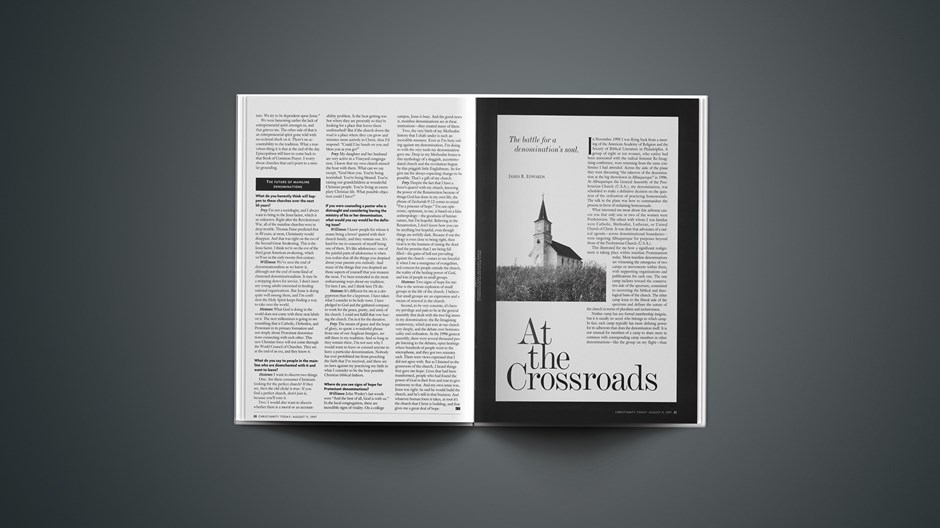
In November 1995 I was flying back from a meeting of the American Academyof Religion and the Society of Biblical Literature in Philadelphia. A groupof eight or ten women, who earlier had been associated with the radical feministRe-Imagining conference, were returning from the same conference I had attended.Across the aisle of the plane they were discussing "the takeover of thedenomination at the big showdown in Albuquerque" in 1996. At Albuquerquethe General Assembly of the Presbyterian Church (U.S.A.), my denomination,was scheduled to make a definitive decision on the question of the ordinationof practicing homosexuals. The talk in the plane was how to commandeer theprocess in favor of ordaining homosexuals.
What interested me most about this airborne caucus was that only one or twoof the women were Presbyterians. The others with whom I was familiar wereCatholic, Methodist, Lutheran, or United Church of Christ. It was clear thatadvocates of a radical agenda—across denominational boundaries—were targetingAlbuquerque for purposes beyond those of the Presbyterian Church (U.S.A.).
This illustrated for me how a significant realignment is taking place withinmainline Protestantism today. Most mainline denominations are witnessingthe emergence of two camps or movements within them, with supportingorganizations and publications for each one. The one camp inclines towardthe conservative side of the spectrum, committed to recovering the biblicaland theological basis of the church. The other camp leans to the liberalside of the spectrum and defines the nature of the church in terms of pluralismand inclusiveness.
Neither camp has any formal membership insignia, but it is usually no secretwho belongs to which camp. In fact, each camp typically has more definingpower for its adherents than does the denomination itself. It is not unusualfor members of a camp to share more in common with corresponding camp membersin other denominations—like the group on my flight—than they do with oppositecamp members of their own denomination.
Been there
The two-camp conflict currently defining the American church struggle, ifit can be called that, is not unique to our time and place. The history ofthe German church in the 1930s is in at least two respects a prototype ofthe current situation of mainline denominations.
The Synod of Barmen, and the Barmen Declaration (1934) that issued from it,grew out of what was known as "the German church struggle." The strugglewas perceived and articulated by the Synod of Barmen in terms of confessionalismversus accommodation to culture. Specifically, that meant a conflict betweentwo understandings and models of Chrisianity. The one, represented by the"German Christians," advocated a "positive Christianity" that sought to integratethe gospel as far as possible with the prevailing ideology ushered in byHitler and National Socialism. This included discarding the Old Testamentand abandoning the Jewish context of Christianity, Aryanizing Jesus, downplayingor denying the Cross and Atonement as symbols of weakness and defeat, andrecasting Jesus as a heroic figure serviceable to the Nazi cause. The rulingaxiom of "German Christianity" was that the church realized its purpose bychampioning the Zeitgeist (spirit of the times), which at thatpoint was the new Aryan Mensch (human being) and his politicalgenie, National Socialism.
The other understanding of Christianity was expressed by the "ConfessingChurch," which at Barmen and subsequent synods protested against reformulatingChristianity according to Germanic, especially Nazi, archetypes. Barmen appealedto Holy Scripture over Nazi ideology, to the lordship of Jesus Christ overthe demagoguery of the "Fuhrer," to the freedom of the church over a"Brown" cultural and ideological captivity.
"We reject the false doctrine," declares the first article of the BarmenDeclaration, "as though the Church could and would have to acknowledge asa source of its proclamation, apart from and besides this one Word of God,still other events and powers, figures and truths, as God's revelation."
The issue of confessionalism versus secularism is immediately relevant toour context today, although it is potentially dangerous to adduce an analogyfrom the German church struggle with Nazism. I am not suggestingthat those who advocate the ordination of homosexuals, for instance, areto be equated with Nazis. That would be grossly unfair; the commitment toinclusiveness of many pro-homosexual advocates simply cannot and should notbe likened to the impulses of domination, power, and hubris inherent in the"German Christian" movement. The likeness is thus not between pro-homosexualordination and "German Christians," nor between the evangelical renewal groupsin mainline Protestantism today, for example, and the Confessing Church atBarmen, for that matter.
A pastor incapable of defending a
Christian ethic of sexuality should
be as a physician who cannot tell
you why he or she is prescribing
a certain medicine or treatment.
Article continues below
The lesson from Barmen is rather in this: The current church struggle inthe Presbyterian church (of which I am an ordained minister and so the mainlinedenomination with which I am the most familiar) is likewise over the authorityof Scripture and creed versus the authority of alien and humanistic ideologies,between the church's faithfulness to the lordship of Christ versus anaccommodation and reformulation of Christianity to the spirit of the age.The issue at stake is this: Who sets the agenda for the church, sola Scripturaor solum saeculum, Holy Scripture or the dominant ideology ofthe day?
The debate over sexuality is only one facet of a larger struggle. The morefundamental struggle is over whether the gospel is the final authority andonly means of salvation for all people, or whether Christianity is one ofvarious equally valid means of salvation, one of many paths leading to thesame summit. It includes the question at the forefront of discussion today:whether a theology of creation or a theology of redemption—what we are versuswhat we may become—expresses God's ultimate and saving will for humanity.It includes the question whether God, through the Holy Spirit, reveals hiswill through human experience and cultural change, or through Scripture asdivine revelation. Above all, it includes the issue of Christology, whetherJesus Christ is by his life, death, and resurrection the one sufficient saviorof all people, or whether he is by his life and teaching alone a mere modelor guide.
Barmen speaks a clear and powerful word that Jesus Christ as revealed inScripture is the one and only Lord of the church. This is a word needed bya church whose message and purpose have become eclipsed by causes or movementsother than the authority of the gospel—a church tempted to divide itsallegiance, following its historic creeds and way of life where they arecompatible with prevailing ideologies and abandoning them when they are not.
Professors, not confessors
There is a second parallel between the current struggle in the Presbyterianchurch and Barmen. The 139 representatives who convened at Barmen in Mayof 1934 were pastors and laity rather than church officials and universityprofessors. Over one-third of the delegates at Barmen were laity. The remainderwere almost without exception pastors. True, Karl Barth, the driving forcebehind the drafting of the Barmen Declaration, was a theological professorfrom Bonn, but when his name is omitted (Barth was expelled from Germanyby the Nazis in 1935), a body of pastors remains who formed the backbone,muscles, and sinew of the Confessing Church.
Article continues below
While Dietrich Bonhoeffer, one of the most famous members of the ConfessingChurch, was not present at Barmen, he illustrates the point at hand. Bonhoefferdeclined a chair of theology at the University of Berlin in favor of a pastoratebecause he feared that a tenured professorship was tempted—or expected!—tosubstitute theological abstractions for the decisive engagement with thegospel that was inherent in the "costly grace" demanded of a Christian, andespecially of a pastor.
The forerunner of the Confessing Church was the Pastors' Emergency League,founded by Martin Niemoller. An ad hoc convocation of 150 pastors, thePastors' Emergency League sought to stem the tide of encroaching NationalSocialism in the churches. It is significant that there was never a "Professors'Emergency League," or a "Bishops' Emergency League." Unfortunately, the lattertwo groups were the chief nests of opposition to Barmen and the ConfessingChurch.
It is no secret that the "German Christians" were largely maneuvered by thechurch hierarchy from Berlin, many of whom were stooges of the Third Reich.More troubling, however, was the number of theology professors who eitherabsented themselves from the conflict or outright opposed Barmen and theConfessing Church. Their names are known even in the English-speaking world:Althaus, Gogarten, Heidegger, Hirsch, G. Kittel, and Weber.
A single statistic clarifies this sorry reality: more than 3,000 pastorswere imprisoned by the Nazis, of whom no fewer than 21 were killed for thesake of the gospel. (This figure does not include the July 20, 1944,conspirators.) By contrast, very few professors (including theology professors)opposed National Socialism, fewer still were dismissed because of theiropposition, and only one, Prof. Kurt Huber from Munich, was executed forhis. Albert Einstein's dictum is worth recalling: Resistance to Nazism camenot from the universities but primarily from simple Christian laity and theirpastors!
The threat from within
The situation in the Presbyterian church bears a clear resemblance to thisdescription of the Confessing Church—and has for the past two or three decades.The effort to check the drift toward acculturation of the gospel, particularlyon the issue of sexuality, has fallen on the shoulders of pastors and layleaders.
The "definitive guidance" of the 1978 general assembly, which refused tosanction ordination of self-affirming homosexuals and which has become thecornerstone of subsequent pronouncements on the subject in the pcusa, wasthe result of an ad hoc group of Presbyterian pastors and laypersons whoput their resources, reputations, and churches on the line to declare thatthe sexual revolution could not be allowed to displace biblical sexual ethics,nor could it become the norm in the church if the church were to remain achurch under the authority of Scripture. The long and costly defense of thatposition has fallen to the same and succeeding pastors over the past 20 years.
Article continues below
As a member of the team that drafted the 1991 minority report in oppositionto the massive majority report (Keeping Body and Soul Together),I can attest to the virtual silence—or opposition—of seminary faculties,religion departments of denominational colleges, and church bureaucrats onthe question of defending biblical theology and morality against its capitulationto secular norms. The outcry against the radical Re-Imagining conference,whose speakers came from seminaries across the country and whose fundingwas procured from various denominational headquarters, was again the resultof discerning pastors and laity. The drafting of Amendment B at the Albuquerquegeneral assembly last year, which demands of anyone seeking ordination inthe Presbyterian Church (U.S.A.) either fidelity in the marriage of one manand one woman or chastity in singleness, again fell to resolute pastors andlaity. Its recent adoption by a majority of presbyteries in the denominationhas been earned in arduous debate, presbytery by presbytery.
Precious few are the presbytery and synod executives or leaders at thedenominational level who have been willing to take their stand in supportof the confessional standards of the church. On the issue of ordainingpracticing, self-affirmed homosexuals, the number of professors from ourdenominational seminaries and colleges who have publicly defended theconfessional standards of the church is a small and brave minority comparedto the number of professors publicly opposing those standards. The lessonof Barmen—as of Presbyterianism at the end of the twentieth century—isclear: the defense of orthodoxy is the task of the gathered church, specificallyof its pastors and laity.
My experience in the Presbyterian church has caused me to see in Scripturewhat I had not seen before, obvious as it is. The chief threat to the Wordof God and to the people of God in Scripture comes not from without but fromwithin—from priests, kings, and false prophets in the Old Testament andfrom scribes, religious leaders, and the Sanhedrin in the New Testament.The warnings against false teachers and false shepherds in 2 Peter 2 andJude, for instance, which seemed to me rather unbridled and sensational whenI was ordained in 1970, are increasingly relevant in our context today, justas they were at Barmen.
Article continues below
The Presbyterian Panel, a respected polling instrument, has shown over thepast three decades that respondents from specialized ministries (e.g., ordainedprofessors) and the church hierarchy (presbytery, synod, and general assemblystaff) depart precipitously from pastors and especially laity on questionsof theological orthodoxy and biblical morality. If the governing bodies ofthe church cannot be counted on to support and enforce the confessional standardsof the church, and if college and seminary faculties cannot be counted onto defend those standards, then the importance of theologically literatepastors and laity is not simply an ideal, but a matter of necessity in preservingthe integrity of the gospel and the fidelity of the church.
The importance of theologically literate
pastors and laity is not simply
an ideal, but a matter of necessity
in preserving the integrity of the
gospel and the fidelity of the church.
How well we Presbyterians and other mainliners are equipped at the pastoraland lay levels "to contend for the faith that was once for all entrustedto the saints" (Jude 3, NIV) is a question worth asking. Apastor recently thanked me for speaking in his presbytery in opposition tothe ordination of practicing homosexuals, saying that he did not feel competentto address the question of the biblical view of human sexuality. That wasa disquieting admission. A pastor who feels incapable of defending a Christianethic of sexuality should be as unsettling as a physician who cannot tellyou why he or she is prescribing a certain medicine or treatment.
Preserving the church's treasures
During a persecution of the church in 258, Laurence, a deacon in Rome, gavelarge sums of church money to support the poor. He was hauled before EmperorValerian and required to produce the treasures of the church or be killed.Laurence went and gathered these same poor, needy, and crippled people.Presenting them to the emperor, he declared, "These are the treasures ofthe church!"
The treasures of the church are the saving truths of the gospel and thelaos, the people of God, to whom they are entrusted. As inearlier crises, whether in the days of Laurence or Barmen, we are in dangerof losing these treasures today. The gospel is not entrusted to the churchto refashion in each generation. It is rather the church that is entrustedto the gospel, to obey from its heart the rule of faith to which it is handedover (Rom. 6:17). The one task of the church—and this includes itsbureaucracies, educational institutions, and governing bodies—is to preservethis one saving gospel and bear witness to it in life and death to the peopleof God for whom it is ordained.
Article continues below
Barmen was jealous to define this gospel and courageous to defend this peopleof God against attacks from within the church. It confessed "that the theologicalbasis of the church has been continually and systematically thwarted andrendered ineffective by alien principles on the part of its leaders and spokesmen … and Church administration." If that statement does not speak to theexperience of mainline Christians today, I do not know what does.
The theological declaration of Barmen addressed that threat by reaffirmingthe evangelical truths on which the church of Jesus Christ exists. Barmenheralds a divine imperative to the church today: mainline Protestantism mustbegin the task of rebuilding its theological foundation on "Jesus Christ,as he is attested for us in Holy Scripture" (art. 1) and accepting "God'smighty claim upon our whole life" (art. 2).
James R. Edwards is professor of religion at Whitworth College, Spokane,Washington.















 While we pray for peace, we need moral clarity about this war.
 A Christian reconciliation group in Israel and Palestine warned that war would come. Now the war threatens their relevance.العربيةFrançais
 But experts say it can offer opportunities for leaders and congregations to grow.






