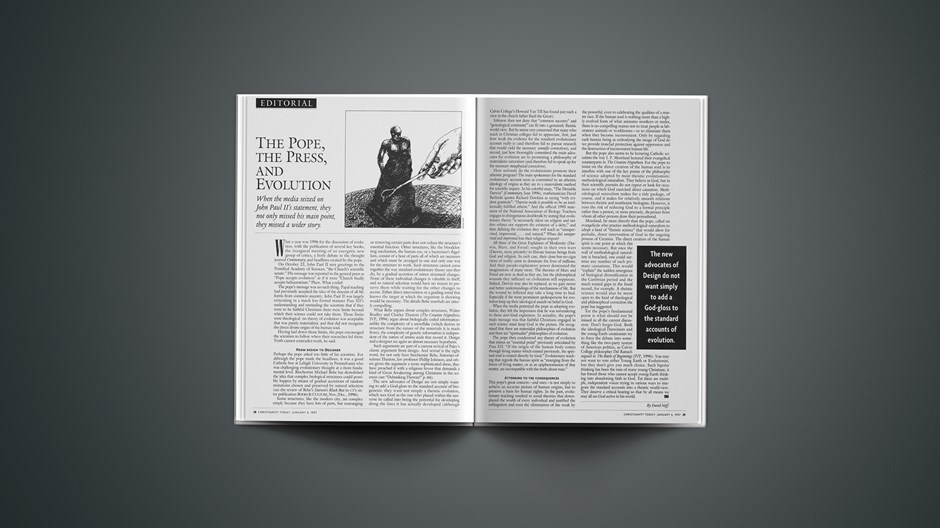
What a year was 1996 for the discussion of evolution, with the publication of several key books, the inaugural meeting of an energetic new group of critics, a lively debate in the thought journal Commentary, and headlines created by the pope.
On October 22, John Paul II sent greetings to the Pontifical Academy of Sciences, "the Church's scientific senate." His message was reported in the general press as "Pope accepts evolution" as if it were "Church finally accepts heliocentrism." Phew. What a relief.
The pope's message was no such thing. Papal teaching had previously accepted the idea of the descent of all life forms from common ancestry. John Paul II was largely reiterating in a much less formal manner Pius XII's understanding and reminding the scientists that if they were to be faithful Christians there were limits beyond which their science could not take them. Those limits were theological: no theory of evolution was acceptable that was purely materialistic and that did not recognize the direct divine origin of the human soul.
Having laid down those limits, the pope encouraged the scientists to follow where their researches led them. Truth cannot contradict truth, he said.
From design to Designer Perhaps the pope asked too little of his scientists. For although the pope made the headlines, it was a good Catholic boy at Lehigh University in Pennsylvania who was challenging evolutionary thought at a more fundamental level. Biochemist Michael Behe has demolished the idea that complex biological structures could possibly happen by means of gradual accretions of random mutations chosen and preserved by natural selection (see the review of Behe's Darwin's Black Box in CT's sister publication Books & Culture, Nov./Dec., 1996).
Some structures, like the modern city, are complex simply because they have lots of parts, but rearranging or removing certain parts does not reduce the structure's essential function. Other structures, like the bloodclotting mechanism, the human eye, or a bacterium's flagellum, consist of a host of parts all of which are necessary and which must be arranged in one and only one way for the structure to work. Such structures cannot come together the way standard evolutionary theory says they do, by a gradual accretion of minor structural changes. None of these individual changes is valuable in itself, and so natural selection would have no reason to preserve them while waiting for the other changes to accrue. Either direct intervention or a guiding mind that knows the target at which the organism is shooting would be necessary. The details Behe marshals are utterly compelling.
What Behe argues about complex structures, Walter Bradley and Charles Thaxton (The Creation Hypothesis, IVP, 1994) argue about biologically coded information: unlike the complexity of a snowflake (which derives its structure from the nature of the materials it is made from), the complexity of genetic information is independent of the nature of amino acids that record it. Design and a designer are again an almost necessary hypothesis.
Such arguments are part of a current revival of Paley's classic argument from design. And revival is the right word, for not only have biochemist Behe, historian-of-science Thaxton, law professor Phillip Johnson, and others given the argument a more sophisticated dress, they have preached it with a religious fervor that demands a kind of Great Awakening among Christians in the sciences (see "Debunking Darwin?" p. 64).
The new advocates of Design are not simply wanting to add a God-gloss to the standard account of biogenesis: they want not simply a theistic evolution, which sees God as the one who placed within the universe he called into being the potential for developing along the lines it has actually developed (although Calvin College's Howard Van Till has found just such a view in the church father Basil the Great).
Johnson does not deny that "common ancestry" and "genealogical continuity" can fit into a genuinely theistic world-view. But he seems very concerned that many who teach in Christian colleges fail to appreciate, first, just how weak the evidence for the standard evolutionary account really is (and therefore fail to pursue research that would yield the necessary scientific correctives), and second, just how thoroughly committed the main advocates for evolution are to promoting a philosophy of materialistic naturalism (and therefore fail to speak up for the necessary metaphysical correctives).
How seriously do the evolutionists promote their atheistic program? The main spokesmen for the standard evolutionary account seem as committed to an atheistic ideology of origins as they are to a materialistic method for scientific inquiry. In his colorful essay, "The Deniable Darwin" (Commentary, June 1996), mathematician David Berlinski quotes Richard Dawkins as saying "with evident gratitude": "Darwin made it possible to be an intellectually fulfilled atheist." And the official 1995 statement of the National Association of Biology Teachers engages in disingenuous doubletalk by stating that evolutionary theory "is necessarily silent on religion and neither refutes nor supports the existence of a deity," and then defining the evolution they will teach as "unsupervised, impersonal, … and natural." When did unsupervised and impersonal lose their religious import?
Article continues below
All three of the Great Explainers of Modernity (Darwin, Marx, and Freud) sought in their own ways (Darwin, more privately) to liberate human beings from God and religion. In each case, their close-but-no-cigar views of reality came to dominate the lives of millions. And their pseudo-explanatory power dominated the imaginations of many more. The theories of Marx and Freud are now as dead as they are, but the philosophical wounds they inflicted on civilization still suppurate. Indeed, Darwin may also be replaced, as we gain newer and better understandings of the mechanisms of life. But the wound he inflicted may take a long time to heal. Especially if the most prominent spokespersons for evolution keep up their ideological assault on belief in God.
When the media portrayed the pope as adopting evolution, they left the impression that he was surrendering to these anti-God explainers. In actuality, the pope's main message was that faithful Christians engaged in such science must keep God in the picture. He recognized that there are materialist philosophies of evolution and there are "spiritualist" philosophies of evolution.
The pope then condemned any theory of evolution that misses an "essential point" previously articulated by Pius XII: "If the origin of the human body comes through living matter which existed previously, the spiritual soul is created directly by God." Evolutionary teaching that regards the human spirit as "emerging from the forces of living matter, or as an epiphenomenon of that matter, are incompatible with the truth about man."
Attending to the consequences This pope's great concern—and ours—is not simply to achieve an accurate picture of human origins, but to preserve a basis for human rights. In the past, evolutionary teaching resulted in social theories that downplayed the worth of every individual and justified the subjugation and even the elimination of the weak by the powerful, even to celebrating the qualities of a master race. If the human soul is nothing more than a highly evolved form of what animates monkeys or mules, there is no compelling reason not to treat people as laboratory animals or workhorses—or to eliminate them when they become inconvenient. Only by regarding each human being as embodying the image of God do we provide ironclad protection against oppression and the destruction of inconvenient human life.
Article continues below
But the pope also seems to be lecturing Catholic scientists the way J. P. Moreland lectured their evangelical counterparts in The Creation Hypothesis. For the pope to insist on the direct creation of the human soul is to interfere with one of the key points of the philosophy of science adopted by most theistic evolutionists: methodological naturalism. They believe in God, but in their scientific pursuits do not expect or look for occasions on which God exercised direct causation. Methodological naturalism makes for a tidy package, of course, and it makes for relatively smooth relations between theistic and nontheistic biologists. However, it runs the risk of reducing God to a formal principle rather than a person, or more precisely, the person from whom all other persons draw their personhood.
Moreland, far more directly than the pope, called on evangelicals who practice methodological naturalism to adopt a kind of "theistic science" that would allow for periodic, direct intervention of God in the ongoing process of Creation. The direct creation of the human spirit is one point at which this seems necessary. But once the wall of methodological naturalism is breached, one could surmise any number of such primary causations. This would "explain" the sudden emergence of biological diversification in the Cambrian period and the much touted gaps in the fossil record, for example. A theistic science would also be more open to the kind of theological and philosophical correction the pope has suggested.
Yet the pope's fundamental point is what should not be missed in all the current discussion: Don't forget God. Both the ideological Darwinists and the young-Earth creationists try to force the debate into something like the two-party system of American politics, as Calvin College philosopher Del Ratzsch argued in The Battle of Beginnings (IVP, 1996): You may not want to vote either Young Earth or Evolutionist, but they don't give you much choice. Such bipolar thinking has been the ruin of many young Christians; it has forced those who cannot accept young-Earth thinking into abandoning faith in God. Yet there are multiple, independent voices trying in various ways to integrate the standard accounts into a theistic world-view. They deserve a critical hearing so that by all means we may all see God active in his world.

















 While we pray for peace, we need moral clarity about this war.
 A Christian reconciliation group in Israel and Palestine warned that war would come. Now the war threatens their relevance.العربيةFrançais
 But experts say it can offer opportunities for leaders and congregations to grow.






