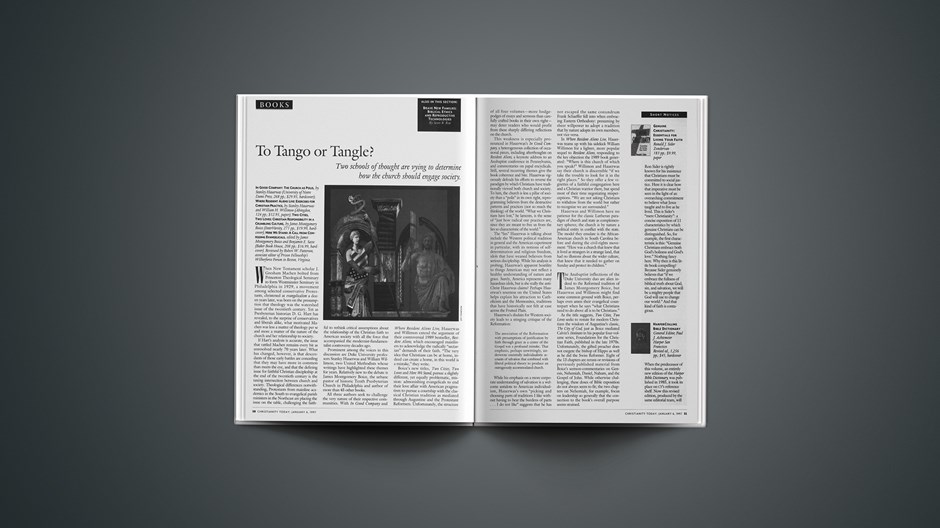
In Good Company: The Church as Polis,by Stanley Hauerwas (Universityof Notre Dame Press, 268 pp.; $29.95, hardcover);
Where Resident Aliens Live: Exercises for Christian Practice, byStanley Hauerwas and William H. Willimon (Abingdon, 124 pp.; $12.95,paper);
Two Cities, Two Loves: Christian Responsibility in a Crumbling Culture,by James Montgomery Boice (InterVarsity, 271 pp., $19.99,hardcover);
Here We Stand: A Call from Confessing Evangelicals,edited by JamesMontgomery Boice and Benjamin E. Sasse (Baker Book House, 208 pp.; $16.99,hardcover). Reviewed by Robert W. Patterson, associate editor of PrisonFellowship's Wilberforce Forum in Reston, Virginia.
When New Testament scholar J. Gresham Machen bolted from Princeton TheologicalSeminary to form Westminster Seminary in Philadelphia in 1929, a movementamong selected conservative Protestants, christened as evangelicalisma dozen years later, was born on the presumption that theology was the watershedissue of the twentieth century. Yet as Presbyterian historian D. G. Harthas revealed, to the surprise of conservatives and liberals alike, what motivatedMachen was less a matter of theology per se and more a matter of the natureof the church and her relationship to society.
If Hart's analysis is accurate, the issue that rattled Machen remains everybit as unresolved nearly 70 years later. What has changed, however, is thatdescendants of those early battles are conceding that they may have morein common than meets the eye, and that the defining issue for faithful Christiandiscipleship at the end of the twentieth century is the taxing intersectionbetween church and society. Theological differences notwithstanding, Protestantsfrom mainline academics in the South to evangelical parish ministers in theNortheast are placing the issue on the table, challenging the faithful torethink critical assumptions about the relationship of the Christian faithto American society with all the force that accompanied themodernist-fundamentalist controversy decades ago.
Prominent among the voices in this discussion are Duke University professorsStanley Hauerwas and William Willimon, two United Methodists whose writingshave highlighted these themes for years. Relatively new to the debate isJames Montgomery Boice, the urbane pastor of historic Tenth PresbyterianChurch in Philadelphia and author of more than 45 other books.
All three authors seek to challenge the very nature of their respectivecommunities. With In Good Company and Where Resident Aliens Live,Hauerwas and Willimon extend the argument of their controversial 1989bestseller, Resident Aliens, which encouraged mainliners to acknowledgethe radically "sectarian" demands of their faith. "The very idea that Christianscan be at home, indeed can create a home, in this world is a mistake," theywrite.
Boice's new titles, Two Cities, Two Loves and Here We Stand,pursue a slightly different, yet equally problematic, mission: admonishingevangelicals to end their love affair with American pragmatism to pursuea courtship with the classical Christian tradition as mediated through Augustineand the Protestant Reformers. Unfortunately, the structure of all fourvolumes—more hodgepodges of essays and sermons than carefully crafted booksin their own right—may deter readers who would profit from these sharplydiffering reflections on the church.
This weakness is especially pronounced in Hauerwas's In Good Company,a heterogeneous collection of occasional pieces, including afterthoughtson Resident Aliens, a keynote address to an Anabaptist conferencein Pennsylvania, and commentaries on papal encyclicals. Still, several recurringthemes give the book coherence and bite. Hauerwas vigorously defends hisefforts to reverse the paradigm by which Christians have traditionally viewedboth church and society. To him, the church is less a pillar of society thana "polis" in its own right, reprogramming believers from the destructivepatterns and practices (not so much the thinking) of the world. "What weChristians have lost," he laments, is the sense of "just how radical ourpractices are, since they are meant to free us from the lies so characteristicof the world."
The "lies" Hauerwas is talking about include the Western political traditionin general and the American experiment in particular, with its notions ofself-determination and religious freedom, idols that have weaned believersfrom serious discipleship. While his analysis is probing, Hauerwas's apparenthostility to things American may not reflect a healthy understanding of natureand grace. Surely, America represents many hazardous idols, but is she reallythe anti-Christ Hauerwas claims? Perhaps Hauerwas's sourness on the UnitedStates helps explain his attraction to Catholicism and the Mennonites, traditionsthat have historically not felt at ease across the Fruited Plain.
Hauerwas's disdain for Western society leads to a stinging critique of theReformation:
The association of the Reformation with presumptions of justification by faith through grace as a center of the Gospel was a profound mistake. That emphasis, perhaps unwittingly, underwrote essentially individualistic accounts of salvation that combined with liberal political theory to produce an outrageously accommodated church.
Article continues below
While his emphasis on a more corporate understanding of salvation is a welcomeantidote to American individualism, Hauerwas's own "picking and choosingparts of traditions I like without having to bear the burdens of parts … I do not like" suggests that he has not escaped the same conundrum FrankSchaeffer fell into when embracing Eastern Orthodoxy: presuming by sheerwillpower to adopt a tradition that by nature adopts its own members, notvice versa.
In Where Resident Aliens Live, Hauerwas teams up with his sidekickWilliam Willimon for a lighter, more popular sequel to Resident Aliens,responding to the key objection the 1989 book generated: "Where is this churchof which you speak?" Willimon and Hauerwas say their church is discernible"if we take the trouble to look for it in the right places." So they offera few vignettes of a faithful congregation here and a Christian warrior there,but spend most of their time negotiating misperceptions. "We are not askingChristians to withdraw from the world but rather to recognize we are surrounded."
Hauerwas and Willimon have no patience for the classic Lutheran paradigmof church and state as complementary spheres; the church is by nature a politicalentity in conflict with the state. The model they emulate is the African-Americanchurch in South Carolina before and during the civil-rights movement: "Herewas a church that knew that it lived as strangers in a strange land, thathad no illusions about the wider culture, that knew that it needed to gatheron Sunday and protect its children."
The Anabaptist inflections of the Duke University duo are alien indeed tothe Reformed tradition of James Montgomery Boice, but Hauerwas and Willimonmight find some common ground with Boice, perhaps even amen their evangelicalcounterpart when he says "what Christians need to do above all is to beChristians."
As the title suggests, Two Cities, Two Loves seeks to restate formodern Christians the wisdom of Augustine's classic, The City of God,just as Boice mediated Calvin's Institutes in his popular four-volumeseries, Foundations for the Christian Faith, published in the late 1970s. Unfortunately, the gifted preacher does not exegete the bishop of Hippo aswell as he did the Swiss Reformer. Eight of the 13 chapters are reruns orrevisions of previously published material from Boice's sermon-commentarieson Genesis, Nehemiah, Daniel, Nahum, and the Gospel of John. While otherwisechallenging, these doses of Bible exposition do not always seem to fit; thetwo chapters on Nehemiah, for example, focus on leadership so generally thatthe connection to the book's overall purpose seems strained.
Article continues below
The opening chapter—providing background to Augustine and paralleling today'scultural crisis to the barbarians that sacked Rome in a.d. 400—is Boiceat his best. In the three chapters in the middle of the book, where he appliesmore directly the insights of Augustine to the current situation, Boice isless effective. He reviews the church/society constructs of Richard Niebuhrbut misses the opportunity to provide an evangelical or Reformed responseto Hauerwas and Willimon. Boice ends up with a weak "Christ and the Two Cities"paradigm that leaves many questions unresolved, maintaining that "Christiansare citizens of two kingdoms, the kingdom of this world and the kingdom ofour Lord Jesus Christ, and they have responsibilities in each."
Inspired by his protege, Michael Scott Horton, the Presbyterianparson urges Christians to "participate in secular life rather than merelyshoot from the sidelines at secular people," while lamenting that
evangelicals have little to offer in the cultural battles, first because they have not participated in culture enough for their views about it to be taken seriously and, second, because they do not know the Bible or their own theology well enough to be able to give a distinctly Christian contribution if they did.
Beyond this, however, Boice does not elaborate. He pitches some fresh ideasto politically engaged evangelicals (urging them to fight discriminationagainst homosexuals and the harassment of abortionists) and offers a compellingchapter on civil disobedience, pointing out how the picketing of abortionclinics has actually hurt the pro-life cause. But he fails to outline acomprehensive strategy for evangelical cultural engagement.
If Boice stumbles in Two Cities, Two Loves, the edited collectionof papers presented at the caucus of the Alliance of Confessing Evangelicalsoutside Boston last year does exactly what the title, Here We Stand,claims. The eight essays (including contributions by David Wells, ErvinDuggan, Albert Mohler, Gene Edward Veith, Michael Horton, Sinclair Ferguson,and W. Robert Godfrey, with a preface and concluding essay by Boice) provideextended commentary on the controversial Cambridge Declaration (see ct, June17, 1996, pp. 14-15); the full text of the declaration is included.
Article continues below
But whether Here We Stand will trigger the reformation that Boiceseeks is another matter. The book may not even help evangelicals substantiallydeal with the cultural problems the thoughtful essays explore, because theyavoid the pivotal issue that Hauerwas and Willimon live and breathe—thechurch. For all the criticism Here We Stand vents, Boice and companynever consider the possibility that the Achilles heel of evangelicalism isits very nature as a movement and not a church—defined by the pragmaticmeans of grace of mailing lists, personal networks, and self-appointed committeesas opposed to a rightly ordered ecclesiastical communion made visible bythe Reformation "marks" of the Word, sacrament, and discipline.
Perhaps this is too much to ask of evangelicals. They will not and shouldnot swallow Hauerwas and Willimon hook, line, and sinker, but evangelicalsought to consider fully the contention that Christians cannot effectivelyengage the realities of the modern world without, or apart from, a real church.The Reformers would surely agree with that, and if Boice would play thatcard, he might gain a wider hearing and possibly trigger a reformation worthyof the name.
Short Notices
Genuine Christianity: Essentials for Living Your Faith Ronald J. Sider
Zondervan
183 pp.; $9.99, paper
Ron Sider is rightly known for his insistence that Christians must be committedto social justice. Here it is clear how that imperative must be seen in thelight of an overarching commitment to believe what Jesus taught and to liveas he lived. This is Sider's "mere Christianity": a concise exposition of11 characteristics by which genuine Christians can be distinguished. So,for example, the first characteristic is this: "Genuine Christians embraceboth God's holiness and God's love." Nothing fancy here. Why then is thislittle book compelling? Because Sider genuinely believes that "if we embracethe fullness of biblical truth about God, sin, and salvation, we will bea mighty people that God will use to change our world." And that kind offaith is contagious.
HarperCollins Bible Dictionary General Editor, Paul J. Achtemeier
Harper San Francisco
Revised ed., 1,256 pp.; $45, hardcover
When the predecessor of this volume, an entirely new edition of the HarperBible Dictionary, was published in 1985, it took its place on ct's referenceshelf. Now this revised edition, produced by the same editorial team, willsupplant it. According to the publisher, more than 25 percent of the entriesare "new or totally revised." Here is a useful source for information onbiblical persons, customs, and places; for concise treatment of subjectssuch as "church" and "faith" in their biblical context; and for accountsof various scholarly approaches to Scripture, which may or may not be compatiblewith orthodox Christianity. (The claim that "Each entry presents thenonsectarian, consensus view of those most knowledgeable in the area" should be taken with skepticism.) The text is supplemented by maps and a generousselection of illustrations.















 While we pray for peace, we need moral clarity about this war.
 We’ve got little information on Jesus’ appearance and personality. But that’s the way God designed it.españolFrançais
 C.S. Lewis recommended discernment over diatribes in exactly the moments we’re most eager to indulge in critique.






