Our mutual challenge
Despite its title and subtitle, Daniel B. Clendenin's piece on "Why I'm Not Orthodox" [Jan. 6] was fair-minded and dialogical. Much of its content showed that "the ancient and alien world of the Eastern church" is no more so than the world of Scripture itself at whose center is the One, living and holy God, Father, Son, and Holy Spirit, working out the mystery of our salvation.
As the dialogue between evangelicals and Orthodox continues to grow, the chief issues raised by Clendenin concerning the church, sacraments (not an Orthodox word), Scripture, tradition, authority, and hermeneutics deserve thorough discussion by speaking the truth in love and in mutual respect. My hunch is that, theologically, such dialogue will be mutually beneficial-enriching for the evangelicals and cleansing for the Orthodox, discerning what is truly orthodox and abiding. What binds us is the commitment to the authority of Scripture, which is both indisputable and massive in the Orthodox tradition. Scripture and tradition cannot be placed at the same level as alternatives, because Scripture is the record of revelation while tradition is the ecclesial hermeneutical context, a category which is equally important for evangelicals who, in the words of Clendenin, have their own "key distinctives of the Protestant evangelical tradition."
Our mutual challenge is, then, to engage the above issues not only in terms of the "distinctives" which differentiate us, but above all in terms of the full and total witness of the canonical Scriptures themselves, which can hardly be divorced from the historical growth of the one, holy, catholic, and apostolic church that canonized the Bible. Such study, accomplished with prayer and the work of the Spirit, may startle many of us both to see and to celebrate that some of our respective "key distinctives" may not be as far apart as we now perceive, while others may need mutual correction precisely on deeply biblical grounds.
Theodore Stylianopoulos
Professor of New Testament, Holy Cross
Greek Orthodox School of Theology
Brookline, Mass.
Dan Clendenin does a wonderfully thorough job of explaining several aspects of Orthodox Christian theology and history—which is why I find it hard to believe that he is not yet Orthodox! While Clendenin is factual in his description of Orthodoxy, because he insists on critiquing Orthodoxy through a Protestant world-view, his analysis falls understandably short. You can't judge a faith that has existed since the first century through sixteenth-century eyes.
Reformation theology, not the Bible, is Clendenin's yardstick. Several times he bases his position on what Luther, Calvin, and "the Reformers" said, which doesn't work, because this movement left Rome, not the Eastern church. But even then, is there some reason we should take the word of sixteenth-century Western Europeans over that of the early Eastern fathers—or the apostles themselves?
Clendenin never really answers the question of why he's not Orthodox. It all comes down to personal choice: being "committed to key distinctives of the Protestant evangelical tradition." It comes off like saying, I prefer vanilla ice cream over chocolate!
Fr. Peter E. Gillquist
Antiochian Orthodox Christian
Archdiocese of North America
Santa Barbara, Calif.
Clendenin states that one of the main reasons he did not become Orthodox is his belief in the Protestant doctrine of sola scriptura, not in the Orthodox church's belief that holy tradition, which goes back along with apostolic succession through the ecumenical councils and the early church fathers to the apostles and Jesus Christ himself, is the interpreter of Scripture and on an equal level with it. As a Greek Orthodox Christian, I see that sola scriptura is certainly not a reality in Protestantism, where each believer is free to interpret Scripture according to his individual bias and denominational tradition. This placing of the individual above Scripture has resulted in the thousands of denominations that make up Protestantism. If, as Protestants believe, every believer is inspired by the Holy Spirit to interpret Scripture, then all such interpretations must be equally valid, even though some may be diametrically opposed to each other.
Nicholas Theodore Thalassinos
Oak Park, Ill.
* Clendenin's article is largely a balanced, fair, and irenic treatment of Eastern Christianity, but a number of his observations would have benefited from a more nuanced approach. First, in his description of the Orthodox view of the sacraments and the Eucharist, he tends to conflate Orthodox approaches with traditional Roman Catholic positions—a forgivable error, since many Orthodox have done the same. However, such a process tends to overlook the deeply evangelical (that is, gospel-centered) themes of Orthodox sacra-mental theology. His near-total omission of Orthodox emphasis on personal spirituality and growth in the divine life (a personal relationship with Christ is hardly a foreign concept in Orthodoxy) gives the impression that the Orthodox view of salvation is a mere mechanical sacramentalism. Reading modern Russian saints such as Seraphim of Sarov, John of Kronstadt, and Silouan of Mt. Athos would clear up such a misunderstanding.
Article continues below
Clendenin should not focus on idiosyncratic statements of individual Orthodox as though such were representative of the church's teaching. While icons are, indeed, "theology in color," or, "the Word of God in color," it is absurd for an Orthodox to state that "icons teach us all we know," as if there was no need for scriptural preaching, doctrinal instruction, moral exhortation, and spiritual direction. All of these are essential to Orthodox life. We do not simply receive the sacraments and gaze at icons.
We Orthodox are greatly appreciative of evangelicals like Clendenin, Oden, and Bloesch, who seek to return to traditional patristic understandings of the faith. What we cannot understand is why they do not desire to enter into the communion of the very church of the fathers themselves!
Paul D. O'Callaghan, Dean
St. George Orthodox Christian Cathedral
Wichita, Kans.
There never was anything similar to the Protestant Reformation in Orthodoxy. Whereas there are different ethnic enclaves in American Orthodoxy, they are all in communion with each other. This cannot be said of many Baptist or Presbyterian groups. I used to be a Lutheran-Missouri Synod. That group and the Evangelical Lutheran Church of America have a very strained relationship. How can Clendenin seemingly relish such fragmentation?
David Snyder
Beaumont, Texas
In the discussion of Orthodoxy's view of the sacraments, Clendenin points out "the nearly complete absence of any mention of the doctrine of justification by faith" and the failure to do justice to the Pauline and Augustinian teaching on original sin.
The sad fact is that Eastern Orthodoxy had nothing comparable to the Protestant Reformation. When one of its seventeenth-century patriarchs, Cyril Lucaris (Patriarch of Alexandria), espoused Protestant doctrine, calling himself a "Calvinist Patriarch," he was deposed by the Holy Synod and eventually executed by Turkish soldiers.
In 1672 the Orthodox Confession of Dositheus rejected justification by faith alone and various other Protestant doctrines.
William S. Barker
Professor of Church History,
Westminster Theological Seminary
Philadelphia, Pa.
Patients who want to pray
If physicians understood their patients' feelings about prayer, they would recognize its essential role in medical practice ["Doctors Who Pray," Jan. 6]. In my series of patients with cancer (to be presented at the Oncology meeting this year), 830 consecutive patients over a five-year period were offered prayer at the time of chemotherapy.
Article continues below
Ninety-six professed faith in God and/or had a religious affiliation. The prayer consisted of a verbal, nondenominational petition asking for God's healing and comfort for the patient and the family. Of the 830 patients, 790 (95%) responded affirmatively to an invitation for a prayer to be said for them.
The prayer was well received. Many remarked that they appreciated an interest in their spiritual and personal life. No patient appeared offended at the prayer or the offer to pray for them. Patients often asked for prayers at subsequent times of crisis, including several of those originally declining prayer. A number have asked for a prayer at each visit.
Physicians should be aware of the spirituality of the patients and their willingness to be prayed for.
Delvyn C. Case, Jr., M.D.
Cumberland Foreside, Maine
* In a time when much of our culture (including Christians) is turning to New Age therapies, Gary Thomas demonstrates that the church already holds the most important "alternative therapy." Of course, nurses have been praying with patients all along, but perhaps that wasn't news. In the process, we have seen patients comforted, healed, or supported in death. More important, we have seen relationships established or restored between patients, family members, and God. Nursing also has a fairly solid body of research literature on spiritual care, beginning with a Nurses Christian Fellowship study in 1970. However, we have taken another approach.
The current physician-directed prayer research seems to view God as a celestial vending machine, with prayer as the coin to insert to get the goods. For the Christian, though, the point is not whether prayer "works" (i.e., we get what we want), but whether it draws us into closer relationship with God. Prayer is the means of communication with our heavenly Father.
J. I. Packer begins to answer that question, but he does not go far enough ["When Prayer Doesn't Work"]. Communication/prayer is much more than asking for goodies, be they video games or healing. There are many reasons why those requests aren't granted. God knows what we need, and sometimes we ask for things that would not be good for us. We don't see the whole picture; God does. His plan is much better than our deepest desires. James 4:3 tells us, "You ask and do not receive, because you ask wrongly, in order to spend what you get on your pleasures." All we know is that God wants us to come to him with our petitions, just as we want our children to keep coming to us and sharing what is on their hearts. That communication keeps the relationship alive, provides teaching moments, and enables the parent to demonstrate love for the children. But they won't get the coveted new toy every time.
Article continues below
Judy Shelly, Senior Editor
Journal of Christian Nursing Frederick, Pa.
In this time in American social history, when voices are urging doctors to become killers through the legalization of euthanasia, it is uplifting to find Christian physicians returning to an emphasis on prayer in their role as healers. May prayer be our response to the challenges of life—rather than the death option promoted by the culture.
Carrie Gordon
Colorado Springs, Colo.
Who is a "public figure"?
Thomas F. Taylor's article ["Will Your Church Be Sued?" Jan. 6], contains a serious misstatement of law in the second hypothetical example, which concerns defamation. Taylor states that "when a plaintiff like Jan sues a 'public figure' like the defendant youth pastor, Kevin, for defamation, she must prove that the defendant publicized false statements that injured the plaintiff's reputation, and that he did so with 'malice.' " Taylor has it exactly backwards. According to the United States Supreme Court in New York Times Co. v. Sullivan (1964), the requirement for proof of malice arises when the "public figure," the plaintiff, must allege and prove that the defendant acted maliciously. Further, it is extremely difficult to imagine that either Jan (the plaintiff) or Kevin (one of the defendants) could be construed to be a "public figure" under the facts set out in Taylor's article. While the question of whether a person is a "public figure" may be a question of fact to be determined at trial, decisions by courts that have addressed this issue in the past make it quite clear that a "public figure" is one who has injected himself into the public eye in some intentional fashion or has been elected or appointed to a public office or other position of high visibility. It would be extremely unlikely that a court would determine that an employee of a local church congregation, even an associate pastor or youth director, would be determined to be a "public figure" as that term is used in the law of defamation.
Article continues below
Based upon the hypothetical facts set out in Taylor's article, it seems quite clear that Kevin defamed Jan by numerous publications of his claim of a sexual relationship between Jan and David. Only if Kevin can prove the truth in his accusations does he have a defense to a claim of defamation.
Stephen W. Reed
Reed and Brown, A Law Corporation
Pasadena, Calif.
Mr. Taylor replies:
Mr. Reed is correct that whether the plaintiff is a "public figure" is the relevant inquiry. However, I seriously disagree with his conclusion that it is "extremely unlikely" that court will find pastors to be "public figures." Most important, readers should not lose sight of the central point that we both agree on—my example is one of defamation. Ministers must be on guard about the things they say, whether in public or in private.
Thomas F. Taylor, J. D.
Salt Lake City, Utah.
The question of intelligent design
With regard to Scott Swanson's News article "Debunking Darwin" and David Neff's editorial "The Pope, the Press, and Evolution" [Jan. 6], I would like to reemphasize something that seems to be in danger of being forgotten in the ongoing debate concerning "theistic science" and "intelligent design."
Those of us who teach at Christian institutions and who continue to oppose these movements are not opposed to the basic premise behind both concepts, namely that God is the ultimate cause of creation. We oppose the movements because, for various reasons, we think they are misguided. I encourage you to delve more into the historical aspects as well as the theological implications.
The current theistic science debate dates at least to the turn of the century when Abraham Kuyper and Benjamin Warfield were the major public participants. During that generation, the nontheistic science argument overwhelmingly prevailed among scientists themselves. Evangelical scholars, however, have never reached a consensus. Maybe we could all learn something from a careful exploration of why the vast majority of scientists rejected a theistic science. I can assure you it is not because we have rejected God as Creator.
With respect to theological implications, intelligent design is based on the notion that God creates at times by direct acts, so no naturalistic explanations could ever be found for some components of creation. Does this mean that God is not responsible for those phenomena, like the formation of mountain ranges, newborn babies, and the rainbow after a storm, that have broadly accepted scientific/naturalistic explanations? Moreover, what happens to God as an explanation when science does find a naturalistic mechanism for an "intelligently designed" phenomenon? Finally, how does such a vision of God compare with historic evangelical theological views? Maybe our theologians, who seem to have been strangely silent in the whole debate, might provide some interesting comments.
Article continues below
At the least, those historians and theologians who are critical of the movements would take some of the heat off those of us scientists who continue to be unconvinced. And in any case, we would all get a welcome change from the usual fare of attorneys and philosophers telling scientists we don't really understand that which we practice. Who knows, maybe they will do better at straightening out the historians and theologians!
Raymond E. Grizzle
Associate Prof., Environmental Science
Taylor University
Upland, Ind.
Jerry Falwell's legacy * In "Jerry Falwell's Uncertain Legacy" [Dec. 9, 1996], ct's readers have been told that Falwell's "crowning achievement" is Liberty University. This legacy consists of 64 buildings, including one known as "the furnace," a "staggering debt," numbers of disenchanted former faculty members, bottom-tier academic rankings, and a dozen tubas. I kept wondering when John Kennedy would balance his report with a few positive comments. As a former lu professor of education and someone who was always treated fairly and with respect by Dr. Falwell, I would like to highlight two areas Kennedy missed.
It is true that LU has open admissions and does give a second chance to students other schools would never admit. Under Barbara Sherman, the Learning Assistance Center provides reading, study skills, and tutoring assistance. It has become one of the best in the nation and has put hundreds of shaky students on the road to college graduation—even graduate degrees.
The School of Education's teacher-education program under Karen Parker each year prepared more than a hundred state-certified elementary and secondary teachers. Both public and private education compete for these graduates.
My husband and I travel extensively as cross-cultural consultants and have met Liberty alumni around the world who are leaders, especially in education and missions. Kennedy needs to talk with some of the many people who know about "Jerry Falwell's Certain Legacy" and write a sequel.
Lila Dean Bruckner
Antioch, Tenn.
After reading your article, I have doubts about two things. First, about continuing my subscription, and, second, how much Christianity is actually in Christianity Today.
Article continues below
I have known Jerry Falwell for over 25 years. I was in the service at Thomas Road the morning they announced the start of Liberty University. My four children are graduates of Liberty. I work with many godly and gifted Liberty graduates in mission spots around the world. I have recommended Liberty University to many parents who have later thanked me for the impact Liberty had on their children. Jerry Falwell is a man of God, a man of integrity, a man of honesty, a caring, compassionate, Christlike man. I think that every concerned American and, certainly, every concerned Christian owes Jerry Falwell a debt of gratitude.
Jimmy Ervin
President, PRO Missions
Cordova, Tenn.
* When I read your December issue, I wondered if you intentionally or coincidentally ran the Jerry Falwell story in the same issue as the article on Henri Nouwen ["The Holy Inefficiency of Henri Nouwen," by Philip Yancey]. The contrast between the Protestant preacher and the Catholic priest was startling, and it caused me to think about the responsibility we take on when we call ourselves Christian. If it means that we are claiming to be Christlike, which of these two religious men would we rather set up as an example to the world? As I focus my attention on the birth of Christ, I find my answer by asking another question: "Which of the two exemplifies the Incarnation and the attitudes it portrays-humility, selflessness, and vulnerability?" And this, of course, brings me to another, more personal question: "Which of these am I more like?"
Julie Ackerman Link
Grand Rapids, Mich.
May I say simply that I am very much disappointed in your article on Jerry Falwell. When my life's work is finished, I trust that I will have influenced at least a fraction of the many thousands that he has reached for good in his widespread ministry.
John F. Walvoord, Chancellor
Dallas Theological Seminary
Dallas, Texas
-Brief letters are welcome. They may be edited for space and clarity and must include the writer's name and address. Send to Eutychus, CHRISTIANITY TODAY, 465 Gundersen Drive, Carol Stream, IL 60188; fax: 630/ 260-0114. E-mail: cteditor@christianitytoday.com. Letters preceded by " * " were received online.















 While we pray for peace, we need moral clarity about this war.
 As my doubts about his teachings grew, so did a secret fascination with Jesus.
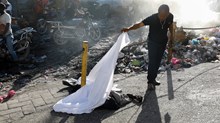 As Haiti is uprooted by violence, church leaders treat gunshot wounds, give up homes for strangers, and rescue dignitaries.






