Standing inside the rustic grotto known as the Garden Tomb during my first trip to Israel was as close as I came to apprehending that Jesus really did everything the Gospels said he had done. Not that I doubted the Scriptures; I believe them with all my heart. But something about feeling the dampness of the cave walls, smelling the musty air, visualizing the strain with which Joseph and Nicodemus would have heaved Jesus' lifeless body through a narrow entrance, and fathoming the darkness that would have swallowed it up once the daylight was sealed out of it startled me with the brutality of the Incarnation and the grisly cost of our salvation.
Prior to this moment my musings had focused on catching a phantasmal glimpse of Jesus walking the dusty hillsides of Nazareth or hearing his distant echo on the Mount of Beatitudes. His ghost was remotely perceivable as we crossed the Sea of Galilee when the mist on the lake brought me within an angel's breath of seeing him out there walking on the water.
But the physicality of the tomb brought me down to earth. Jesus' corpse seemed to lie beside me inside that cave, even though our guide persistently reminded us, "We can't say for sure that this was where his body was laid." But standing there puts you in the situation as it would have occurred, he said.
The irony of my climactic moment in the Garden Tomb lies in the fact that the site was not part of our tour's itinerary. Our escort and guide from the Israel Government Tourist Office, Tsion Ben-David, insisted on bringing us to the Garden Tomb because "evangelicals like going there."
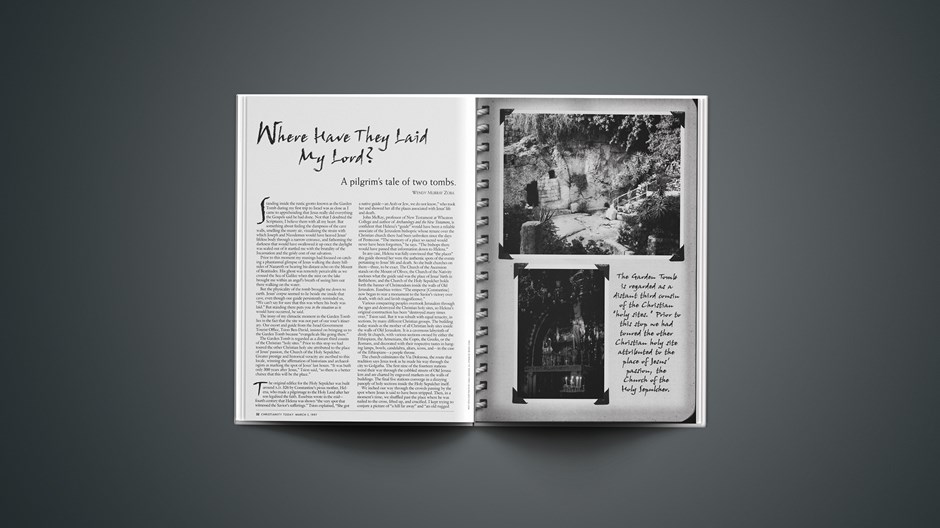
The Garden Tomb is regarded as a distant third cousin of the Christian "holy sites." Prior to this stop we had toured the other Christian holy site attributed to the place of Jesus' passion, the Church of the Holy Sepulcher. Greater prestige and historical veracity are ascribed to this locale, winning the affirmation of historians and archaeologists as marking the spot of Jesus' last hours. "It was built only 300 years after Jesus," Tsion said, "so there is a better chance that this will be the place."
T he original edifice for the Holy Sepulcher was built around a.d. 326 by Constantine's pious mother, Helena, who made a pilgrimage to the Holy Land after her son legalized the faith. Eusebius wrote in the mid-fourth century that Helena was shown "the very spot that witnessed the Savior's sufferings." Tsion explained, "She got a native guide—an Arab or Jew, we do not know," who took her and showed her all the places associated with Jesus' life and death.
John McRay, professor of New Testament at Wheaton College and author of Archaeology and the New Testament, is confident that Helena's "guide" would have been a reliable associate of the Jerusalem bishopric whose tenure over the Christian church there had been unbroken since the days of Pentecost. "The memory of a place so sacred would never have been forgotten," he says. "The bishops there would have passed that information down to Helena."
In any case, Helena was fully convinced that "the places" this guide showed her were the authentic spots of the events pertaining to Jesus' life and death. So she built churches on them—three, to be exact. The Church of the Ascension stands on the Mount of Olives; the Church of the Nativity encloses what the guide said was the place of Jesus' birth in Bethlehem; and the Church of the Holy Sepulcher holds forth the banner of Christendom inside the walls of Old Jerusalem. Eusebius writes: "The emperor [Constantine] now began to rear a monument to the Savior's victory over death, with rich and lavish magnificence."
Various conquering peoples overtook Jerusalem through the ages and destroyed the Christian holy sites, so Helena's original construction has been "destroyed many times over," Tsion said. But it was rebuilt with equal tenacity, in sections, by many different Christian groups. The building today stands as the mother of all Christian holy sites inside the walls of Old Jerusalem. It is a cavernous labyrinth of dimly lit chapels, with various sections owned by either the Ethiopians, the Armenians, the Copts, the Greeks, or the Romans, and decorated with their respective tastes in hanging lamps, bowls, candelabra, altars, icons, and—in the case of the Ethiopians—a purple throne.
The church culminates the Via Dolorosa, the route that tradition says Jesus took as he made his way through the city to Golgatha. The first nine of the fourteen stations wend their way through the cobbled streets of Old Jerusalem and are charted by engraved markers on the walls of buildings. The final five stations converge in a dizzying panoply of holy sections inside the Holy Sepulcher itself.
We inched our way through the crowds passing by the spot where Jesus is said to have been stripped. Then, in a moment's time, we shuffled past the place where he was nailed to the cross, lifted up, and crucified. I kept trying to conjure a picture of "a hill far away" and "an old rugged cross," but the image eluded me. The slab on which his body was laid for purification and burial dressing was another few steps away. I saw a woman clutching her hankie and pressing it to her forehead, weeping, as she knelt before the rock to kiss it. Then the flow of the crowd carried us apace to the place said to be that of his burial and resurrection, though I didn't know what I was looking at.
Article continues below
All of these sacred sites exist within footsteps of one another, and few of them can actually be seen. The "Rock of Golgatha," where tradition says he was crucified, is hidden under a structure—maybe an altar—and could only be glanced at fleetingly (as the shuffling permitted) through a small, dull window.
If this was where the events of Jesus' passion were played out, I found it nearly impossible to grasp it for all the crowds, candles, altars, statues, and thrones—not to mention the overarching roof encasing what had originally been an outside event.
It was after this visit that Tsion suggested we get on the bus and make a quick jaunt to the Garden Tomb.
We arrived at closing time, but the amiable English gentleman who greeted us agreed to show us around anyway. He said outright that he was not trying to convince anyone that this was the actual place of Jesus' death and burial. But, he said, it serves as a "remarkable visual aid" for envisioning the final events of Jesus' life as they might have occurred.
There was no Byzantine architecture at the Garden Tomb—I heard birds singing.
The English guide led us to a lookout point and directed our gaze toward a rugged cliff overlooking a bus station, some 200 yards before us. He explained how, from a distance, the erosion of the dolomite (limestone) created the effect of features looking like a human skull. "If you look carefully you can see what could be the eye sockets," he said.
In 1883 the British general Charles Gordon championed the notion that Jesus could not have been buried in the Holy Sepulcher because it exists inside the walls of Jerusalem, which violated Jewish laws for burial. Driven by the conviction that Helena built her church in the wrong place, he undertook a quest for the real Golgatha, using the Bible (Ps. 48, to be precise) as his guide. He found this hill just outside the walls of the city, near the Damascus gate, noticing its uncanny resemblance to a human skull.
And, it should be noted, this skull-hill does possess many of the elements attendant to an execution spot. Our guide told us that when the Romans carried out crucifixions it was intended to be a public spectacle, so the execution site would often be a place readily accessible to the general public, such as this spot would have been. As mentioned, it is just outside the city walls, near one of the city's main gates. Two roads converged in this place during the first century (which would explain, to some degree, the presence of the bus station today). By point of fact, the guide continued, evidence indicates that the skull-hill was, indeed, the site of public executions. "Many Jewish criminals were executed here," he said, though he was not suggesting that this is proof that Jesus was.
Article continues below
Shortly after Gordon found the skull-hill—"by a remarkable coincidence," our British guide said—a team of archaeologists found an ancient tomb hewn into the side of another hill a short distance from the skull-hill. Gordon, with equal vigor, then countenanced this as the tomb of Jesus, which made perfect sense to me given the nearby crucifixion hill that really did look like a skull.
We turned and walked, following our guide as he led us away from the lookout point. Suddenly, we found ourselves, almost in Narnia fashion, stepping into a lush, green woodland dripping with vines, padded with underbrush, and shaded by trees with leaves the size of baseball mitts.
We were in a garden—not a stone's throw away from the dusty, dry soil of the skull-hill. "You are standing above a cistern," our guide said, and he pointed to a small opening in the ground that revealed a cavernous holding tank the size of a small swimming pool. "It is known that this cistern existed in the first century and would have been the source of water for a garden to thrive in this otherwise rocky soil," he said.
He then led us into a welcoming open courtyard where pink geraniums hung from pots on ledges, and where a doorway had been cut into the face of a cliff. A feeling of expectation overtook me as I stood at a distance looking at the entrance to the tomb. I wondered if this was how Mary felt when she approached it and saw that the stone had been rolled away from the entrance: A great mystery—terrible or wonderful—awaited her behind that open door.
"We can't know for sure," our British guide reminded us, "but you will see that this tomb carries remarkable resemblances to the one Jesus may have been laid in." He told us to take note of the doorway itself: "It is larger than usual, which hints of pilgrimages made here through the years, wearing away the normal, smaller entrance," he said. He then turned our attention to the small channel that stretched across the base of the entrance, parallel to the face of the cliff. This channel guided the rock that would be rolled across the entrance of the tomb to seal it, he told us.
Article continues below
Then he took us inside the tomb. "The presence of the weeping chamber, where you are standing, suggests that this tomb belonged to a wealthy individual. Of course, we know Joseph was a wealthy man," the British guide said.
He proceeded to point out how the tomb was divided into two main sections. The "weeping chamber" took up the space of about ten square feet on the left as you entered the tomb. The "burial chamber" composed the other main section; it was on the right. Two grave "benches" had been chiseled out of that section and were parallel to each other, perpendicular to the entrance. The "bench" farthest from the entrance extended the length of an adult human body, with the end gently curved like the nose of a toboggan, (for the feet, I thought). The "bench" nearest the entrance, to the immediate right, had not been completed—the toboggan part remained unhewn. The rough edges of uncut rock protruded so that an adult body wouldn't have fit there.
It was while I was looking at these benches that I was overcome by the picture of the Son of God drenched in his own blood. And I was dumbfounded by the picture of those two old Jewish men taking him and cleaning him up to give him a decent burial.
I read the gospel narratives of Jesus' passion with new eyes that night. Little facts that I had passed over hundreds of times captured my imagination. The phrase in Matthew (and Mark), for example, explaining that "those who passed by hurled insults at him" (27:39) suggested to me that people were coming and going in the place where he was crucified—that it was a busy thoroughfare (like where two roads would come together). The description in John's gospel that "where he was crucified there was a garden " (19:41) confirmed in my mind that the cistern provided the needed water supply for a garden to flourish there. The fact that it was "a new tomb in which no one had even been laid" (v. 41) made perfect sense to me since I saw with my own eyes that one of the two burial benches had not been finished. ("Joseph made the tomb available for Jesus in an emergency situation; he didn't have time to see it finished," our British guide said.) Peter, John, and Mary "bent over" (John 20:5, 11) to get inside the tomb, which fit the picture perfectly: How else could they have entered that once small, narrow entrance? But the "young man dressed in a white robe sitting on the right side " (Mark 16:5) nailed it, in my mind. Every point of these narratives seemed to describe the Garden Tomb to the last detail.
Article continues below
But Professor McRay regretfully assures me that the Garden Tomb is not the place. It is a "fantasy," he says, based upon "the emotional reaction" of General Gordon. "We would all like it to be so, because it is so appealing," he says. But archaeologists have determined that it is one of a network of tombs that belong to the second Iron Age—closer to the time of David and Solomon. Several others just like it can be found up and over the very same cliff. The pottery found in those tombs is dated to the time of Solomon. The layout of the Garden Tomb, he says, conforms to the "tomb typology" of the second Iron Age. A typical tomb of this period, he writes in his book, "is a two-chambered tomb, the rooms arranged side by side with the burial chamber on the right of the entrance." Tombs built later, in the first century, he notes, tended to have additional, smaller rooms in the back.
I was compelled to ask: What about the garden? The cistern? What about the fact that it was unfinished? The skull-hill? Or the fact that the Church of the Holy Sepulcher is inside the walls?
McRay allows that the cistern may well have existed in the first century and that the "skull-hill" could have been the site for public executions. But, finished or unfinished, this tomb is still "an Iron-Age tomb," and the tomb Jesus was laid in was "new." "Surely, there could not have been a 'new' tomb in Jesus' day that was over a thousand years old," he demurs. As for the location of the Holy Sepulcher inside the walls, he notes in his book that within 15 years of Jesus' death, Herod Agrippa I had "built a new wall on the north side of the city, placing the tomb within the city walls." (Though he admits that absolute certainty about the location of Golgatha and the tomb is "beyond our reach.")
So I was left to ponder the fact that the "real" spot disoriented me while the "unreal" one transported me, which goes to show that—as Jerome once said—Britain is as near heaven as Jerusalem.
Hearing the birds in the trees, following the path to the tomb, seeing the entrance channel, touching the rock, standing in the weeping chamber, smelling the stifling air, and studying the almost-finished burial benches—all of these conspired to create a vision for me. And I saw the damaged body of someone I loved being cleaned, and wrapped, and carried up these hills by two old men, laid to rest, and swallowed up into darkness before the sun went down. It made me wish that I could thank Joseph for his trouble in tending to the indelicate details of burying his dead, secret friend.
Article continues below
But for all Joseph's efforts, the bigger story is—as our British guide put it—"if Jesus was here, he wasn't here for very long." And with that, our guide thanked us for coming and then left us.
I understood why, when she was taken to the "very spot that witnessed the Savior's sufferings," Helena felt the compunction to build something there. Standing inside that tomb put me in touch with the part of my nature that cried out for an incarnational connection to the One I worship and read about in my Bible. Seeing something made the fact of his life and his death more accessible, more real. But I also recognized as I faced the empty grave bed that the real validation for what I believe exists not in what is left behind for us to speculate about-but in what is not left behind.
Tsion was waiting; it was time for us to go, too. I threw a final look at the bench, the finished one, where the angels probably were not sitting when they asked, "Why do you seek the living among the dead?" I bent over and stepped out through the narrow door into the sunlight. He's not here. That's all we need to know.
















 While we pray for peace, we need moral clarity about this war.
 As my doubts about his teachings grew, so did a secret fascination with Jesus.
 When I married into a Jewish family, antisemitism hit home. Now, the holy day reminds me of our future hope.






