A Little Child Shall Lead Them,by Johann Christoph Arnold
(Plough/Intervarsity, 193 pp.; $9.99, paper);
Raising Them Right: A Saint's Advice on Raising Children,by Theophan
the Recluse (Conciliar Press, rev. ed., 71 pp.; $5.95, paper). Reviewed by
Gregory Mathewes-Green, a priest of the Antiochian Orthodox Christian Archdiocese
and pastor of Holy Cross Mission, Baltimore.
It is difficult not to envy the Bruderhof community. We rarely meet Christians
with such dedication to their common life that they won't serve the Lord's
Supper if any two members are not in spiritual harmony. Folks like that are
just plain admirable, and in some ways a judgment on all the rest of us.
And the wonderfully sturdy children's toys that come out of the Bruderhof
shop are the envy of every parent who has attempted to cobble together wooden
playthings for the kids. Then there is the Bruderhof's simple Christian
lifestyle, a concept the rest of us have been talking about for at least
a quarter of a century; while we have been yakking, they have been doing
it.
So why is this book by a certified Bruderhof leader so disappointing? A
Little Child Shall Lead Them: Thoughts on Children and Education, by
Johann Christoph Arnold, elder, counselor, father, and grandfather, is a
personal reflection that, while serving up some very moving stories and
thoughtful insights, nevertheless remains fundamentally flawed. Early in
the book Arnold builds on Bonhoeffer's "Wedding Sermon from a Prison Cell"
and briefly states the case for a Christ-centered, two-parent family in which
prayer is the sustaining force for living the biblical family life. It is
within this kind of family that strong and Christian children will grow up,
and where the husband and father will demonstrate the firm love of God. Good
stuff as far as it goes.
But why not draw the parallel to God the Father, "from Whom the whole family
in heaven and earth is named"? Christian dads know how to be real fathers
because of the Father revealed in the stories of the Bible. In both the Old
and New Testaments he is seen to be strong, reliable, trustworthy, and loving.
He, like many of the pagan gods, "begets" children, though spiritually rather
than materially. But unlike many of the gods in the pagan stories, the biblical
God sticks around to love, lead, and discipline his children. Thus, he teaches
all of us earthly fathers something fundamentally important about duty and
responsibility as well. In short, more emphasis on the meaning of the Fatherhood
of the First Person of the Trinity for family relations, and commentary on
its implications, would add a distinctly scriptural view to the dad's role.
Stories form the most effective part of this book. In two sections titled
"When Children Suffer" and "The Special Child," Arnold presents in simple,
straightforward language the troubling, yet deeply meaningful, lives of some
very unfortunate children. Told mostly by the parents, these stories argue
strongly against that adjective unfortunate, because even in their
pain, these children are so clearly bearers of God's strange grace to those
who, even in their own pain, love them.
It seems unfair to criticize a book that conveys such beautiful and hauntingly
true pictures of what life is like for some among us. But the overwhelming
image of childhood presented here is straight from the sketchbook of Rousseau.
Though mixed with brief and seemingly obligatory talk of sin and the need
for discipline, the overall impression is that children probably won't need
it, because they are so good. Original sin is acknowledged, but not presented
as the powerful force that it is.
This romanticizing of children and childhood obscures the true nature of
youth (with its distortions of God's image as well as its own distinctive
beauty) and distorts the nature of the parent-child relationship. Arnold
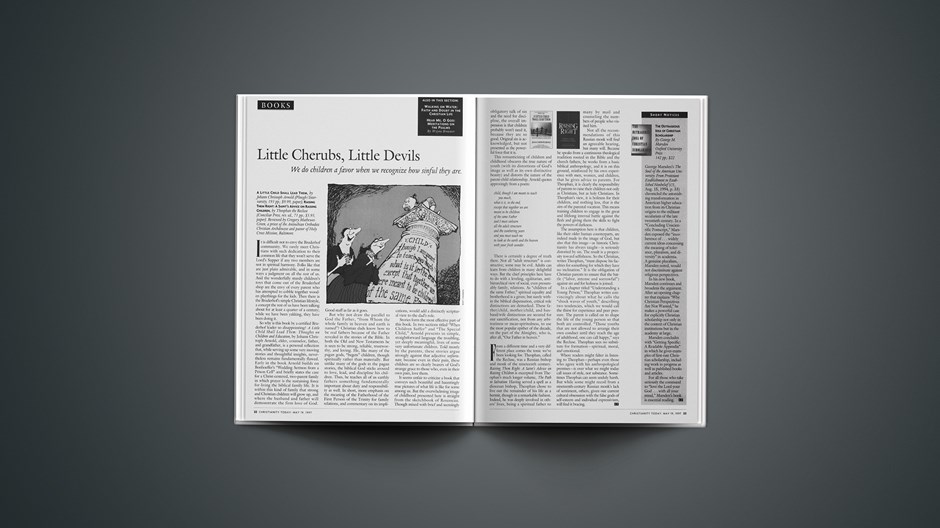
quotes approvingly from a poem:
child, though I am meant to teach you much,
what is it, in the end,
except that together we are
meant to be children
of the same Father
and I must unlearn
all the adult structure
and the cumbering years
and you must teach me
to look at the earth and the heaven
with your fresh wonder.
There is certainly a degree of truth there. Not all "adult structure" is
constructive; some may be evil. Adults can learn from children in many delightful
ways. But the chief principles here have to do with a leveling, egalitarian,
anti-hierarchical view of social, even presumably family, relations. As "children
of the same Father," spiritual equality and brotherhood is a given; but surely
within the biblical dispensation, critical role distinctions are demarked.
These father/child, mother/child, and husband/wife distinctions are secured
for our sanctification, not from any arbitrariness or mean-spiritedness,
to use the most popular epithet of the decade, on the part of the Almighty,
who is, after all, "Our Father in heaven."
From a different time and a very different place comes the tonic we've been
looking for. Theophan, called the Recluse, was a Russian bishop and monk
of the nineteenth century. Raising Them Right: A Saint's Advice on Raising
Children is excerpted from Theophan's much longer volume, The Path
to Salvation. Having served a spell as a diocesan bishop, Theophan chose
to live out the remainder of his life as a hermit, though in a remarkable
fashion. Indeed, he was deeply involved in others' lives, being a spiritual
father to many by mail and counseling the numbers of people who visited him.
Article continues below
Not all the recommendations of this Russian monk will find an agreeable hearing,
but many will. Because he speaks from a continuous theological tradition
rooted in the Bible and the church fathers, he works from a basic biblical
anthropology, and it is on this ground, reinforced by his own experience
with men, women, and children, that he gives advice to parents. For Theophan,
it is clearly the responsibility of parents to raise their children not only
as Christians, but as holy Christians. In Theophan's view, it is holiness
for their children, and nothing less, that is the aim of the parental vocation.
This means training children to engage in the great and lifelong internal
battle against the flesh and giving them the skills to fight the powers of
darkness.
The assumption here is that children, like their older human counterparts,
are indeed made in the image of God, but also that this image—as historic
Christianity has always taught—is seriously distorted by sin. The result
is a propensity toward selfishness. So the Christian, writes Theophan, "must
dispose his faculties for something for which they have no inclination."
It is the obligation of Christian parents to ensure that the battle ("labor,
intense and sorrowful") against sin and for holiness is joined.
In a chapter titled "Understanding a Young Person," Theophan writes convincingly
about what he calls the "shock waves of youth," describing two tendencies,
which we would call the thirst for experience and peer pressure. The parent
is called on to shape the life of the young person so that both are controlled.
"Those youths that are not allowed to arrange their own conduct until they
reach the age of adulthood, one can call happy," says the Recluse. Theophan
sees no substitute for formation—spiritual, moral, and emotional.
Where readers might falter in listening to Theophan—perhaps even those who
agree with his anthropological premises—is over what we might today call
issues of style, not substance. Sometimes Theophan can seem unduly harsh.
But while some might recoil from a nineteenth-century Russian monk's lack
of sentiment, others, given our current cultural obsesssion with the false
gods of self-esteem and individual expressivism, will find it bracing.
Article continues below
Short Notices The Outrageous Idea of Christian Scholarship By George M. Marsden
Oxford University Press
142 pp.; $22
George Marsden's The Soul of the American University: From Protestant
Establishment to Established Nonbelief (CT, Aug. 15, 1994,
p. 33) chronicled the astonishing transformation in American higher education
from its Christian origins to the militant secularism of the late twentieth
century. In a "Concluding Unscientific Postscript," Marsden exposed the
"incoherence of … widely current ideas concerning the meaning of tolerance,
pluralism, and diversity" in academia. A genuine pluralism, Marsden noted,
would not discriminate against religious perspectives.
In his new book, Marsden continues and broadens the argument. After an opening
chapter that explains "Why Christian Perspectives Are Not Wanted," he makes
a powerful case for explicitly Christian scholarship not only in the context
of Christian institutions but in the academy at large.
Marsden concludes with "Getting Specific: A Readable Appendix" in which he
gives examples of first-rate Christian scholarship, including work in progress
as well as published books and articles.
For all those who take seriously the command to "love the Lord your God … with all your mind," Marsden's book is essential reading.















 While we pray for peace, we need moral clarity about this war.
 As my doubts about his teachings grew, so did a secret fascination with Jesus.
 After lobbying from fellow Southern Baptists and Christians affected by the war, the House speaker moves a package forward.






