Last Spring, the Center for the Study of Popular Culture invited 49-year-old screenwriter/director Ronald Maxwell to participate on a panel of filmmakers at Paramount Studios. The subject was Hollywood and historicity in film. The usual pontifications regarding art and entertainment permeated the discussion—"compression," "inescapable subjectivism," "pre-eminent aesthetic considerations"—until it came to Maxwell.
"[People say] it's only a movie, not brain surgery. I disagree. What we do is soul surgery, and it reaches millions. We have important stories to tell—wonderful, mythic, true stories. The first job of the filmmaker making a historical film is to tell the truth. … I must try, as hard as I can, to discover the truth and tell it."
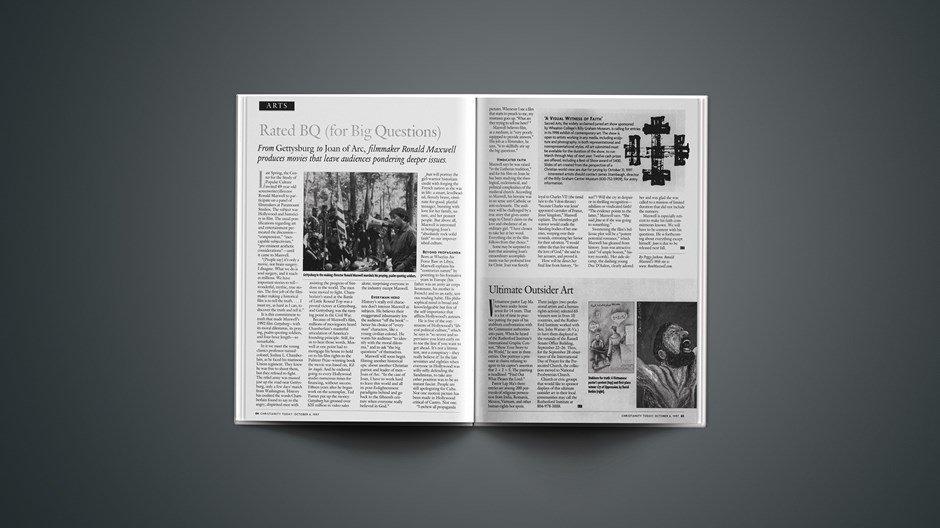
It is this commitment to truth that made Maxwell's 1992 film Gettysburg—with its moral dilemmas, its praying, psalm-quoting soldiers, and four-hour length—so remarkable.
In it we meet the young classics professor-turned-colonel, Joshua L. Chamberlain, as he faced his mutinous Union regiment. They knew he was free to shoot them, but they refused to fight. The rebel army was massed just up the road near Gettysburg, only a few days' march from Washington. History has credited the words Chamberlain found to say to the angry, dispirited men with assisting the progress of freedom in the world. The men were moved to fight. Chamberlain's stand at the Battle of Little Round Top was a pivotal victory at Gettysburg, and Gettysburg was the turning point in the Civil War.
Because of Maxwell's film, millions of moviegoers heard Chamberlain's masterful articulation of America's founding principle. Still, for us to hear those words, Maxwell at one point had to mortgage his house to hold on to his film rights to the Pulitzer Prize-winning book the movie was based on, Killer Angels. And he endured going to every Hollywood studio numerous times for financing, without success. Fifteen years after he began work on the screenplay, Ted Turner put up the money. Gettysburg has grossed over $25 million in video sales alone, surprising everyone in the industry except Maxwell.
EVERYMAN HERO
History's really evil characters don't interest Maxwell as subjects. He believes their exaggerated inhumanity lets the audience "off the hook"—hence his choice of "everyman" characters, like a young civilian colonel. He wants his audience "to identify with the moral dilemma," and to ask "the big questions" of themselves.
Maxwell will soon begin filming another historical epic about another Christian patriot and leader of men—Joan of Arc. "In the case of Joan, I have to work hard to leave this world and all its post-Enlightenment paradigms behind and go back to the fifteenth century when everyone really believed in God."
Joan will portray the girl-warrior historians credit with forging the French nation as she was in life: a smart, levelheaded, fiercely brave, obstinate-for-good, playful teenager, bursting with love for her family, nature, and her peasant people. But above all, Maxwell is interested in bringing Joan's "absolutely rock-solid faith" to our impoverished culture.
BEYOND PROPAGANDA
Born at Wheelus Air Force Base in Libya, Maxwell explains his "contrarian nature" by pointing to his formative years in Europe (his father was an army air corps lieutenant, his mother is French) and to an early, serious reading habit. His philosophical mind is broad and knowledgeable but free of the self-importance that afflicts Hollywood's auteurs.
He is free of the constraints of Hollywood's "liberal political culture," which he says is "so severe and so pervasive you learn early on to toe the line if you want to get ahead. It's not a litmus test, not a conspiracy—they really believe it! In the late seventies and eighties when everyone in Hollywood was willy-nilly defending the Sandinistas, to take any other position was to be an instant fascist. People are still apologizing for Cuba. Not one motion picture has been made in Hollywood critical of Castro. Not one.
"I eschew all propaganda pictures. Whenever I see a film that starts to preach to me, my resistance goes up. 'What are they trying to sell me here?' "
Maxwell believes film, as a medium, is "very poorly equipped to provide answers." His job as a filmmaker, he says, "is to skillfully stir up the big questions."
VINDICATED FAITH
Maxwell says he was raised "in the Lutheran tradition," and for his film on Joan he has been studying the theological, ecclesiastical, and political complexities of the medieval church. According to Maxwell, his heroine was in no sense anti-Catholic or anti-ecclesiastic. The audience will be challenged by a true story that gives center stage to Christ's claim on the love and obedience of an ordinary girl. "I have chosen to take her at her word. Everything else in the film follows from that choice."
Some may be surprised to learn that animating Joan's extraordinary accomplishments was her profound love for Christ. Joan was fiercely loyal to Charles VII (the timid heir to the Valois throne) "because Charles was Jesus' appointed caretaker of France, Jesus' kingdom," Maxwell explains. The relentless girl-warrior would cradle the bleeding bodies of her enemies, weeping over their wounds, entreating her Savior for their salvation. "I would rather die than live without the love of God," she said to her accusers, and proved it.
Article continues below
How will he direct her final line from history, "Jesus!"? Will she cry in despair or in thrilling recognition—nihilism or vindicated faith? "The evidence points to the latter," Maxwell says. "She said Jesus as if she was going to something."
Sweetening the film's bellicose plot will be a "potent potential romance," which Maxwell has gleaned from history. Joan was attractive (and "of ample bosom," history records). Her aide-de-camp, the dashing young Duc D'Aulon, clearly adored her and was glad she was called to a mission of limited duration that did not include the nunnery.
Maxwell is especially reticent to make his faith commitments known. We will have to be content with his questions. He is forthcoming about everything except himself. Joan is due to be released next fall.
Ultimate Outsider Art Vietnamese pastor Lap Ma has been under house arrest for 14 years. That is a lot of time to practice putting the pain of his stubborn confrontation with the Communist authorities into paint. When he heard of the Rutherford Institute's International Graphic Contest, "Show Your Story to the World," he sent in three entries. One portrays a prisoner in chains refusing to agree to his captor's assertion that 2 + 2 = 5. The painting is headlined: "Find Out What Pleases the Lord."
Pastor Lap Ma's three entries are among 200 portrayals of religious persecution from India, Romania, Mexico, Vietnam, and other human-rights hot spots. Three judges (two professional artists and a human-rights activist) selected 65 winners sent in from 10 countries, and the Rutherford Institute worked with Sen. John Warner (R-Va.) to have them displayed in the rotunda of the Russell Senate Office Building, September 22-26. Then, for the September 28 observance of the International Day of Prayer for the Persecuted Church, the collection moved to National Presbyterian Church.
Church or civic groups that would like to sponsor displays of this ultimate outsider art in their local communities may call the Rutherford Institute at 804-978-3888.
Article continues below
'A Visual Witness of Faith'
Sacred Arts, the widely acclaimed juried art show sponsored by Wheaton College's Billy Graham Museum, is calling for entries in its 1998 exhibit of contemporary art. The show is open to artists working in any media, including sculpture and photography, in both representational and nonrepresentational styles. All art submitted must be available for the duration of the show, to run March through May of next year. Twelve cash prizes are offered, including a Best of Show award of $400. Slides of art created from the perspective of a Christian world-view are due for jurying by October 31, 1997.
Interested artists should contact James Stambaugh, director of the Billy Graham Center Museum (630-752-5909), for entry information.















 While we pray for peace, we need moral clarity about this war.
 As my doubts about his teachings grew, so did a secret fascination with Jesus.
 Beyoncé’s right. Whether listening to Cowboy Carter or reading theology, diversity is a good thing.






