A broad coalition of religious and civil liberties experts are hailing a directive issued by President Clinton on August 14 protecting religious rights in the federal workplace. But legal representatives of some faith-based organizations fear the guidelines will create more confusion than they resolve.
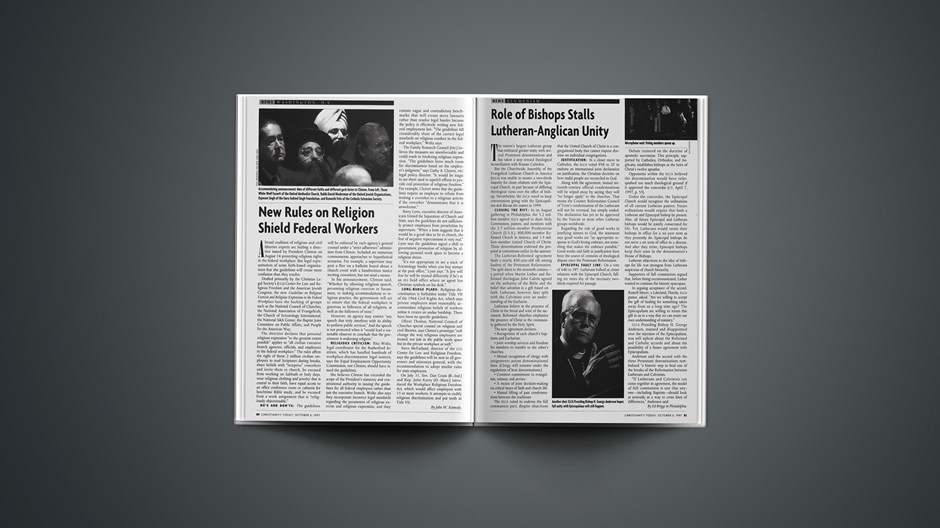
Drafted primarily by the Christian Legal Society's (CLS) Center for Law and Religious Freedom and the American Jewish Congress, the new Guidelines on Religious Exercise and Religious Expression in the Federal Workplace have the backing of groups such as the National Council of Churches, the National Association of Evangelicals, the Church of Scientology International, the National Sikh Center, the Baptist Joint Committee on Public Affairs, and People for the American Way.
The directive declares that personal religious expression "to the greatest extent possible" applies to "all civilian executive branch agencies, officials, and employees in the federal workplace." The rules affirm the right of those 2 million civilian employees to read Scriptures during breaks, share beliefs with "receptive" coworkers and invite them to church, be excused from working on Sabbath or holy days, wear religious clothing and jewelry that is central to their faith, have equal access to an office conference room or cafeteria for lunchtime Bible study, and be excused from a work assignment that is "religiously objectionable."
DO'S AND DON'TS: The guidelines will be enforced by each agency's general counsel under a "strict adherence" admonition from Clinton. Included are numerous commonsense approaches to hypothetical scenarios. For example, a supervisor may post a flier on a bulletin board about a church event with a handwritten notice inviting coworkers, but not send a memo.
In his announcement, Clinton said, "Whether by allowing religious speech, preventing religious coercion or harassment, or making accommodations to religious practice, the government will act to ensure that the federal workplace is generous to followers of all religions, as well as the followers of none."
However, an agency may restrict "any speech that truly interferes with its ability to perform public services." And the speech is not protected when it "would lead a reasonable observer to conclude that the government is endorsing religion."
RELIGIOUS CRITICISM: Rita Woltz, legal coordinator for the Rutherford Institute, which has handled hundreds of workplace-discrimination legal matters, says the Equal Employment Opportunity Commission, not Clinton, should have issued the guidelines.
She believes Clinton has exceeded the scope of the President's statutory and constitutional authority in issuing the guidelines for all federal employees rather than just the executive branch. Woltz also says they incorporate incorrect legal standards regarding the parameters of religious exercise and religious expression, and they contain vague and contradictory benchmarks that will create more lawsuits rather than resolve legal hassles because the policy is effectively writing new federal employment law. "The guidelines fall considerably short of the correct legal standards on religious conduct in the federal workplace," Woltz says.
The Family Research Council (FRC) believes the measures are unenforceable and could result in hindering religious expression. "The guidelines leave much room for discrimination based on the employer's judgment," says Cathy A. Cleaver, FRC legal policy director. "It would be tragic to see them used to squelch efforts to provide real protection of religious freedom." For example, Cleaver notes that the guidelines require an employee to refrain from inviting a coworker to a religious activity if the coworker "demonstrates that it is unwelcome."
Barry Lynn, executive director of Americans United for Separation of Church and State, says the guidelines do not sufficiently protect employees from proselytism by supervisors. "When a boss suggests that it would be a good idea to be in church, the fear of negative repercussions is very real." Lynn says the guidelines signal a shift to government promotion of religion by allowing personal work space to become a religious shrine.
"It's not appropriate to see a stack of Scientology books when you buy stamps at the post office," Lynn says. "A Jew will fear he will be treated differently if he's at an irs field office where an agent has Christian symbols on his desk."
LONG-RANGE PLANS: Religious discrimination is forbidden under Title VII of the 1964 Civil Rights Act, which says private employers must reasonably accommodate religious beliefs of workers unless it creates an undue hardship. There have been no specific guidelines.
Oliver Thomas, National Council of Churches special counsel on religious and civil liberties, says Clinton's prototype "will change the way religious employees are treated, not just in the public work space but in the private workplace as well."
Steve McFarland, director of the CLS Center for Law and Religious Freedom, says the guidelines will be sent to all governors and attorneys general, with the recommendation to adopt similar rules for state employees.
On July 31, Sen. Dan Coats (R.-Ind.) and Rep. John Kerry (D.-Mass.) introduced the Workplace Religious Freedom Act, which would affect employers with 15 or more workers. It attempts to codify religious discrimination and put teeth in Title VII.















 While we pray for peace, we need moral clarity about this war.
 We’ve got little information on Jesus’ appearance and personality. But that’s the way God designed it.españolFrançais
 After lobbying from fellow Southern Baptists and Christians affected by the war, the House speaker moves a package forward.






