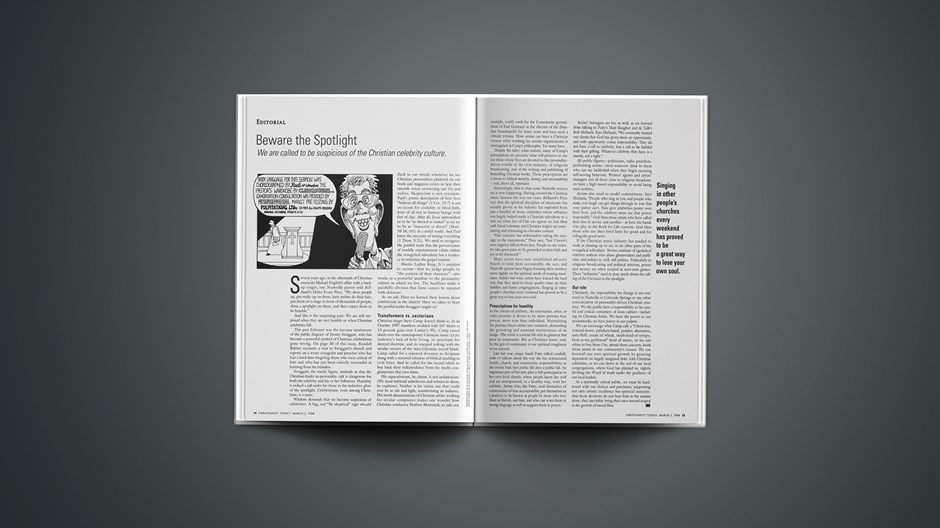
Several years ago, in the aftermath of Christian musician Michael English's affair with a backup singer, one Nashville pastor told Billboard's Debra Evans Price: "We dress people up, put make-up on them, have stylists do their hair, put them on a stage in front of thousands of people, shine a spotlight on them, and then expect them to be humble."
And this is the surprising part: We are still surprised when they are not humble or when Christian celebrities fall.
This past February was the ten-year anniversary of the public disgrace of Jimmy Swaggart, who has become a powerful symbol of Christian celebrityism gone wrong. On page 30 of this issue, Randall Balmer recounts a visit to Swaggart's church and reports on a weary evangelist and preacher who has had a hard time forgiving those who were critical of him and who has not been entirely successful at learning from his mistakes.
Swaggart, the media figure, reminds us that the Christian-leader-as-personality cult is dangerous for both the celebrity and his or her followers. Humility is indeed a tall order for those in the seductive glow of the spotlight. Celebrityism, even among Christians, is a snare.
Wisdom demands that we become suspicious of celebrities. A big, red "Be skeptical" sign should flash in our minds whenever we see Christian personalities plastered on our book and magazine covers or hear their smooth voices sweetening our tvs and radios. Skepticism is not cynicism; Paul's poetic description of how love "believes all things" (1 Cor. 13:7) is not an excuse for credulity or blind faith, least of all not in human beings with feet of clay. After all, Jesus admonished us to be "as shrewd as snakes" as we try to be as "innocent as doves" (Matt. 10:16, NIV) in a sinful world. And Paul knew the necessity of testing everything (1 Thess. 5:21). We need to recognize the painful truth that the pervasiveness of worldly entertainment values within the evangelical subculture has a tendency to minimize the gospel content.
Martin Luther King, Jr.'s antidote to racism—that we judge people by "the content of their character"—also works as a powerful antidote to the personality culture in which we live. The headlines make it painfully obvious that fame cannot be equated with character.
So we ask: Have we learned these lessons about celebrityism in the church? Have we taken to heart the painful truths Swaggart taught us?
TRANSFORMERS VS. SECTARIANS
Christian singer Steve Camp doesn't think so. In an October 1997 manifesto studded with 107 theses (a 13 percent gain over Luther's 95), Camp raised alarm over the contemporary Christian music (CCM) industry's lack of holy living, its penchant for skewed doctrine, and its unequal yoking with the secular owners of the once-Christian record labels. Camp called for a renewed devotion to Scripture along with a renewed infusion of biblical teaching in CCM lyrics. And he called for the record labels to buy back their independence from the media conglomerates that own them.
His separationism, he claims, is not isolationism. (We must befriend unbelievers and witness to them, he explains). Neither is his vision one that could ever be as salt and light, transforming an industry. His harsh denunciations of Christian artists working for secular companies makes one wonder how Christian conductor Herbert Blomstedt, to take one example, could work for the Communist government of East Germany as the director of the Dresden Staatskapelle for many years and have such a vibrant witness. How artists can have a Christian witness while working for secular organizations is unimagined in Camp's philosophy. Yet many have.
Despite his naive come-outism, many of Camp's prescriptions are precisely what will preserve or rescue those whose lives are devoted to the personality-driven worlds of the CCM industry, of religious broadcasting, and of the writing and publishing of bestselling Christian books. Those prescriptions are a return to biblical morality, literacy, and accountability—and, above all, repentance.
Interestingly, that is what some Nashville sources say is now happening. Having covered the Christian music business for over ten years, Billboard's Price says that the spiritual discipline of musicians has actually grown as the industry has exploded from just a handful of music celebrities whose influence was largely locked inside a Christian subculture to a new era when Jars of Clay can appear on Late Show with David Letterman, and Christian singers are entertaining and witnessing in a broader context.
"Our industry has ambassadors taking the message to the mainstream," Price says, "but I haven't seen negative fallout from that. People in our industry take great pains to be grounded in their faith and not to be distracted."
Many artists have now established advisory boards to hold them accountable, she says, and Nashville pastors have begun focusing their ministry more tightly on the spiritual needs of touring musicians. Sadder but wiser artists have learned the hard way that they need to focus quality time on their families and home congregations. Singing in other people's churches every weekend has proved to be a great way to lose your own soul.
Article continues below
PRESCRIPTIONS FOR HUMILITY
In the culture of celebrity, the entertainer, artist, or radio preacher is driven to be more persona than person, more icon than individual. Maintaining the persona forces artists into isolation, demanding the grooming and constant maintenance of an image. The result is a social life rich in glamour but poor in community. But as Christians know, only by the grit of community is our spiritual roughness worn smooth.
Late last year, singer Sandi Patty talked candidly with CT editors about the way she has restructured family, church, and community responsibilities as she moves back into public life after a public fall. An important part of her new plan is full participation in her own local church, where people know her well and are unimpressed, in a healthy way, with her celebrity. Artists who, like Patty, avail themselves of communities of true accountability put themselves in a position to be known as people by those who love them as friends, not fans, and who can warn them in strong language as well as support them in prayer.
Artists' managers are key as well, as we learned from talking to Patty's Matt Baugher and dc Talk's Rob Michaels. Says Michaels, "We constantly remind our clients that God has given them an opportunity, and with opportunity comes responsibility. They do not have a call to celebrity, but a call to be faithful with their gifting. Whatever celebrity they have is a mantle, not a right."
All public figures—politicians, radio preachers, performing artists—need someone close to them who can say balderdash when they begin excusing self-serving behavior. Writers' agents and artists' managers and all those close to religious broadcasters have a high moral responsibility to avoid being mere acolytes.
Artists also need to model commitment. Says Michaels, "People who sing to you and people who make you laugh can get things through to you that your pastor can't. Fans give celebrities power over their lives, and the celebrity must use that power responsibly." God bless those artists who have called their fans to service and sacrifice—as have the bands who play in the Rock for Life concerts. God bless those who use their brief fame for good and for telling the good news.
If the Christian music industry has needed to work at cleaning up its act, so do other parts of the evangelical subculture. Stories continue of egotistical celebrity authors who abuse ghostwriters and publicists, and politics is, well, still politics. Particularly in religious broadcasting and political activism, power and money are often treated as zero-sum games. These "industries" need to pray much about the calling of the Christian in the spotlight.
Article continues below
OUR ROLE
Ultimately, the responsibility for change is not centered in Nashville or Colorado Springs or any other concentration of personality-driven Christian ministry. We the public have a responsibility to be careful and critical consumers of mass culture—including its Christian forms. We have the power in our pocketbooks; we have power in our pulpits.
We can encourage what Camp calls a "Christ-less, watered-down, pabulum-based, positive alternative, aura-fluff, cream of wheat, mush-kind-of-syrupy, God-as-my-girlfriend" kind of music, or we can refuse to buy those CDs, attend those concerts, book those artists in our community's venues. We can forestall our own spiritual growth by growing dependent on largely imagined links with Christian celebrities, or we can thrive in the soil of our local congregations, where God has planted us, rightly dividing the Word of truth under the guidance of our local leaders.
As a spiritually critical public, we must be hardnosed with our choices and purchases, supporting not only artistic excellence but spiritual maturity. And those decisions do not bear fruit in the market alone; they inevitably bring their own reward reaped in the growth of moral fiber.















 While we pray for peace, we need moral clarity about this war.
 As my doubts about his teachings grew, so did a secret fascination with Jesus.
 The Grammy-winning artist was found dead at her home in Nashville at age 47.






