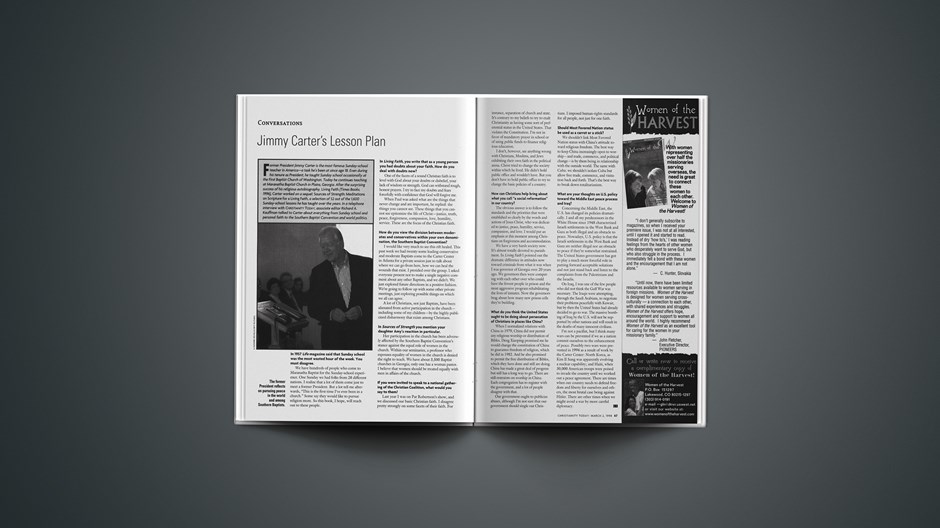
Former President Jimmy Carter is the most famous Sunday-school teacher in America—a task he's been at since age 18. Even during his tenure as President, he taught Sunday school occasionally at the First Baptist Church of Washington. Today he continues teaching at Maranatha Baptist Church in Plains, Georgia. After the surprising success of his religious autobiography, Living Faith (Times Books, 1996), Carter worked on a sequel: Sources of Strength: Meditations on Scripture for a Living Faith, a selection of 52 out of the 1,600 Sunday-school lessons he has taught over the years. In a telephone interview with CHRISTIANITY TODAY, associate editor Richard A. Kauffman talked to Carter about everything from Sunday school and personal faith to the Southern Baptist Convention and world politics.
In 1957 Life magazine said that Sunday school was the most wasted hour of the week. You must disagree.
We have hundreds of people who come to Maranatha Baptist for the Sunday-school experience. One Sunday we had folks from 28 different nations. I realize that a lot of them come just to meet a former President. But a lot tell me afterwards, "This is the first time I've ever been in a church." Some say they would like to pursue religion more. So this book, I hope, will reach out to these people.
In Living Faith, you write that as a young person you had doubts about your faith. How do you deal with doubts now?
One of the facets of a sound Christian faith is to level with God about your doubts or disbelief, your lack of wisdom or strength. God can withstand tough, honest prayers. I try to face my doubts and fears forcefully with confidence that God will forgive me.
When Paul was asked what are the things that never change and are important, he replied: the things you cannot see. These things that you can-not see epitomize the life of Christ—justice, truth, peace, forgiveness, compassion, love, humility, service. These are the focus of the Christian faith.
How do you view the division between moderates and conservatives within your own denomination, the Southern Baptist Convention?
I would like very much to see this rift healed. This past week we had twenty-some leading conservative and moderate Baptists come to the Carter Center in Atlanta for a private session just to talk about where we can go from here, how we can heal the wounds that exist. I presided over the group. I asked everyone present not to make a single negative comment about any other Baptists, and we didn't. We just explored future directions in a positive fashion. We're going to follow up with some other private meetings, just exploring possible things on which we all can agree.
A lot of Christians, not just Baptists, have been alienated from active participation in the church—including some of my children—by the highly publicized disharmony that exists among Christians.
In Sources of Strength you mention your daughter Amy's reaction in particular.
Her participation in the church has been adversely affected by the Southern Baptist Convention's stance against the equal role of women in the church. Within our seminaries, a professor who espouses equality of women in the church is denied the right to teach. We have about 3,500 Baptist churches in Georgia; only one has a woman pastor. I believe that women should be treated equally with men in affairs of the church.
If you were invited to speak to a national gathering of the Christian Coalition, what would you say to them?
Last year I was on Pat Robertson's show, and we discussed our basic Christian faith. I disagree pretty strongly on some facets of their faith. For instance, separation of church and state. It's contrary to my beliefs to try to exalt Christianity as having some sort of preferential status in the United States. That violates the Constitution. I'm not in favor of mandatory prayer in school or of using public funds to finance religious education.
I don't, however, see anything wrong with Christians, Muslims, and Jews exhibiting their own faith in the political arena. Christ tried to change the society within which he lived. He didn't hold public office and wouldn't have. But you don't have to hold public office to try to change the basic policies of a country.
How can Christians help bring about what you call "a social reformation" in our country?
The obvious answer is to follow the standards and the priorities that were established so clearly by the words and actions of Jesus Christ, who was dedicated to justice, peace, humility, service, compassion, and love. I would put an emphasis at this moment among Christians on forgiveness and accommodation.
We have a very harsh society now. It's almost totally devoted to punishment. In Living Faith I pointed out the dramatic difference in attitudes now toward criminals from what it was when I was governor of Georgia over 20 years ago. We governors then were competing with each other over who could have the fewest people in prison and the most aggressive program rehabilitating the lives of inmates. Now the governors brag about how many new prison cells they're building.
Article continues below
What do you think the United States ought to be doing about persecution of Christians in places like China?
When I normalized relations with China in 1979, China did not permit any religious worship or distribution of Bibles. Deng Xiaoping promised me he would change the constitution of China to guarantee freedom of religion, which he did in 1982. And he also promised to permit the free distribution of Bibles, which they have done and still are doing. China has made a great deal of progress but still has a long way to go. There are still restraints on worship in China. Each congregation has to register with the government, and a lot of people disagree with that.
Our government ought to publicize abuses, although I'm not sure that our government should single out Christians. I imposed human-rights standards for all people, not just for one faith.
Should Most Favored Nation status be used as a carrot or a stick?
We shouldn't link Most Favored Nation status with China's attitude toward religious freedom. The best way to keep China increasingly open to worship—and trade, commerce, and political change—is by them being in relationship with the outside world. The same with Cuba: we shouldn't isolate Cuba but allow free trade, commerce, and visitation back and forth. That's the best way to break down totalitarianism.
What are your thoughts on U.S. policy toward the Middle East peace process and Iraq?
Concerning the Middle East, the U.S. has changed its policies dramatically. I and all my predecessors in the White House since 1948 characterized Israeli settlements in the West Bank and Gaza as both illegal and an obstacle to peace. Nowadays, U.S. policy is that the Israeli settlements in the West Bank and Gaza are neither illegal nor an obstacle to peace if they're somewhat restrained. The United States government has got to play a much more forceful role in putting forward acceptable solutions and not just stand back and listen to the complaints from the Palestinians and the Israelis.
On Iraq, I was one of the few people who did not think the Gulf War was necessary. The Iraqis were attempting, through the Saudi Arabians, to negotiate their problems peacefully with Kuwait, but by then the United States had already decided to go to war. The massive bombing of Iraq by the U.S. will not be supported by other nations and will result in the deaths of many innocent civilians.
Article continues below
I'm not a pacifist, but I think many wars can be prevented if we as a nation commit ourselves to the enhancement of peace. Possibly two wars were prevented in 1994 as a result of work by the Carter Center: North Korea, as Kim Il Sung was apparently evolving a nuclear capability; and Haiti, when 30,000 American troops were poised to invade the country until we worked out a peace agreement. There are times when our country needs to defend freedom and liberty for ourselves and others, the most brutal case being against Hitler. There are other times when we might avoid a war by more careful diplomacy.















 While we pray for peace, we need moral clarity about this war.
 As my doubts about his teachings grew, so did a secret fascination with Jesus.
 After lobbying from fellow Southern Baptists and Christians affected by the war, the House speaker moves a package forward.






