As the death toll in Mexico's blood-stained southern state of Chiapas continues to rise, Protestant and Roman Catholic church leaders are intensifying their efforts toward peaceful reconciliation.
Starting in 1994, the Zapatista Liberation Army launched an armed campaign against the Mexican government. The Zapatistas are demanding greater autonomy for Mexico's 8.7 million Indians, who are among the poorest ethnic groups in all of Latin America. Much of the bloodshed has been concentrated in Mexico's southern states, including Chiapas, along the border with Guatemala. About 500 peasants have died in the conflicts, both in attacks by the Zapatistas and reprisal killings by government supporters.
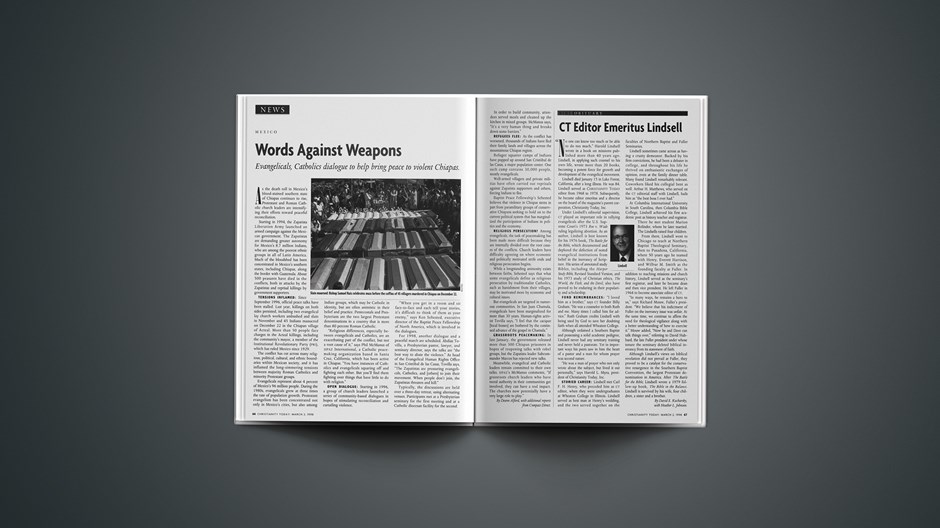
TENSIONS INFLAMED: Since September 1996, official peace talks have been stalled. Last year, killings on both sides persisted, including two evangelical lay church workers ambushed and slain in November and 45 Indians massacred on December 22 in the Chiapan village of Acteal. More than 50 people face charges in the Acteal killings, including the community's mayor, a member of the Institutional Revolutionary Party (PRI), which has ruled Mexico since 1929.
The conflict has cut across many religious, political, cultural, and ethnic boundaries within Mexican society, and it has inflamed the long-simmering tensions between majority Roman Catholics and minority Protestant groups.
Evangelicals represent about 4 percent of Mexico's 96 million people. During the 1980s, evangelicals grew at three times the rate of population growth. Protestant evangelism has been concentrated not only in Mexico's cities, but also among Indian groups, which may be Catholic in identity, but are often animistic in their belief and practice. Pentecostals and Presbyterians are the two largest Protestant denominations in a country that is more than 80 percent Roman Catholic.
"Religious differences, especially between evangelicals and Catholics, are an exacerbating part of the conflict, but not a root cause of it," says Phil McManus of SIPAZ International, a Catholic peacemaking organization based in Santa Cruz, California, which has been active in Chiapas. "You have instances of Catholics and evangelicals squaring off and fighting each other. But you'll find them fighting over things that have little to do with religion."
OPEN DIALOGUE: Starting in 1996, a group of church leaders launched a series of community-based dialogues in hopes of stimulating reconciliation and curtailing violence.
"When you get in a room and sit face-to-face and each tell your stories, it's difficult to think of them as your enemy," says Ken Sehested, executive director of the Baptist Peace Fellowship of North America, which is involved in the dialogues.
For 1998, another dialogue and a peaceful march are scheduled. Abdias Tovilla, a Presbyterian pastor, lawyer, and seminary director, says the talks are "the best way to abate the violence." As head of the Evangelical Human Rights Office in San Crist—bal de las Casas, Tovilla says, "The Zapatistas are pressuring evangelicals, Catholics, and [others] to join their movement. When people don't join, the Zapatistas threaten and kill."
Typically, the discussions are held over a three-day retreat, using alternating venues. Participants met at a Presbyterian seminary for the first meeting and at a Catholic diocesan facility for the second.
In order to build community, attendees served meals and cleaned up the kitchen in mixed groups. McManus says, "It's a very human thing and breaks down some barriers."
REFUGEES FLEE: As the conflict has worsened, thousands of Indians have fled their family lands and villages across the mountainous Chiapas region.
Refugee squatter camps of Indians have popped up around San Crist—bal de las Casas, a major population center. One such camp contains 30,000 people, mostly evangelicals.
Well-armed villagers and private militias have often carried out reprisals against Zapatista supporters and others, forcing Indians to flee.
Baptist Peace Fellowship's Sehested believes that violence in Chiapas stems in part from paramilitary groups of conservative Chiapans seeking to hold on to the current political system that has marginalized the participation of Indians in politics and the economy.
RELIGIOUS PERSECUTION? Among evangelicals, the task of peacemaking has been made more difficult because they are internally divided over the root causes of the conflicts. Church leaders have difficulty agreeing on where economic and politically motivated strife ends and religious persecution begins.
While a longstanding animosity exists between faiths, Sehested says that what some evangelicals define as religious persecution by traditionalist Catholics, such as banishment from their villages, may be motivated more by economic and cultural issues.
But evangelicals are targeted in numerous communities. In San Juan Chamula, evangelicals have been marginalized for more than 30 years. Human-rights activist Tovilla says, "I feel that the caciques [local bosses] are bothered by the continued advance of the gospel in Chamula."
Article continues below
GRASSROOTS PEACEMAKING: In late January, the government released more than 300 Chiapan prisoners in hopes of reopening talks with rebel groups, but the Zapatista leader Subcommander Marcos has rejected new talks.
Meanwhile, evangelical and Catholic leaders remain committed to their own talks. SIPAZ's McManus comments, "If grassroots church leaders who have moral authority in their communities get involved, they can have a real impact. The churches now potentially have a very large role to play."
















 While we pray for peace, we need moral clarity about this war.
 We’ve got little information on Jesus’ appearance and personality. But that’s the way God designed it.españolFrançais
 After lobbying from fellow Southern Baptists and Christians affected by the war, the House speaker moves a package forward.






