Twenty-four years ago this month I learned something specific. The specificity of what I learned is what makes it, to many, offensive.
Twenty-four years ago a hitchiking jaunt around Europe brought me one afternoon to a church in Dublin. I was intrigued by Eastern religions at the time, particularly Hinduism, but was theologically open-minded enough to appreciate Christian art and architecture.
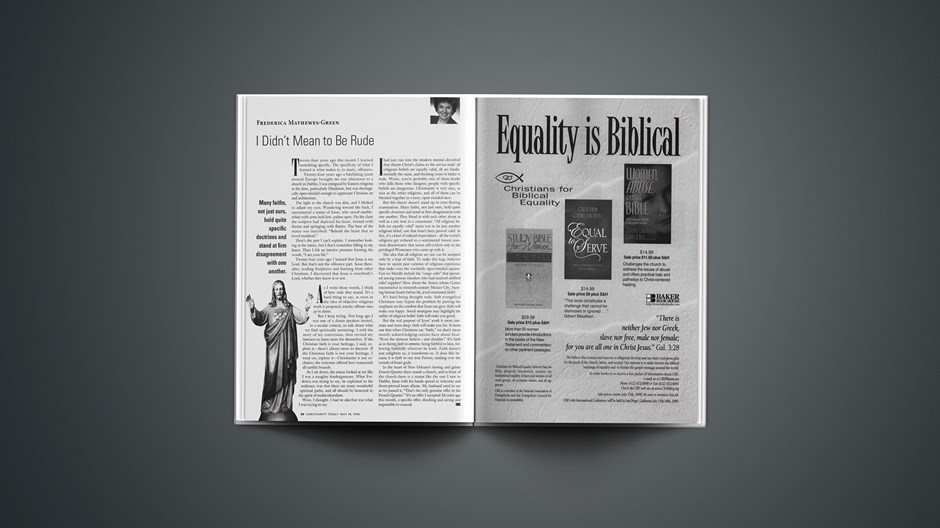
The light in the church was dim, and I blinked to adjust my eyes. Wandering toward the back, I encountered a statue of Jesus, who stood marble-white with arms held low, palms open. On his chest the sculptor had depicted his heart, twined with thorns and springing with flames. The base of the statue was inscribed: "Behold the heart that so loved mankind."
Here's the part I can't explain. I remember looking at the statue, but I don't remember falling to my knees. Then I felt an interior presence forming the words, "I am your life."
Twenty-four years ago I learned that Jesus is my Lord. But that's not the offensive part. Soon thereafter, reading Scriptures and learning from other Christians, I discovered that Jesus is everybody's Lord, whether they know it or not.
As I write those words, I think of how rude they sound. It's a hard thing to say; as soon as the idea of objective religious truth is proposed, touchy offense rises up in alarm.
But I keep trying. Not long ago I was one of a dozen speakers invited, in a secular context, to talk about what we find spiritually nurturing. I told the story of my conversion, then invited my listeners to learn more for themselves. If the Christian faith is your heritage, I said, explore it—there's always more to discover. If the Christian faith is not your heritage, I went on, explore it—Christianity is not exclusive; the welcome offered here transcends all earthly bounds.
As I sat down, the emcee looked at me like I was a naughty kindergartener. What Frederica was trying to say, he explained to the audience, was that there are many wonderful spiritual paths, and all should be honored in the spirit of multiculturalism.
Wow, I thought. I had no idea that was what I was trying to say.
I had just run into the modern mental cloverleaf that shunts Christ's claims to the service road: all religious beliefs are equally valid, all are fundamentally the same, and thinking yours is better is rude. Worse, you're probably one of those kooks who kills those who disagree; people with specific beliefs are dangerous. Christianity is very nice, as nice as the other religions, and all of them can be blended together in a tasty, open-minded stew.
But this theory doesn't stand up to even fleeting examination. Many faiths, not just ours, hold quite specific doctrines and stand at firm disagreement with one another. They blend in with each other about as well as a tire iron in a consomme. "All religious beliefs are equally valid" turns out to be just another religious belief, one that hasn't been proved valid. In fact, it's a kind of cultural imperialism—all the world's religions get reduced to a sentimental lowest common denominator that seems self-evident only to the privileged Westerners who came up with it.
The idea that all religions are one can be accepted only by a leap of faith. To make this leap, believers have to squint past varieties of religious experience that make even the resolutely open-minded squirm. Can we blandly include the "cargo cults" that sprouted among remote islanders who had received airlifted relief supplies? How about the Aztecs whom Cortez encountered in sixteenth-century Mexico City, burning human hearts before fat, jewel-encrusted idols?
It's hard being thought rude. Soft evangelical Christians may bypass the problem by putting the emphasis on the comfort that Jesus can give: faith will make you happy. Social strategists may highlight the utility of religious belief: faith will make you good.
But the real purpose of Jesus' work is more intimate and more deep: faith will make you his. It turns out that when Christians say "faith," we don't mean merely acknowledging certain facts about God: "Even the demons believe—and shudder." It's faith as in having faith in someone, being faithful to him, following faithfully wherever he leads. Faith doesn't just enlighten us, it transforms us. It does this because it is faith in one true Person, striding over the tumult of lesser gods.
In the heart of New Orleans's leering and grimy French Quarter there stands a church, and in front of the church there is a statue like the one I saw in Dublin, Jesus with his hands spread in welcome and thorn-pierced heart aflame. My husband used to say as we passed it, "That's the only genuine offer in the French Quarter." It's an offer I accepted 24 years ago this month, a specific offer, shocking and saving and impossible to conceal.
Frederica Mathewes-Green is the author of several books and has been a commentator for National Public Radio, National Review, and other media outlets. Her books include The Jesus Prayer and Facing East: A Pilgrim's Journey into the Mysteries of Orthodoxy. Mathewes-Green's podcast "Frederica Here and Now" is carried on Ancient Faith Radio. Her column, "Your World," ran from 1998 to 2000.















 While we pray for peace, we need moral clarity about this war.
 A Christian reconciliation group in Israel and Palestine warned that war would come. Now the war threatens their relevance.españolالعربيةFrançais
 After lobbying from fellow Southern Baptists and Christians affected by the war, the House speaker moves a package forward.






