The pope's chief doctrinal officer has always been in dialogue with the Reformation traditions. Now he reveals his vision for Christianity in the new millennium.
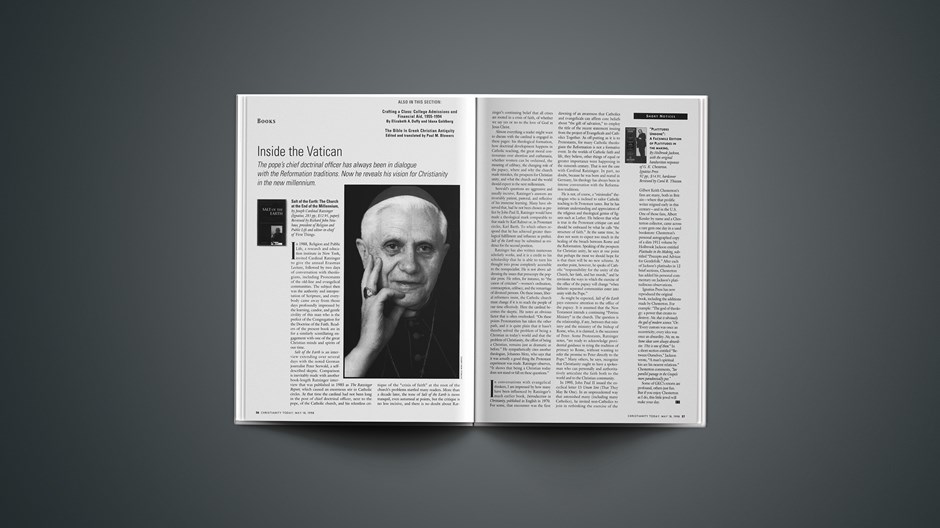
Salt of the Earth: The Church at the End of the Millenium, by Joseph Cardinal Ratzinger (Ignatius, 283 pp.; $12.95, paper). Reviewed by Richard John Neuhaus, president of Religion and Public Life and editor-in-chief of First Things.
In 1988, Religion and Public Life, a research and education institute in New York, invited Cardinal Ratzinger to give the annual Erasmus Lecture, followed by two days of conversation with theologians, including Protestants of the old-line and evangelical communities. The subject then was the authority and interpretation of Scripture, and everybody came away from those days profoundly impressed by the learning, candor, and gentle civility of this man who is the prefect of the Congregation for the Doctrine of the Faith. Readers of the present book are in for a similarly scintillating engagement with one of the great Christian minds and spirits of our time.
Salt of the Earth is an interview extending over several days with the noted German journalist Peter Seewald, a self-described skeptic. Comparison is inevitably made with another book-length Ratzinger interview that was published in 1985 as The Ratzinger Report, which caused an enormous stir in Catholic circles. At that time the cardinal had not been long in the post of chief doctrinal officer, next to the pope, of the Catholic church, and his relentless critique of the "crisis of faith" at the root of the church's problems startled many readers. More than a decade later, the tone of Salt of the Earth is more tranquil, even autumnal at points, but the critique is no less incisive, and there is no doubt about Ratzinger's continuing belief that all crises are rooted in a crisis of faith, of whether we say yes or no to the love of God in Jesus Christ.
Almost everything a reader might want to discuss with the cardinal is engaged in these pages: his theological formation, how doctrinal development happens in Catholic teaching, the great moral controversies over abortion and euthanasia, whether women can be ordained, the meaning of celibacy, the changing role of the papacy, where and why the church made mistakes, the prospects for Christian unity, and what the church and the world should expect in the next millennium.
Seewald's questions are aggressive and usually incisive; Ratzinger's answers are invariably patient, pastoral, and reflective of his immense learning. Many have observed that, had he not been chosen as prefect by John Paul II, Ratzinger would have made a theological mark comparable to that made by Karl Rahner or, in Protestant circles, Karl Barth. To which others respond that he has achieved greater theological fulfillment and influence as prefect. Salt of the Earth may be submitted as evidence for the second position.
Ratzinger has also written numerous scholarly works, and it is a credit to his scholarship that he is able to turn his thought into prose completely accessible to the nonspecialist. He is not above addressing the issues that preoccupy the popular press. He refers, for instance, to "the canon of criticism"—women's ordination, contraception, celibacy, and the remarriage of divorced persons. On these issues, liberal reformers insist, the Catholic church must change if it is to reach the people of our time effectively. Here the cardinal becomes the skeptic. He notes an obvious factor that is often overlooked: "On these points Protestantism has taken the other path, and it is quite plain that it hasn't thereby solved the problem of being a Christian in today's world and that the problem of Christianity, the effort of being a Christian, remains just as dramatic as before." He sympathetically cites another theologian, Johannes Metz, who says that it was actually a good thing the Protestant experiment was made. Ratzinger observes, "It shows that being a Christian today does not stand or fall on these questions."
In conversations with evangelical thinkers, I am impressed by how many have been influenced by Ratzinger's much earlier book, Introduction to Christianity, published in English in 1970. For some, that encounter was the first dawning of an awareness that Catholics and evangelicals can affirm core beliefs about "the gift of salvation," to employ the title of the recent statement issuing from the project of Evangelicals and Catholics Together. As off-putting as it is to Protestants, for many Catholic theologians the Reformation is not a formative event. In the worlds of Catholic faith and life, they believe, other things of equal or greater importance were happening in the sixteenth century. That is not the case with Cardinal Ratzinger. In part, no doubt, because he was born and reared in Germany, his theology has always been in intense conversation with the Reformation traditions.
He is not, of course, a "minimalist" theologian who is inclined to tailor Catholic teaching to fit Protestant tastes. But he has intimate understanding and appreciation of the religious and theological genius of figures such as Luther. He believes that what is true in the Protestant critique can and should be embraced by what he calls "the structure of faith." At the same time, he does not seem to expect too much in the healing of the breach between Rome and the Reformation. Speaking of the prospects for Christian unity, he says at one point that perhaps the most we should hope for is that there will be no new schisms. At another point, however, he speaks of Catholic "responsibility for the unity of the Church, her faith, and her morals," and he envisions the ways in which the exercise of the office of the papacy will change "when hitherto separated communities enter into unity with the Pope."
Article continues below
As might be expected, Salt of the Earth pays extensive attention to the office of the papacy. It is assumed that the New Testament intends a continuing "Petrine Ministry" in the church. The question is the relationship, if any, between that ministry and the ministry of the bishop of Rome, who, it is claimed, is the successor of Peter. Some Protestants, Ratzinger notes, "are ready to acknowledge providential guidance in tying the tradition of primacy to Rome, without wanting to refer the promise to Peter directly to the Pope." Many others, he says, recognize that Christianity ought to have a spokesman who can personally and authoritatively articulate the faith both to the world and to the Christian community.
In 1995, John Paul II issued the encyclical letter Ut Unum Sint (That They May Be One). In an unprecedented way that astonished many (including many Catholics), he invited non-Catholics to join in rethinking the exercise of the papal office so that it might become an instrument of, rather than an obstacle to, Christian unity. As Ratzinger notes, the invitation is addressed first of all to the Orthodox East, but it also has large ramifications for the separated communities of the West. It is a source of considerable disappointment in Rome, a disappointment reflected in this book, that other Christians have not taken up that invitation. But, as it is said, Rome thinks in terms of centuries—and, as is evident in this book, in terms of millennia.
When the cardinal turns his attention to the next millennium, now only months away, the tone is sober, even somber. He envisions a largely post-Christian world in which the church will be on the defensive, smaller in numbers, but, he hopes, more coherent and committed in its faith. This is in contrast with John Paul II's frequently expressed vision of the third millennium as a "springtime"—a springtime of world evangelization, a springtime of Christian unity, a springtime of the renewal of human dignity.
Article continues below
The difference in expectations is undoubtedly related in part to personal disposition and experience. Ratzinger's world is chiefly that of a dismally secularized Western Europe. The pope's experience is that of Central and Eastern Europe, where a vibrant, if often contentious, Christianity has risen from beneath the rubble of Nazism and communism's evil empire. In addition, the pope's unceasing travels have established close ties with Africa, Asia, and Latin America, where anticipation of Christianity's future is frequently exuberant.
Not too much should be made of these differences, since it is obvious that God alone knows what the third millennium holds. What comes through in Salt of the Earth is the unshakable confidence that, no matter what happens, Christ is Lord. In his first sermon as pope, John Paul chose the theme "Be not afraid!" That theme has been repeated like a triphammer throughout this pontificate, and it is powerfully sounded in the present book. Salt of the Earth is an invitation to engage the mind and soul of a Christian made wise by life and learning, one who has had an inestimable influence in directing the church that embraces more than half the Christians in the world today and reaches out to all. Some readers, whether Protestant or Catholic, may not be persuaded by all that Cardinal Ratzinger has to say, but the book is an invitation that should not be declined.
Article continues below
"PLATITUDES UNDONE": A FACSIMILE EDITION OF PLATITUDES IN THE MAKING,By Holbrook Jackson, with the original handwritten responses of G. K. Chesterton.
Ignatius Press
92 pp.; $14.95, hardcover
Reviewed by Carol R. Thiessen.
Gilbert Keith Chesterton's fans are many, both in Britain—where that prolific writer reigned early in this century—and in the U.S. One of those fans, Albert Kessler by name and a Chesterton collector, came across a rare gem one day in a used bookstore: Chesterton's personal autographed copy of a slim 1911 volume by Holbrook Jackson entitled Platitudes in the Making, subtitled "Precepts and Advices for Gentlefolk." After each of Jackson's platitudes in 12 brief sections, Chesterton has added his personal commentary on Jackson's platitudinous observations.
Ignatius Press has now reproduced the original book, including the additions made by Chesterton. For example: "The god of theology: a power that creates to destroy. No: that is obviously the god of modern science." Or: "Every custom was once an eccentricity; every idea was once an absurdity. No, no, no. Some ideas were always absurdities. This is one of them." In a short section entitled "Between Ourselves," Jackson wrote, "A man's spiritual kin are his nearest relations." Chesterton comments, "See parallel passage in the Gospels more paradoxically put."
Some of GKC's retorts are profound, others just fun. But if you enjoy Chesterton as I do, this little jewel will make your day.
















 While we pray for peace, we need moral clarity about this war.
 As my doubts about his teachings grew, so did a secret fascination with Jesus.
 But experts say it can offer opportunities for leaders and congregations to grow.






