"We pray that a lost generation of Europeans will come home to the God of their forebears."
Roland Werner
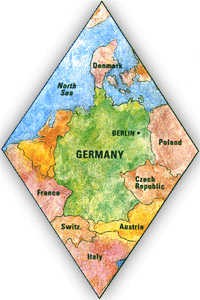
Nine years after the Berlin Wall came down and eight years after the reunification of the two German states, the country of Martin Luther and of the Heidelberg Confession faces challenges as never before. Germany truly has a new face, one that people in both the east and the west of our nation still have to get used to beholding in the mirror. The same is true for the church.
Before reunification, just under half of the population in West Germany was Roman Catholic, and just over half was Protestant. We now are confronted with a three-thirds situation, the last third being unchurched or openly atheistic citizens. Under the rule of communism and the antireligious policies of the East German government, church membership dropped from 95 percent in 1945 to about 20 percent in 1990. Over a million people left the official church after reunification on October 3, 1990 (which is now our National Day). This was due in large measure to the reintroduction of the system of church taxation in the east. Today, only 5 percent of the Protestants and 10 percent of the Catholics bother to go to church on any kind of regular basis. In the east, many families have been unchurched and therefore untouched by the gospel for three or four generations. At a recent evangelistic outdoor event, young people were asking: "God—what is that? We have never heard about it."
Nevertheless, there is a real—but by no means pervasive—evangelical movement within the traditional Protestant churches, as there is, of course, in what are called the "free churches." Free churches include Baptists (80,000 members), Methodists (almost 50,000), Free Evangelicals (30,000), various Pentecostal and charismatic churches (80,000), the Salvation Army, and a few other small denominations. Altogether, their membership totals only 300,000, which is less than half a percent of the total population. Even though attendance in these churches is sometimes double the actual membership, their numbers are still minuscule in relationship to the overall population.
~Of the estimated 10 million Gypsies in Europe, over 200,000 are fervent Pentecostal Christians. They form the largest group of evangelical believers in both Spain and France.
~French evangelicals have more than 200 missionaries in 30 foreign lands and operate 10 evangelical Bible schools and seminaries.
~German evangelicals publish more than 150 magazines with a combined circulation of 50 million and publish more than 65 percent of all Protestant book titles.
~Polish evangelicals use radio station TWR to broadcast Christian programing 24 hours a day.
~An evangelical movement called Oasis in the Catholic Church in Poland now numbers in the hundreds of thousands. Reached through Bible-study groups, camps, and publishing houses, these believers continue forming Bible studies and informal fellowships throughout the country.
Source: Operation World (1993)
Sadly, there is an unhealthy tendency toward in-house fighting among certain evangelicals. Some more fundamentalist evangelicals, who have stood their ground against liberal, neoliberal, Marxist, and feminist interpretations of the gospel, are now turning against their fellow evangelicals, whom they see as compromising culturally and dogmatically. They protest especially the inclusion of charismatics into the German Evangelical Alliance and cooperation in evangelism with renewal groups inside the Roman Catholic church.
But despite these internal problems, there is also a growing interest among evangelicals from the traditional, free, and charismatic churches to make the gospel known in Germany. The opening up of the Iron Curtain has opened up new avenues of outreach to sister evangelical churches in central and eastern Europe, which need our support. There are many partnership and exchange programs linking Christians from different European countries. Some of these links had been formed in communist times, when Christians from East Germany already shouldered the responsibility of helping their more eastern brothers and sisters.
Christians are also responding to the millions who have lost their jobs and find themselves in a psychological and spiritual vacuum following the breakdown of the Communists' centralized system. Under the motto "Come follow Jesus," Christival 1996—a five-day congress for young Christians—brought together over 32,000 young people from all over Germany, plus another 2,000 from neighboring countries, to the east-German city of Dresden. It helped define a new positive identity for young people of many different churches as followers of Christ.
In the wake of Billy Graham's 1993 "Mission to Europe," held in Essen and linked via satellite to 330 venues in Germany and throughout Europe, other similar events followed—in 1995 from Leipzig with 360 link-ups, and in 1997 from Nuremberg with 660 link-ups and a combined participation of 1 million people. In January of this year, a youth event trained and challenged young Christians to work together across denominational lines in witnessing to their friends. Two major evangelistic events are being planned for 2000, one of them involving youth at the World's Fair to be held in Hanover.
Article continues below
Although the fires of the gospel may not burn as high and as brightly in "post-Christian" Europe as in other areas of the world, and though most churches and ministries are small and regional, the fruit they are producing is real and will last. Christians here are confident that the tearing down of the physical walls is a sign of what God wants to do in the spiritual world as well. We pray and believe that a lost generation of Europeans will come home to the God of their forebears. For Germany is not only a country with a rich spiritual history, but also a people called to trust the God of the future.
Roland Werner is a Bible translator, university evangelist, and the leader of an interdenominational church for students in Marburg. At 41, he serves as chair of the Christival evangelistic festivals and is a member of the German Lausanne committee. E-mail: rolwerner@aol.com















 While we pray for peace, we need moral clarity about this war.
 We’ve got little information on Jesus’ appearance and personality. But that’s the way God designed it.españolFrançais
 After lobbying from fellow Southern Baptists and Christians affected by the war, the House speaker moves a package forward.






