"Africa is a land of great potential, a sleeping spiritual giant."
David M. Kasali
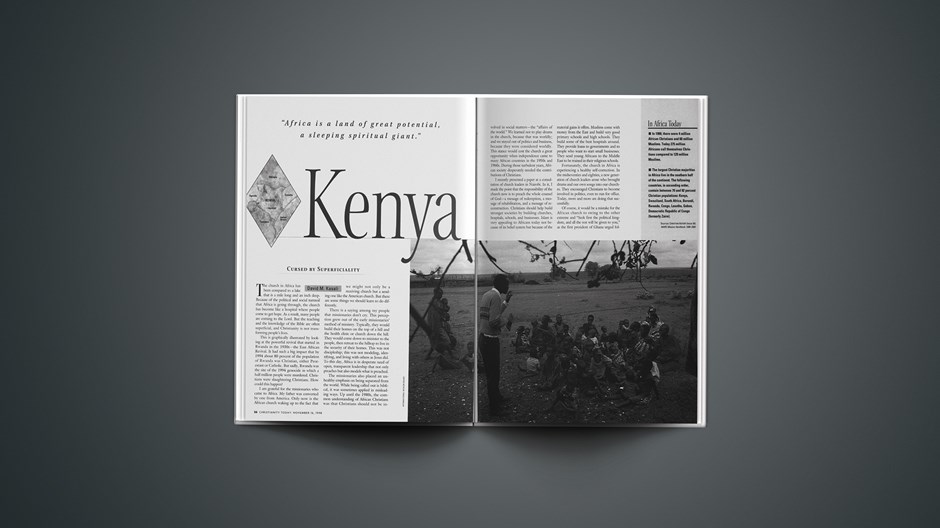
The church in Africa has been compared to a lake that is a mile long and an inch deep. Because of the political and social turmoil that Africa is going through, the church has become like a hospital where people come to get hope. As a result, many people are coming to the Lord. But the teaching and the knowledge of the Bible are often superficial, and Christianity is not transforming people's lives.
This is graphically illustrated by looking at the powerful revival that started in Rwanda in the 1930s—the East African Revival. It had such a big impact that by 1994 about 80 percent of the population of Rwanda was Christian, either Protestant or Catholic. But sadly, Rwanda was the site of the 1994 genocide in which a half-million people were murdered. Christians were slaughtering Christians. How could this happen?
I am grateful for the missionaries who came to Africa. My father was converted by one from America. Only now is the African church waking up to the fact that we might not only be a receiving church but a sending one like the American church. But there are some things we should learn to do differently.
In Africa Today
~In 1900, there were 4 million African Christians and 60 million Muslims. Today 275 million Africans call themselves Christians compared to 129 million Muslims.
~The largest Christian majorities in Africa live in the southern half of the continent. The following countries, in ascending order, contain between 70 and 92 percent Christian populations: Kenya, Swaziland, South Africa, Burundi, Rwanda, Congo, Lesotho, Gabon, Democratic Republic of Congo (formerly Zaire).
There is a saying among my people that missionaries don't cry. This perception grew out of the early missionaries' method of ministry. Typically, they would build their homes on the top of a hill and the health clinic or church down the hill. They would come down to minister to the people, then retreat to the hilltop to live in the security of their homes. This was not discipleship; this was not modeling, identifying, and living with others as Jesus did. To this day, Africa is in desperate need of open, transparent leadership that not only preaches but also models what is preached.
The missionaries also placed an unhealthy emphasis on being separated from the world. While being called out is biblical, it was sometimes applied in misleading ways. Up until the 1980s, the common understanding of African Christians was that Christians should not be involved in social matters—the "affairs of the world." We learned not to play drums in the church, because that was worldly; and we stayed out of politics and business, because they were considered worldly. This stance would cost the church a great opportunity when independence came to many African countries in the 1950s and 1960s. During those turbulent years, African society desperately needed the contributions of Christians.
I recently presented a paper at a consultation of church leaders in Nairobi. In it, I made the point that the responsibility of the church now is to preach the whole counsel of God—a message of redemption, a message of rehabilitation, and a message of reconstruction. Christians should help build stronger societies by building churches, hospitals, schools, and businesses. Islam is very appealing to Africans today not because of its belief system but because of the material gains it offers. Muslims come with money from the East and build very good primary schools and high schools. They build some of the best hospitals around. They provide loans to governments and to people who want to start small businesses. They send young Africans to the Middle East to be trained in their religious schools.
Fortunately, the church in Africa is experiencing a healthy self-correction. In the midseventies and eighties, a new generation of church leaders arose who brought drums and our own songs into our churches. They encouraged Christians to become involved in politics, even to run for office. Today, more and more are doing that successfully.
Of course, it would be a mistake for the African church to swing to the other extreme and "Seek first the political kingdom, and all the rest will be given to you," as the first president of Ghana urged following the independence of his country. Politics alone has not brought solutions to the challenges of Africa. In fact, since independence, we have had more problems to deal with than ever before. Our problems ultimately are not economic, but spiritual. If we engage the world from this spiritual perspective, we will maintain a biblical balance of being in the world but not of it.
Not all of our problems are inherited ones. A lesson Christians in Africa could learn from those in America is about how to operate in a democracy. In many African countries today, people vote not necessarily for the best candidates or according to issues, but along tribal lines. If Christians in my country (where 80 percent are Christians) and other countries would rise above these tribalisms, they would make a tremendous difference in Africa.
Article continues below
I believe African Christians must also take an active part in forming democracies that are not defined by the West but by the African context. American-style democracy cannot work in Africa for two reasons. The first is that democracy is expensive. It costs a lot to maintain it, and we cannot afford it in Africa with our current economic situation. The second is that democracy can run well only where people are informed about the issues. We are not trained in democracy. Many people in my country have not even finished primary school. And so they depend on their leaders to decide for them what is good and what is right.
But Africa is a land of great potential. It is a sleeping giant spiritually. My prayer is that we can awaken this giant so that we can be a blessing not only to our own countries but also to others around the world. As Christians, we too are called to make disciples of all nations, both in Africa and abroad.
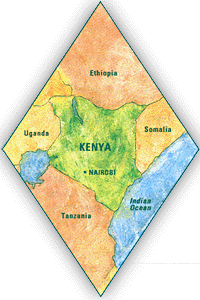
David M. Kasali, 44, is president of the Nairobi Evangelical Graduate School of Theology in Kenya. He holds degrees from the Nairobi Evangelical Graduate School of Theology and Trinity Evangelical Divinity School in Deerfield, Illinois. E-mail: pnegst@maf.org














 While we pray for peace, we need moral clarity about this war.
 A Christian reconciliation group in Israel and Palestine warned that war would come. Now the war threatens their relevance.españolالعربيةFrançaisрусскийУкраїнська
 NIL deals in college athletics present new challenges—and opportunities—for colleges and students.






