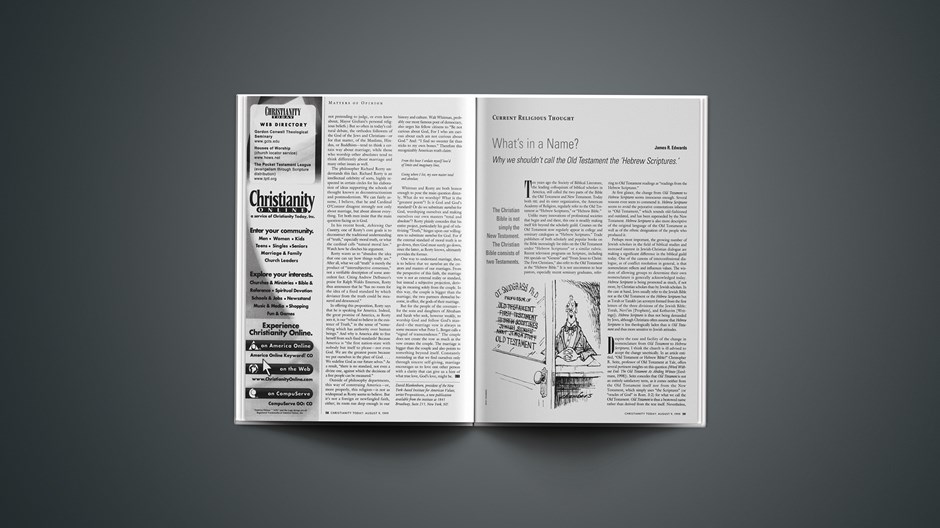
Ten years ago the Society of Biblical Literature, the leading colloquium of biblical scholars in America, still called the two parts of the Bible the Old Testament and New Testament. Today both SBL and its sister organization, the American Academy of Religion, regularly refer to the Old Testament as "Hebrew Scriptures," or "Hebrew Bible."
Unlike many innovations of professional societies that begin and end there, this one is steadily making itself felt beyond the scholarly guild. Courses on the Old Testament now regularly appear in college and seminary catalogues as "Hebrew Scriptures." Trade publishers of both scholarly and popular books on the Bible increasingly list titles on the Old Testament under "Hebrew Scriptures" or a similar rubric. Recent television programs on Scripture, including PBS specials on "Genesis" and "From Jesus to Christ: The First Christians," also refer to the Old Testament as the "Hebrew Bible." It is not uncommon to hear pastors, especially recent seminary graduates, referring to Old Testament readings as "readings from the Hebrew Scriptures."
At first glance, the change from Old Testament to Hebrew Scriptures seems innocuous enough. Several reasons even seem to commend it. Hebrew Scriptures seems to avoid the pejorative connotations inherent in "Old Testament," which sounds old-fashioned and outdated, and has been superseded by the New Testament. Hebrew Scriptures is also more descriptive of the original language of the Old Testament as well as of the ethnic designation of the people who produced it.
The Christian Bible is not simply the New Testament. The Christian Bible consists of two Testaments.
Perhaps most important, the growing number of Jewish scholars in the field of biblical studies and increased interest in Jewish-Christian dialogue are making a significant difference in the biblical guild today. One of the canons of interconfessional dialogue, as of conflict resolution in general, is that nomenclature reflects and influences values. The wisdom of allowing groups to determine their own nomenclature is generally acknowledged today. Hebrew Scriptures is being promoted as much, if not more, by Christian scholars than by Jewish scholars. In the case at hand, Jews usually refer to the Jewish Bible not as the Old Testament or the Hebrew Scriptures but as Torah or Tanakh (an acronym formed from the first letters of the three divisions of the Jewish Bible: Torah, Nevi'im [Prophets], and Kethuvim [Writings]). Hebrew Scriptures is thus not being demanded by Jews, although Christians often assume that Hebrew Scriptures is less theologically laden than is Old Testament and thus more sensitive to Jewish attitudes.
Despite the ease and facility of the change in nomenclature from Old Testament to Hebrew Scriptures, I think the church is ill-advised to accept the change uncritically. In an article entitled, "Old Testament or Hebrew Bible?" Christopher R. Seitz, professor of Old Testament at Yale, offers several pertinent insights on this question (Word With out End: The Old Testament As Abiding Witness [Eerdmans, 1998]). Seitz concedes that Old Testament is not an entirely satisfactory term, as it comes neither from the Old Testament itself nor from the New Testament, which simply uses "the Scriptures" (or "oracles of God" in Rom. 3:2) for what we call the Old Testament. Old Testament is thus a bestowed name rather than derived from the text itself. Nevertheless, dumping Old Testament for Hebrew Scriptures is a mistake, in Seitz's view. I think he is right.
Hebrew Scriptures, or alternative names such as First and Second Testaments, Jewish Scriptures, Tanakh, and so forth, are not, according to Seitz, theologically neutral. Titling is more than what a body of literature claims for itself; it is equally a matter of what the communities that read the body of literature claim about it.
Hebrew Scriptures may appear to be a more historically accurate designation than Old Testament, but that is only partially true. Some sections of the Old Testament are written in Aramaic, not Hebrew; and Hebrew Scriptures excludes the Greek Deutero-canonical books accepted by Roman Catholics. Moreover, the Bible of the early church was not the Hebrew Scriptures but the Greek translation of the Hebrew Bible, called the Septuagint. Thus, contrary to common assumption, Hebrew Scriptures is not an entirely accurate historical designation.
The change to Hebrew Scriptures is, in fact, motivated more by theological interests than by pure historical interests, according to Seitz. Specifically, Hebrew Scriptures uncouples the Old Testament from the two primary faith communities that consider it authoritative—Jews and Christians—in a way that endows it not with greater specificity but with greater generality. Jettisoning the term testament, with its associations of covenant, reconciliation, redemption, and salvation, into "a bin of abstraction or pious disregard" is particularly problematic for Seitz. Testament anchors the Old Testament specifically and uniquely to God's people Israel. When that linkage is severed, a very different understanding of salvation emerges.
Article continues below
The writings of the Old Testament are not theological generalities, neutral and objective. They all emerge from God's covenant relationship with a specific people, Israel, a covenant relationship that in the New Testament is both presupposed and completed in Jesus Christ. Hebrew Scriptures calls this relationship into question and makes it more ambiguous and less distinct, precisely because Hebrew Bible and New Testament are not correlative terms.
Hebrew Bible connotes something Jewish rather than Christian and can thus appeal to the infection of the second-century heretic Marcion, which to this day lies dormant in the bloodstream of the church. Marcion taught that the old covenant, and the God who contracted it, were inferior to the gospel of Jesus Christ and hence were to be extirpated from the faith. If the Old Testament is alienated from the church, says Seitz, Christians will be even less inclined to read the Old Testament—and when they do they will feel as though they are "reading someone else's mail."
Christians cannot look to the Old Testament as "someone else's mail."
"'Old Testament' was chosen to clarify what is the Christian relationship to Israel's scriptures," says Seitz. "Israel's scriptures are constitutive of God's covenant with Israel, to which the church is related because of the covenant made in Christ. There is thus an Old Testament and a New Testament record of this series of decisive and nonsubstitutable theological moments. Abandoning the term 'Old Testament' would be to abandon a statement of the relationship of Christians to the literature of Israel and to modern Judaism. It would be to place Christians in the same category as the simply curious, before whom this literature offers profound, or banal, glimpses at antiquity, things 'Hebrew.' "
Seitz's words and instincts are worth heeding. What may or may not be good diction in scholarly circles is decidedly not good theology for the church. What we decide to call the Old Testament defines not only how we understand the relationship between it and the New Testament, but also how we understand ourselves as the people of God.
The most important reason for retaining traditional nomenclature in this instance is that Old Testament, in combination with New Testament, preserves the essence of the Canon. Christians all too often think of the New Testament as "required reading" and the Old Testament simply as "recommended reading." It cannot be repeated often enough, however, that the Christian Bible is not simply the New Testament. The Christian Bible consists of two testaments: a foundational covenant with Israel in the Old Testament and a fulfillment of that covenant in Jesus Christ in the New Testament. The saving work of God in Jesus Christ was not an innovation that began with John the Baptist. The gospel, as Paul's analogy of the olive tree in Romans 11 teaches, consists of the proclamation of God's saving activity from Abraham to Jesus. From inception to culmination, the saving work of God is recounted in the one Christian Bible.
Article continues below
It takes two testaments to tell the one story. The change in name to Hebrew Scriptures may suggest that the work of God in the one testament is different—and hence divisible—from the other. Any attempt to separate the Old Testament from the New has the effect of removing the only testament the early church possessed as Scripture!
Old Testament, moreover, is not a derogatory name nor a title of diminishment. The Old Testament is, by its own witness and canonical shape, incomplete. From the call of Abraham on ward it presupposes a fulfillment of its story and history beyond itself. (This is why the three religions that appeal to the Old Testament all add a sequel to it—Talmud for Jews, New Testament for Christians, Qur'an for Muslims.) According to the witness of the Old Testament, the "new covenant," or "New Testament" as it is better known, is foreshadowed in the Old Testament as its fulfillment and consummation. The prophet Jeremiah envisioned a "new covenant" that God would make with Israel in the last days (Jer. 31:31 34; also Ezek. 34:25 31). Jesus' reference to "the new covenant in my blood" at the Last Supper (1 Cor. 11:25) recalls Jeremiah's vision and indicates that our Lord—and early Christianity with him (Heb. 9:15 22)—understood his sacrifice as a fulfillment of Jeremiah's prophecy.
Indeed, the Christ-event is not understandable apart from the history of Israel that necessitated it. The Christ-event is the once-for-all fulfillment of the promises of the Old Testament that can neither be repeated nor augmented. This argues against adopting terminology such as First Testament and Second Testament, as though there could be additional testaments.
Most Jews, of course, do not consider Jesus to be the Messiah. Hence, they do not have the problem with canonical nomenclature that we Christians have. Jews designate their scriptures as Tanakh. The New Testament is for them "someone else's mail." But Christians cannot look to the Old Testament as "someone else's mail." What Jews believe they must do in order to maintain their identity (i.e., reject the New Testament), Christians cannot do if they are to maintain theirs (i.e., reject the Old Testament)! Christians cannot look to the Old Testament and say, "This is not our book."
Article continues below
There is a final reason why I believe Christians should retain the nomenclature of Old Testament. Holding the two testaments together testifies to the inevitable relationship that exists between Jews and Christians—regardless of how unwilling both Christians and Jews have been to acknowledge and honor that relationship in the past.
Less than a lifetime ago, an attempt was made in Germany to discard the Old Testament, to deny Christianity's provenance in Israel, and to make of Christianity something autonomous, entirely Gentile and Aryan. Those who lobbied for this so-called Positive Christianity may not have intended the Holocaust, but their mistaken theology nevertheless helped pave the way for the horrors of Bergen-Belsen and Auschwitz.
Most Christians now recognize the wisdom and courage of Barth, Lohmeyer, Bonhoeffer, and others who foresaw the danger of denigrating the Old Testament as inferior to the New. They confessed the intrinsic union of the two testaments and warned that an ax laid at the root of Judaism would not only result in evil done to Jews, but eventually and inevitably would call the same evil down on the head of Christians.
In our day of designer spirituality, when it is fashionable to talk of the "divine within," or even the "Christ within," it is important to recall that the only Christ the church has ever known is Jesus, the Jew of Nazareth. The proclamation of a non-Jewish Messiah is, quite simply, the proclamation of a non-Messiah.
There are several warning lights to be aware of before substituting Hebrew Scriptures for Old Testament. Whether in second-century Gnosticism or in twentieth-century Nazi theology, a New Testament shorn of its relationship to the people of Israel makes the Christian proclamation increasingly vulnerable to the prevailing ideologies of the day.
James R. Edwards is professor of religion at Whitworth College, Spokane, Washington.















 While we pray for peace, we need moral clarity about this war.
 We’ve got little information on Jesus’ appearance and personality. But that’s the way God designed it.españolFrançais
 We must always be people of the Word, but we’ll have to reimagine deep engagement with Scripture.






