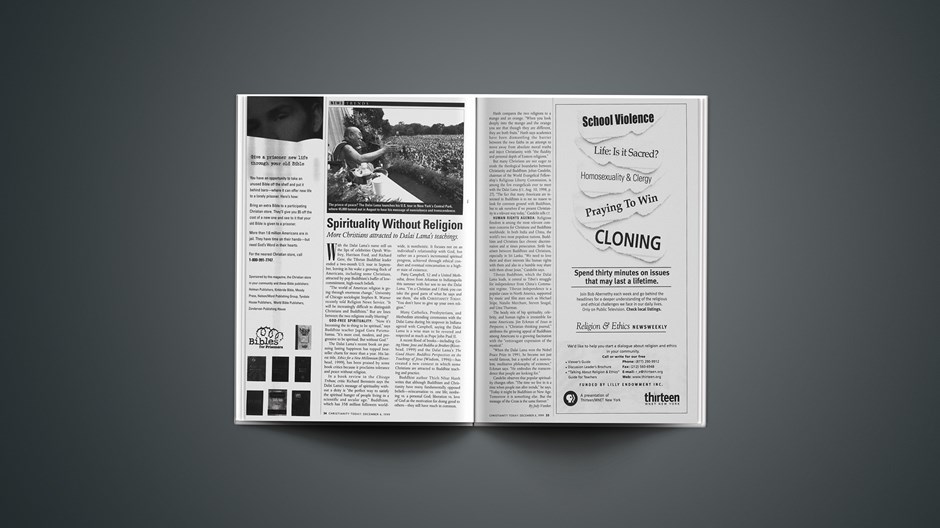
With the Dalai Lama's name still on the lips of celebrities Oprah Winfrey, Harrison Ford, and Richard Gere, the Tibetan Buddhist leader ended a two-month U.S. tour in September, leaving in his wake a growing flock of Americans, including some Christians, attracted by pop Buddhism's buffet of low-commitment, high-touch beliefs.
"The world of American religion is going through enormous change," University of Chicago sociologist Stephen R. Warner recently told Religion News Service. "It will be increasingly difficult to distinguish Christians and Buddhists." But are lines between the two religions really blurring?
GOD-FREE SPIRITUALITY:
"Now it's becoming the in thing to be spiritual," says Buddhist teacher Jagad Guru Paramahamsa. "It's more cool, modern, and progressive to be spiritual. But without God."
The Dalai Lama's recent book on pursuing lasting happiness has topped bestseller charts for more than a year. His latest title, Ethics for a New Millennium (Riverhead, 1999), has been praised by some book critics because it proclaims tolerance and peace without religion.
In a book review in the Chicago Tribune, critic Richard Bernstein says the Dalai Lama's message of spirituality without a deity is "the perfect way to satisfy the spiritual hunger of people living in a scientific and secular age." Buddhism, which has 358 million followers worldwide, is nontheistic. It focuses not on an individual's relationship with God, but rather on a person's incremental spiritual progress, achieved through ethical conduct and eventual reincarnation to a higher state of existence.
Patty Campbell, 52 and a United Methodist, drove from Arkansas to Indianapolis this summer with her son to see the Dalai Lama. "I'm a Christian and I think you can take the good parts of what he says and use them," she tells Christianity Today. "You don't have to give up your own religion."
Many Catholics, Presbyterians, and Methodists attending ceremonies with the Dalai Lama during his stopover in Indiana agreed with Campbell, saying the Dalai Lama is a wise man to be revered and respected as much as Pope John Paul II.
A recent flood of books—including Going Home: Jesus and Buddha as Brothers (Riverhead, 1999) and the Dalai Lama's The Good Heart: Buddhist Perspectives on the Teachings of Jesus (Wisdom, 1996)—has created a new context in which some Christians are attracted to Buddhist teaching and practice.
Buddhist author Thich Nhat Hanh writes that although Buddhism and Christianity have many fundamentally opposed beliefs—reincarnation vs. one life; nonbeing vs. a personal God; liberation vs. love of God as the motivation for doing good to others—they still have much in common.
Hanh compares the two religions to a mango and an orange. "When you look deeply into the mango and the orange you see that though they are different, they are both fruits." Hanh says academics have been dismantling the barrier between the two faiths in an attempt to move away from absolute moral truths and inject Christianity with "the fluidity and personal depth of Eastern religions."
But many Christians are not eager to erode the theological boundaries between Christianity and Buddhism. Johan Candelin, chairman of the World Evangelical Fellowship's Religious Liberty Commission, is among the few evangelicals ever to meet with the Dalai Lama. "The fact that many Americans are interested in Buddhism is to me no reason to look for common ground with Buddhism, but to ask ourselves if we present Christianity in a relevant way today," Candelin tells CT.
HUMAN RIGHTS AGENDA:
Religious freedom is among the most relevant common concerns for Christians and Buddhists worldwide. In both India and China, the world's two most populous nations, Buddhists and Christians face chronic discrimination and at times persecution. Strife has arisen between Buddhists and Christians, especially in Sri Lanka. "We need to love them and share interests like human rights with them and also in a humble way share with them about Jesus," Candelin says.
Tibetan Buddhism, which the Dalai Lama leads, is central to Tibet's struggle for independence from China's Communist regime. Tibetan independence is a popular cause in North America, supported by music and film stars such as Michael Stipe, Natalie Merchant, Steven Seagal, and Uma Thurman.
The heady mix of hip spirituality, celebrity, and human rights is irresistible for some Americans. Jim Eckman of Issues in Perspective, a "Christian thinking journal," attributes the growing appeal of Buddhism among Americans to a growing fascination with the "extravagant expression of the mystical."
"When the Dalai Lama won the Nobel Peace Prize in 1989, he became not just world famous, but a symbol of a nonviolent, meditative philosophy of existence," Eckman says. "He embodies the transcendence that people are looking for."
Candelin observes that popular spirituality changes often. "The time we live in is a time when people run after trends," he says. "Today it might be Buddhism or New Age. Tomorrow it is something else. But the message of the Cross is the same forever."
















 While we pray for peace, we need moral clarity about this war.
 A Christian reconciliation group in Israel and Palestine warned that war would come. Now the war threatens their relevance.españolالعربيةFrançais
 After lobbying from fellow Southern Baptists and Christians affected by the war, the House speaker moves a package forward.






