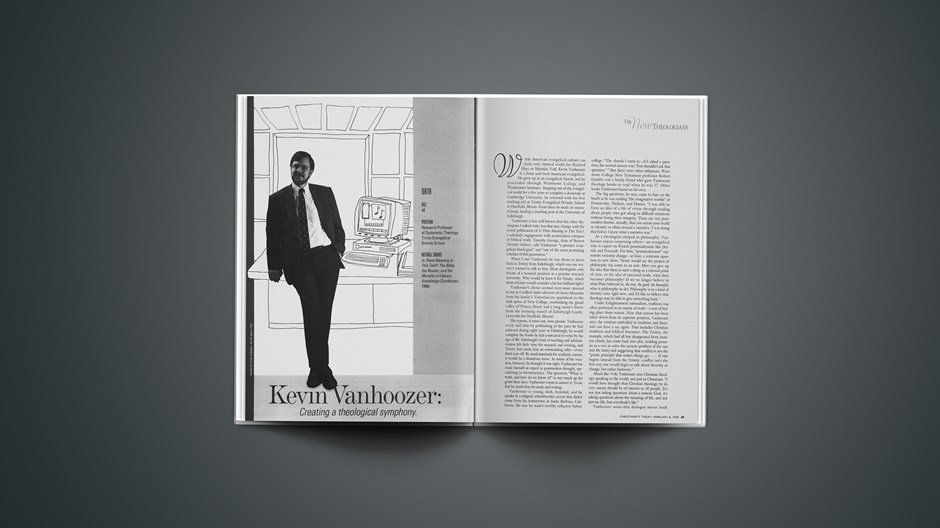
POSITION Research Professor of Systematic Theology, Trinity Evangelical Divinity School
NOTABLE BOOKS Is There Meaning in This Text?: The Bible, the Reader, and the Morality of Literary Knowledge (Zondervan, 1998)
While American evangelical culture can claim only limited credit for Richard Hays or Miroslav Volf, Kevin Vanhoozer is a born-and-bred American evangelical. He grew up in an evangelical church, and he proceeded through Westmont College and Westminster Seminary. Stepping out of the evangelical world for a few years to complete a doctorate at Cambridge University, he returned with his first teaching job at Trinity Evangelical Divinity School in Deerfield, Illinois. From there he made an unusual jump, landing a teaching post at the University of Edinburgh.
Vanhoozer is less well known than the other theologians I talked with, but that may change with the recent publication of Is There Meaning in This Text?, a scholarly engagement with postmodern critiques of biblical truth. Timothy George, dean of Beeson Divinity School, calls Vanhoozer "a premier evangelical theologian" and "one of the most promising scholars of this generation."
When I met Vanhoozer he was about to move back to Trinity from Edinburgh, which was one reason I wanted to talk to him. Most theologians only dream of a tenured position at a premier research university. Why would he leave it for Trinity, which most scholars would consider a far less brilliant light?
Vanhoozer's choice seemed even more unusual to me as I walked under showers of cherry blossoms from his family's Victorian-era apartment to the dark spires of New College, overlooking the grand valley of Princes Street and a long stone's throw from the looming massif of Edinburgh Castle. Leave this for Deerfield, Illinois?
His reasons, it turns out, were prosaic. Vanhoozer wryly said that by publishing at the pace he had achieved during eight years at Edinburgh, he would complete the books he had contracted to write by the age of 88. Edinburgh's load of teaching and administration left little time for research and writing, and Trinity had made him an outstanding offer—every third year off. By usual standards for academic careers, it would be a disastrous move. In terms of his vocation, however, he thought it was right. Vanhoozer has made himself an expert in postmodern thought, specializing in hermeneutics. The question "What is truth, and how do we know it?" is very much up for grabs these days. Vanhoozer wants to answer it. To do that he needs time for study and writing.
Vanhoozer is young, dark, bearded, and he speaks in a clipped, schoolteacher accent that didn't come from his hometown in Santa Barbara, California. He says he wasn't terribly reflective before college. "The church I went to—if I asked a question, the normal answer was, 'You shouldn't ask that question.' " But there were other influences. Westmont College New Testament professor Robert Gundry was a family friend who gave Vanhoozer theology books to read when he was 17. Other books Vanhoozer found on his own.
The big questions, he says, came to him on the beach as he was reading "the imaginative worlds" of Dostoevsky, Dickens, and Dumas. "I was able to form an idea of a life of virtue through reading about people who got along in difficult situations without losing their integrity. These are very postmodern themes, actually, that you orient your world or identity or ethics around a narrative. I was doing that before I knew what a narrative was."
As a theologian steeped in philosophy, Vanhoozer enjoys surprising others—an evangelical who is expert on French postmodernists like Derrida and Foucault. For him, "postmodernism" represents welcome change—at least, a welcome openness to new ideas. "Some would say the project of philosophy has come to an end. After you give up the idea that there is such a thing as a rational point of view, or the idea of universal truth, what then becomes philosophy? If we no longer believe in what Plato believed in, the true, the good, the beautiful, what is philosophy to do? Philosophy is in a kind of identity crisis right now, and I'd like to believe that theology may be able to give something back."
Under Enlightenment rationalism, tradition was often portrayed as an enemy of truth—a sort of hiding place from reason. Now that reason has been taken down from its supreme position, Vanhoozer says, the wisdom embodied in tradition and literature can have a say again. That includes Christian tradition and biblical literature. The Trinity, for example, which had all but disappeared from modern minds, has come back into play, holding promise as a way to solve the ancient problem of the one and the many and suggesting that conflict is not the "prime principle that makes things go. … If one begins instead from the Trinity, conflict isn't the first way one would begin to talk about diversity or change, but rather harmony."
Article continues below
Much like Volf, Vanhoozer sees Christian theology speaking to the world, not just to Christians. "I would have thought that Christian theology by its very nature should be of interest to all people. It's not just asking questions about a remote God; it's asking questions about the meaning of life, and not just my life, but everybody's life."
Vanhoozer notes that dialogue moves both directions. In many ways, he says, evangelical theology with its emphasis on propositional truth and law is a step-child of the Enlightenment. "I'm not denying inerrancy, but it's not big enough." It offers only a partial rendering of the whole picture of biblical truth, compared to the wideness of Scripture's narrative, song, poetry, and aphorism. "We are trying to get away from an idea of language simply picturing the world. A promise, for example, has a much more complicated relationship to the self and others. You can become a positivist, but why? Does this do justice to Brahms?"
The reference to Brahms is not incidental. Vanhoozer is a gifted pianist, and after college spent a year in France developing an evangelistic program organized around concerts of classical music. It was "a test case for me," he says. "What I didn't want to do was to put classical music next to some kind of Christian witness without any explanation of what the connection was. That seemed to me to be a gimmick. The Christian director I was working with felt that Christian witness meant smiling when you sing. I was only 21, but I hadn't given up a year of my life to put together a group of concerts for people to smile. It was my personal challenge to come up with a way of witnessing to a French public that would not be gimmicky. What was the connection between the music of the West, these masterpieces, and the Christian faith we wish to proclaim?"
A television show by Leonard Bernstein gave him a theme: the joy of music. "Is that a kind of soporific effect, like a drug?" Vanhoozer asked. "Or is music putting us in touch with a level of reality that we glimpse and then fall back from? Using the analogy of music, we were able to introduce the idea of God as composer and conductor, the idea of differences, cosmic harmony, but also the idea of dissonance. There are wrong notes. There are passages that make us weep. Some bits of music are so beautiful it hurts. Others are cacaphonic. The problem of evil appears in music, as it were."
Article continues below
Vanhoozer organized over 50 concerts by several troupes of American musicians. (He also met the woman who would become his wife, a new Christian from the south of France named Sylvie.)
This experiment with music is often in Vanhoozer's mind when he thinks about truth. "Brahms says a lot, but if you try to sum it up in a proposition, the way we often try to sum up the Bible in a proposition, you lose so much. My early work with music and mission has helped me to see the same problem in other areas of theology." Vanhoozer's hope: to capture the fullness of truth, not losing something in the translation. In an academic world skeptical of any truth, he wants to show that the true, the good, and the beautiful still have meaning in Christ. To do that means expanding beyond the categories recognized by Enlightenment rationalism. Vanhoozer thinks, in musical terms, of "polyphony"—many voices creating one music. He hopes for something "akin to the Reformation, in which the church recovers the literature of the Bible, and has what Lewis calls a baptism of our imaginations."
Another way forward is to think in terms of witness. There, the human qualities of the witness must come together with his words. He notes that the word martyr first meant "witness." "It's not enough to state the truth, you must suffer for it. … The goal of theology is wisdom, not knowledge. You have to be a model as a theologian. I think suffering is a part of that."
In all this, Vanhoozer aims to learn in dialogue with people who don't share his faith. Given his evangelical heritage, he is well aware of a more antagonistic approach, but he doesn't believe in it. "I've been on football teams where all the fouls [are said to be] on the other side. I never believed that story. I never believed it about myself, and I never believed it about my teammates.
"Interestingly, when I think back to my career at Westmont, and to some extent at Westminster, no one breathed a word of postmodernism. The idea that modernity could be criticized was not even on the horizon, with the possible exception of [Cornelius] Van Til's presuppositional apologetic. And this despite the fact that [a critic of modernity like] Kierkegaard had written a hundred years before, that Nietzsche had written a hundred years before, that Barth had written fifty years before. … Evangelicals had tied themselves to the mast of the modern ship." Vanhoozer notes that modernist thinking, which has been so devastating to orthodox faith, ultimately fell to a critique brought by linguistics and the philosophy of science. "I regret that. I wish I could say that it is because of genuine theological insight that the dragon was slain."
Article continues below
Vanhoozer has no doubt, then, that the university has truth he needs to learn—not merely errors he needs to counter. "The nice thing about being in a university is that the men are no longer straw. They're standing right in front of me, not at all prepared to be blown over." The university's critical questions and competing points of view makes it, Vanhoozer thinks, an ideal place to practice theology.
Just like Miroslav Volf, Vanhoozer sees the true enemy not in competing theologies but in the persistent agnosticism of our culture. "There is a feeling among a number of my students that the subject of God is such that knowledge doesn't apply—and shouldn't we be tolerating different points of view anyway? That means theology becomes phenomenology, merely a description of the differences. It's breeding a spiritual quality of indifference. I'll ask a question, my students will trot out some of the things they've heard, but then they'll say, 'But in the end it's God, so who knows?' And then they might add, 'Who cares?'
"I try to attack the prejudice that agnosticism is right. Can you be sure that knowledge about God is not available? And then, what are the implications of this agnosticism? Are you really telling me that certain cultures or religions or value systems are not better than others? Is there no such thing as a false religious idea? Are you really prepared to live with the implications of this position?"















 While we pray for peace, we need moral clarity about this war.
 We’ve got little information on Jesus’ appearance and personality. But that’s the way God designed it.españolFrançais
 NIL deals in college athletics present new challenges—and opportunities—for colleges and students.






