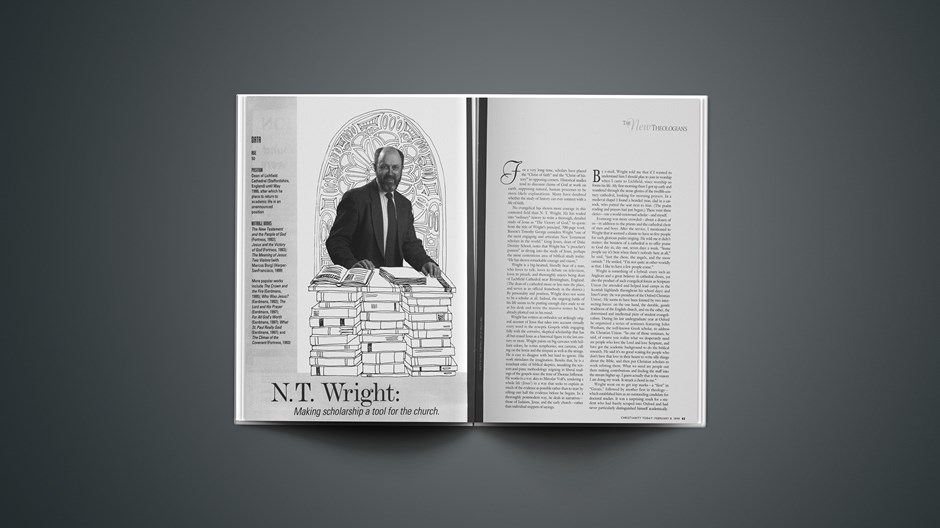
POSITION Dean of Lichfield Cathedral (Staffordshire, England) until May 1999, after which he plans to return to academic life in an unnanounced position
NOTABLE BOOKS The New Testament and the People of God (Fortress, 1992); Jesus and the Victory of God (Fortress, 1993); The Meaning of Jesus: Two Visions (with Marcus Borg) (Harper-SanFrancisco, 1999)
More popular works include The Crown and the Fire (Eerdmans, 1995); Who Was Jesus? (Eerdmans, 1992); The Lord and His Prayer (Eerdmans, 1997); for All God's Worth (Eerdmans, 1997); What St. Paul Really Said (Eerdmans, 1997); and The Climax of the Covenant (Fortress, 1993)
For a very long time, scholars have placed the "Christ of faith" and the "Christ of history" in opposing corners. Historical studies tend to discount claims of God at work on earth, supposing natural, human processes to be more likely explanations. Many have doubted whether the study of history can ever connect with a life of faith.
No evangelical has shown more courage in this contested field than N. T. Wright. He has waded into "ordinary" history to write a thorough, detailed study of Jesus as "The Victory of God," to quote from the title of Wright's principal, 700-page work. Beeson's Timothy George considers Wright "one of the most engaging and articulate New Testament scholars in the world." Greg Jones, dean of Duke Divinity School, notes that Wright has "a preacher's passion" in diving into the study of Jesus, perhaps the most contentious area of biblical study today. "He has shown remarkable courage and vision."
Wright is a big-hearted, friendly bear of a man, who loves to talk, loves to debate on television, loves to preach, and thoroughly enjoys being dean of Lichfield Cathedral near Birmingham, England. (The dean of a cathedral more or less runs the place, and serves as an official Somebody in the district.) By personality and position, Wright does not seem to be a scholar at all. Indeed, the ongoing battle of his life seems to be putting enough days aside to sit at his desk and write the massive tomes he has already plotted out in his mind.
Wright has written an orthodox yet strikingly original account of Jesus that takes into account virtually every word in the synoptic Gospels while engaging fully with the corrosive, skeptical scholarship that has all but erased Jesus as a historical figure in the last century or more. Wright paints on big canvases with brilliant colors; he writes symphonies, not cantatas, calling on the horns and the timpani as well as the strings. He is easy to disagree with but hard to ignore. His work stimulates the imagination. Besides that, he is a trenchant critic of biblical skeptics, assaulting the scissors-and-paste methodology reigning in liberal readings of the gospels since the time of Thomas Jefferson. He works in a way akin to Miroslav Volf's, rendering a whole life (Jesus') in a way that seeks to explain as much of the evidence as possible rather than to start by sifting out half the evidence before he begins. In a thoroughly postmodern way, he deals in narratives—those of Judaism, Jesus, and the early church—rather than individual snippets of sayings.
By e-mail, Wright told me that if I wanted to understand him I should plan to join in worship when I came to Lichfield, since worship so forms his life. My first morning there I got up early and wandered through the stone glories of the twelfth-century cathedral, looking for morning prayers. In a medieval chapel I found a bearded man, clad in a cassock, who patted the seat next to him. (The psalm reading and prayers had just begun.) There were three clerics—one a world-renowned scholar—and myself.
Evensong was more crowded—about a dozen of us—in addition to the priests and the cathedral choir of men and boys. After the service, I mentioned to Wright that it seemed a shame to have so few people for such glorious psalm singing. He told me it didn't matter; the business of a cathedral is to offer praise to God day in, day out, seven days a week. "Some people say it's best when there's nobody here at all," he said, "just the choir, the angels, and the snow outside." He smiled. "I'm not quite as other-worldly as that. I like to have a few people come."
Wright is something of a hybrid: every inch an Anglican and a great believer in cathedral choirs, yet also the product of such evangelical forces as Scripture Union (he attended and helped lead camps in the Scottish highlands throughout his school days) and InterVarsity (he was president of the Oxford Christian Union). He seems to have been formed by two intersecting forces: on the one hand, the durable, gentle traditions of the English church, and on the other, the determined and intellectual piety of student evangelicalism. During his last undergraduate year at Oxford he organized a series of seminars featuring John Wenham, the well-known Greek scholar, to address the Christian Union. "In one of those seminars, he said, of course you realize what we desperately need are people who love the Lord and love Scripture, and have got the academic background to do the biblical research. He said it's no good waiting for people who don't have that love in their hearts to write silly things about the Bible, and then put Christian scholars to work refuting them. What we need are people out there making contributions and feeding the stuff into the stream higher up. I guess actually that is the reason I am doing my work. It struck a chord in me."
Article continues below
Wright went on to get top marks—a "first" in "Greats," followed by another first in theology—which established him as an outstanding candidate for doctoral studies. It was a surprising result for a student who had barely scraped into Oxford and had never particularly distinguished himself academically. But Wright was working with unprecedented intensity—so much so that he gave up cricket and rugby, a wrenching decision for a good athlete who had always liked sports better than school. Wright still seems to grow slightly melancholy when he remembers the choice.
Having made up his mind to be a biblical scholar but lacking any precise role models, he studied according to his own ideas. "I'd always read the Bible, but I set myself during those two years [studying theology at Oxford's Wycliffe Hall] to read through the Old Testament in English twice a year, and the New Testament in Greek four times a year. I also tape-recorded Romans in Greek, Galatians in Greek, 1 Corinthians in Greek, John in Greek, Hebrews in Greek, and Isaiah in English. I used to listen to them while doing housework or driving the car or whatever. These texts were just constantly flowing through my head." He says that to this day he can recite nearly the whole of Galatians in Greek.
At first, Wright tended to see things in black and white. "There was all this liberal stuff on the one hand, and then the noble evangelicals saving the day. Of course, I realized before my first year at Wycliffe Hall was over that you couldn't actually divide scholars like that. A lot of liberals, including a gentleman named Rudolf Bultmann, were actually saying very sensible things. A lot of evangelicals seemed actually to be digging deep holes and jumping into them. There wasn't a clear line.
Article continues below
"I remember in the summer at the end of my first year reading [Joachim] Jeremias on the parables, and realizing that this man was by no stretch of the imagination an evangelical, and that I didn't want to agree with everything he said by any manner or means, but nevertheless, the heart of the matter was in him, that this man was a deeply devout Christian wrestling with Scripture. He might be wrong about lots of things, but I had to do business with him. I think that sort of opened me up, and opened up possibilities."
Wright did his doctoral studies under George Caird, studying Romans. To do so, he placed photocopies of Romans in Greek on a board and used the copies as the backdrop for his study of the book. "I would often spend hours and days with colored felt tip pens, just getting the whole picture of Romans and how it worked—covering the board with scribbles and dots and dashes and bits and pieces of this and that, and noticing particularly the way in which—almost like themes in a symphony—there were clusters of words at a certain point which then occurred somewhere else. These didn't by any means always tally with the structure that I had been taught to look for. I was testing some ideas, and thumping my nose against the reality of the letter."
Then came a research fellowship at Merton, one of the Oxford colleges, followed by a chaplaincy at Downing College in Cambridge. There he finished his doctoral thesis, working over holidays at Tyndale House. Then he took his first real teaching job, at McGill University in Montreal.
Wright keeps carefully annotated notebooks, in which he records his thoughts. In going back over these, he has found, somewhat to his surprise, that his years at McGill were extraordinarily creative. Though years would pass before he put his thoughts into published form, it was while at McGill that Wright began to see a grand unified picture of the New Testament. This picture lies behind his multivolume work-in-progress entitled Christian Origins and the Question of God.
The surprise comes because the McGill years were desperately unhappy in some respects. His wife, Maggie, was miserable, saddled with small children and no car, far from friends and family. Wright's doctoral thesis was bruisingly rejected by a publisher. Wright fell into a deep depression. Some of it, he thinks now, was delayed culture shock. "Partly I was allowing myself to get grossly tired, without realizing that I was. We were living outside Montreal, I was commuting in, and it was winter, dark and cold. I got physically drained, and not allowing for the fact that I was physically drained, and then trying to flog myself all the harder, and then feeling guilty if I couldn't do it, I got highly irritable. I didn't like myself very much in that period." Only through counseling and the healing of memories did he eventually emerge from the gloom.
Article continues below
Nevertheless, something marvelous was happening underneath. Wright had been working on a Tyndale Commentary on Colossians. "When I wrote the first draft, in '82 or '83, I had real problems with the material in chapter 1 about Christ and the powers. I remember reading Caird's commentary, and I didn't understand what he was saying about the passage."
When he returned to Colossians after his depression, he recalls, "not only did it all make sense, but I couldn't understand what it was that I hadn't understood before." Instead of thinking about gospel and salvation as being something that saved people apart from the world, "I was being challenged to see the gospel as something which was basically God saving the world. The gospel declared something that was publicly true about the whole world rather than simply opening up an option into which I as an individual and other individuals could step."
Another revelation came when he taught a New Testament Introduction class. He began with a synopsis of the period from the Maccabees to John the Baptist, including the history of the Pharisees, the Essenes, chief priests, and Herod. "The whole of the warp and the woof of first-century Jewish history was just so exciting. I then went, gunk, we now get to Jesus and the kingdom of God. Do we take a step back, put on a different tone of voice, and detach Jesus and the kingdom of God from this flow of history that is so alive and meaningful and exciting and dramatic? Or do we just carry on with the history and see what all that stuff might have meant?"
"The academic world has been in pain because it has tried to separate the spiritual from the academic. I think it was my vocation to stand with one arm holding onto one and one arm holding onto the other."
—N. T. Wright
That, in a nutshell, is what Wright has been trying to do ever since: write about Jesus as part of the flow of Jewish history. Wright is trying to understand what Jesus meant to first-century Israel with all its political and religious turmoil. His Jesus has Abraham very much in view, but also the Roman legions marching in the streets of Jerusalem. He believes Jesus addressed his life to that moment in history, not to "timeless truths," a phrase he often uses with scorn.
Article continues below
His fundamental insights came in the early eighties, but not until the summer of 1989, long after he had returned to Oxford, did Wright have a sabbatical. He went to Jerusalem and holed up to write his book about Jesus. The project grew while he was there. In one Herculean summer he drafted The New Testament and the People of God, a 500-page book on New Testament background; Jesus and the Victory of God, a 700-page volume on Jesus; and, he says, about half of a volume on Jesus' resurrection—material that had to be pulled out of Jesus and the Victory of God because it was too long. Beyond finishing that book, he plans to write volumes on the Gospels, on Paul, and on the development of the first-century church. Nobody who knows him could believe that it will stop there. He has a fertile vision, which he sometimes complains of. "Many, many times in the last 20 years I have said in prayer, 'Look, I've got enough big ideas for one lifetime. Please, can I just work these out rather than getting any more?' "
Wright is a peculiar figure in the scholarly world, not least because for the time being he has left the university for a cathedral. I asked him whether that implied a judgment on the university. He indicated it has more to do with his own divided personality. He wants to be a priest and pastor, and he wants to be a scholar, and those two are rarely united. "I suppose part of the aca-demic world has been in pain because it's tried to separate the spiritual from the academic. I think it probably was my vocation, painful as it was, to stand with one arm holding on to one and one arm holding on to the other, and to be in prayer at that point." His reason for going to Lichfield, however, was just that he was promised time to write. Whether he will spend the rest of his life in a church setting or a university setting is far from clear to him.
I asked him whether he found barriers against orthodox positions in the academy. He said he thought so, though they were subtle. He cited a panel discussion at a scholarly gathering where all the participants were asked to say something they positively disbelieved about Jesus, as well as something they believed. "There is a sense in some circles that you must put your liberal credentials on the table by saying here is the list of ten things in the Canon which I don't go with. I'm afraid I got out of it by picking a couple of bits from the Gospel of Thomas and saying I'm quite sure that Jesus did not say that.
Article continues below
"Sometimes, it's senior scholars who look back with a certain embarrassment to a time when they were quite conservative themselves. This is so particularly in America where so many of your biblical professors are biblical professors because the stuff grabbed them by the throat when they were 19 or 22. Then they went off to college, and at the same time that they discovered that someone other than Mother could cook, they discovered about JEDP [the hypothetical non-Mosaic sources for the Pentateuch]. Probably they learned to disbelieve in the miracles of Jesus at the same time they first had sex. For them this stuff is part of liberation. To say maybe the conservative position is right is really to undermine their lives."
I asked Wright whether that would describe a younger generation of scholars. "Oh, no," he said, laughing; "they have sex much earlier."
Even so, Wright doesn't find it distressing to mix it up in the academy. On the contrary, he is extremely friendly with several leading scholars of the Jesus Seminar; they often go out to eat together after a conference. "I engage in a great deal of dialog with people like Crossan and Borg. Often that dialog is as one historian to another. What was really going on in these events that are here recorded? Or, in Pauline theology, what did Paul actually mean in this verse? I would expect to do business with a Jew, with an atheist, with an agnostic, with a Russian Orthodox, or whatever on those terms. I mightn't persuade them, because reason ain't everything, and some of this stuff is very underdetermined anyway. Historically, there are various things which could, in theory, be possible; the argument doesn't absolutely force us to go this way, like anything in interpreting Shakespeare or writing the history of Elizabethan England or whatever. Scholars can legitimately disagree.
"I suppose the difference between the Christian and the non-Christian at this point is that the Christian is prepared to say, 'I don't like the sound of this, but golly, if this is what it really means, I'm going to have to pray for grace and strength somehow to get that into my heart and soul and be shaped by it.'"
Article continues below
For Wright, as for many of the scholars I spoke with, the more distressing difficulties lie in their relationships with conservative Christians. "Within orthodoxy, there is always a danger of faith collapsing into fear. I'm speaking autobiographically here, because I'm thinking of reactions to my own work. I see myself as a deeply orthodox theologian, and I am wryly amused, and sometimes a little frustrated, when I see would-be orthodox people saying, 'Oh dear, have you seen what Tom Wright is doing? Are you quite sure he's an evangelical?'
"The Bible is the book of my life. It's the book I live with, the book I live by, the book I want to die by. How emphatic can I get about what the Bible means to me? But the Bible is God's book for God's people, and the security of God's people is ultimately in God. To get overprotective about particular readings of the Bible is always in danger of idolatry."
He explained himself in cricketing terms. "A front-foot batsman puts his front foot down the wicket and is going to have a go. He may get out, but he is likely to score a few runs in the process. The back-foot batsman is more cautious, and his instinct is to defend and be patient and wait for a chance. In my old age I'm becoming more of a front-foot batsman. I find myself thinking, Come on, life's too short to mess around here. There are things to be won out there, let's get on and do it."
I asked him how he would describe the "it" he wants to do. Wright said, "I would like to be instrumental. At the moment, a great many devout Christians do not believe that anything good can come out of serious, academic, historical study. They just don't believe it. Their seminary gave them plenty of evidence that these guys have got their heads in the clouds, or their heads in the sand, or both, and that the real world is different. I struggle to show again and again that when you really do business with the Bible at the fullest historical and theological level, then it is passionately and dramatically relevant, life changing, and community changing. And I suppose I would like to kick-start a biblical renewal within the church—not simply a renewal of private piety, though God knows if you got the sort of renewal I am talking about, it would drive people to their knees, it would fill their hearts with joy, it would challenge them at every possible level.
"Far too many people, especially within evangelicalism, think that the individual is all that matters, and that the corporate dimension is a distraction or diversion. Of course Christianity is deeply personal for every single Christian; nobody gets lost in the kingdom of God. But you can't play that off against the corporate dimension. If you get the corporate right, you get the personal thrown in."















 While we pray for peace, we need moral clarity about this war.
 We’ve got little information on Jesus’ appearance and personality. But that’s the way God designed it.españolFrançais
 Christian artists work at the intersection of music and climate change.






