In September 1559, Don Juan Ponce de Leon was led around the Plaza San Francisco in Seville, Spain, to take his place upon the platform where the Inquisitors would hear his confession. The public spectacles known as the autos da fe ("acts of faith") attracted huge crowds that came to witness the fate of those indicted for heresy. Don Juan, according to the documents of that time, had spent two years in prison for being "a damned Lutheran."
Don Juan said: "I wish to God that I had an income of 20,000 ducats and could use them to spread our faith all over Spain so that people might be enlightened to become Christians and know their faith." For this, "Don Juan was sentenced to die at the stake."
While Luther, Calvin, and Zwingli changed the face of Europe, the Spanish crown refused to give ground to the "Protestant Revolt." The country held out as the last bastion of Catholicism and ruthlessly guarded the faith. Emperor Charles V, the grandson of Ferdinand and Isabela (of Christopher Columbus fame), issued this decree in 1550:
No one, whatsoever his rank or condition, shall print, transcribe, copy, or knowingly have by him, receive, carry, keep, conceal, have in his possession, sell, buy, give, distribute, scatter, or let fall in churches, or on the street, or in other places, any books or writing composed by Martin Luther, Johann Oecolampadius, Huldreich Zwingli, Martin Bucer, John Calvin, or other heretics.
Despite the opposition, Juan de Valdez and Francisco de San Roman, most notably, could be considered Spanish "Reformers" who attempted to advance Protestantism. But the former was exiled in Italy while the latter was burned at the stake in Valladolid in 1540.
Today the continent that spawned the Reformation is considered "truly post-Christian," according to Patrick Johnson in Operation World. Evangelicals in Europe, he says, exist as an "irrelevant" Christian remnant. One salient point where the movement of God contradicts this assessment, he notes, is in "the turning of the Gypsy people to Christ." This is especially notable in Spain, which is in the midst of a cultural renaissance that has enabled Protestantism to take root and spring to life for the first time in the country's history. And one of the fastest-growing expressions of Protestantism in Spain arises from the Gypsy churches.
One wonders how, in the land of los conquistadores ("the conquerors") and Don Quijote, this disenfranchised reviled minority has become the catalyst for this surprising movement of God.
It has been long in coming, but recent religious freedoms in Spain have set the stage for a revival in Protestantism generally, and the Gypsy church movement particularly, after a tortured and convoluted history of religious repression. The political and religious consolidation of Spain under the Catholic church was initiated by Ferdinand and Isabela, los reyes catolicos ("the Catholic royals"), and heralded what was to become "the golden era" (for Spain, anyway) of their world domination, which was climaxed under their grandson, Charles V. Spain's glory was short-lived, however, as the country soon devolved into social and political chaos. From the sixteenth century to the late twentieth, the Spanish people had no voice as they endured centuries of political instability, monarchical madness, brutality, civil war, and repression.
When the dictator Francisco Franco died in 1975 and King Juan Carlos assumed the throne, he surprised everyone when he overturned Franco's despotic model of government and moved the country into a democratic system. By 1978 Spain had a new constitution and was formally recognized as a constitutional monarchy with a democratic political system.
But democracy, being a gift from the king, has meant that the people have not developed the level of appreciation for it as would be the case if they had had to fight and die for it. This has had a deleterious effect on the expansion of new-found religious liberties. These freedoms have been in effect on paper since 1978, but, for example, it has only been since 1992 that Protestant ministers could perform legally binding marriages and be included in social security.
Gypsies were persecuted during the Inquisition; decimated under Hitler; imprisoned and sometimes executed by Franco. It wasn't until July 1978 that they could no longer be legally discriminated against in Spain.
Says missionary Edwin Kerr, who has served with Latin America Mission (LAM) in both Latin America and Spain—the latter for nine years: "Twenty years [after constitutional freedom of religion], growth among evangelicals is almost nonexistent. There is a little growth among the charismatic and Pentecostal church," he says. "The only significant growth is among the Gypsy churches."
Half bronze, half dream
The Gypsies who inhabit Spain probably crossed the Strait of Gibraltar from Morocco in the fifteenth century. Gabino Fernandez Campos, founder and director of the Center for Reformation Studies, estimates that there are approximately 800,000 Gypsies in Spain, though some estimates put their numbers as high as 2-3 million. The Gypsies most likely migrated from India and today exist in India, Africa, America, and all over Europe, with the heaviest concentration in Romania. The Gypsies themselves claim to be descendants of Egyptian pharaohs (hence the terms "Gypsy" and gitano, which is Spanish for Egyptian).
Article continues below
They have preserved a strong ethnic identity—speaking various dialects of their common language, Romany—despite a history of persecution. Between 1499 and 1783, at least 12 Spanish laws were passed limiting their activities. Philip II (1556-98), who launched the autos da fe, called the Gypsies "a collection of vicious people drawn from the dregs of Spanish society." Some lived in caves and in otherwise unsanitary surroundings, and they have been accused of child stealing, witchcraft, and causing the plague. "Horse traders, beggars, blacksmiths, butchers, tinkers, smugglers, basketweavers, acrobats, fortune tellers," writes Allen Josephs in White Wall of Spain, Gypsies were known to be "haughty and hardy, aristocratic yet primative, thieving but fiercely loyal, salacious yet strictly chaste."
They were persecuted during the Inquisition; decimated under Hitler (500,000 died in concentration camps); imprisoned and sometimes executed by Franco. It was not until July 1978 that they could no longer be legally discriminated against in Spain.
The First National Gypsy Congress met last August and approved a petition "to live like the rest of their Spanish compatriots" and "to end the racism suffered since their arrival in Spain 475 years ago." According to their studies, 60 percent of the Spanish population show racist attitudes toward Gypsies; 40 percent would not marry a Gypsy; 35 percent of young people support the expulsion of all Gypsies from Spain.
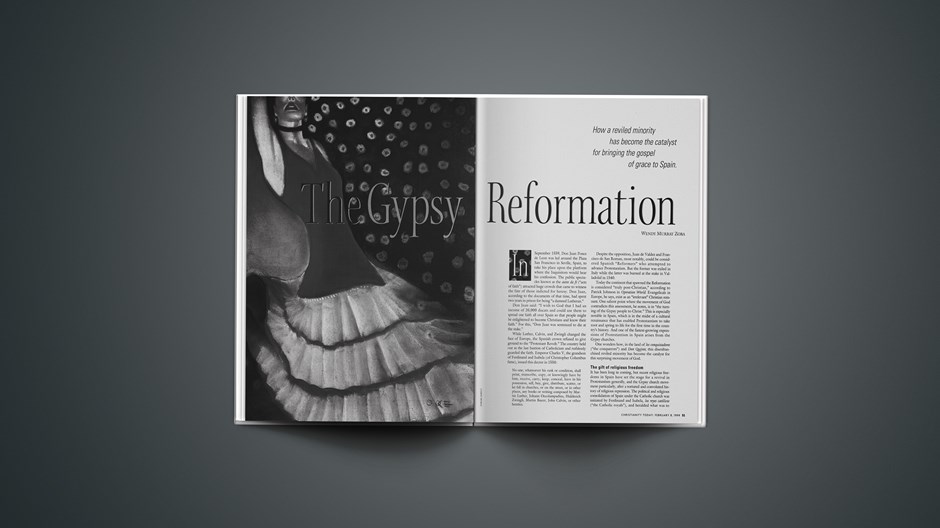
Ironically, tourism posters throughout the country showcase Gypsy culture. Federico Garc'a Lorca, the famed poet who died under Franco, characterized Gypsies as "half bronze, half dream" and did much to encourage appreciation for their heritage. This has won them, if not a place at the table in Spanish high society, at least a place in Spanish folklore. Images on posters of Gypsy women donning colorful frilly dresses, fringed shawls, with tied-back hair and raised arms showcase the country's passion for flamenco. "It's as if Gypsies were the most appreciated aspect of the culture," says Edwin Kerr.
Article continues below
The Gypsy love for flamenco illustrates their passion and mysticism, and demonstrates how this aspect of their identity has ripened them for the movement of the Spirit in Spain.
Flamenco was co-opted by the Gypsies from the Moriscos, persecuted Arabs (baptized as Christians) who remained in Spain after the expulsion of the Moors. It is more ritual than spectacle and involves equal parts lament and love song, anguish and sensuality.
A singer and guitarist improvise (there is no written form of this music), the former clapping and singing in earthy, throaty wails, while the latter attacks the strings of his guitar with his bare fingers. A dancer enters, male or female, and moves across the platform with fluid arm motions and exaggerated foot tapping. The clapping and wailing of the singer along with the rhythm of the guitar moves the dancer—sometimes in slow, measured foot tapping or sometimes in a frenetic outburst. There are moments in flamenco when the dancer's feet move so fast they are nothing more than a blur floating across the stage. (Flamenco dancers have been known to suffer coronary arrest during their performances.)
The Gypsies attribute an intangible "force" for giving flamenco its mystical aspect. They call it duende: the "mysterious power which everyone senses and no philosopher explains," wrote Lorca. In flamenco, he said, "duende climbs up inside you, from the soles of your feet."
One writer said that "Spain is a tragic land, its songs are sad songs, and its dances are tragic dances." Flamenco, as an expression of this passion and suffering, has struck a chord with the general populace in Spain. This is why Gypsy dancers grace tourism posters. It is also how the duende-sensitive Gypsy culture is helping Protestantism gain a foothold in Spain. One could say a kind of "sanctified duende" is capturing their longings, igniting their churches, and empowering them as a robust expression of fledgling Protestantism in Spain today.
The Filadelfia movement
Francisco Garcia Gutierrez—a Spaniard, not a Gypsy—was a drug addict and a goat herder who was led to the Lord by a "Gypsy brother." "I was raised in the fields taking care of goats, and this brother, a goat herder and a Gypsy, was a very rough man—one who would be ready to stab anybody," he says. "Because he had been converted to God, because of his testimony, he showed me that God exists. At first I was very doubtful about the Word of God. But God supplied according to my necessity, and from there, I turned myself to God. He gave me a burden. I was baptized, and here I am, serving God."
Article continues below
The Gypsy church phenomenon is part of the Filadelfia movement, named for the church in Revelation 3 that had "little strength" but obeyed the command "to persevere" (vv. 8, 10). The movement began in France in 1950 when a pastor named Clement Le Crossec "heard the Lord" tell him to witness to a Gypsy woman who was passing by. It reached Spain in 1966 when several Gypsy men went to work as farm laborers in France, heard the gospel, and returned to preach it to their families.
Francisco serves as a deacon in the Filadelfia congregation in Brenes, on the outskirts of Seville. The fact that he is a Spaniard attending a Gypsy church does not faze him: "I was brought up among Gypsies. I have been accepted among the Gypsies as one of their brethren in the Lord. I love them, and they give me a great deal of love."
The congregation at Brenes and several other small churches in the neighborhoods outside Seville were started by Jose Serrano, 59, who would go out to preach, attracting crowds of 400 to 500 people. "I would get afraid to continue," he says, "because I didn't have a formal education and felt I was doing things that I wasn't really prepared to do. But the people would say, 'Go on.'
"I got in touch with a French missionary, and we founded a church. Today the church has 500 to 600 members in every neighborhood of the Seville [area]. God takes up an instrument from the despised of the world—he chooses that to confound the wise."
Various aspects of the Gypsy culture have enabled the Filadelfia churches to take root and grow quickly. First, Gypsies are clannish and family centered, which means that entire families or villages will convert, even if only one member does so initially. Sometimes the village tio, a tribal chief, will proclaim: "We are all going to become evangelicals," and the entire clan will start going to church.
Then there is the persecution factor. Says Kerr: "Perhaps the Gypsies, disenfranchised by society in general, turn to Filadelfia churches because they have nothing to lose by being different."
But there are other more subtle, but no less significant, factors that have enabled this minority to capture the movement of the Spirit. Historian Gabino Fernandez says their emotional intensity has translated into an equally enthusiastic commitment to the church: "In the same way that the Acts of the Apostles tell us people got together every day, they hold meetings and services most of the week."
Article continues below
Fernandez also notes that their mystical connection to music as a vehicle for storytelling has made song the primary mode of teaching and communicating the gospel. The majority are illiterate, he says, and "the only way they can learn is through listening"; and music is how the Gypsies express their deepest longings.
"Their music is nothing like the grand choruses of the sixteenth century or the hymns of Charles Wesley, nor even the American revival of the nineteenth century," says Fernandez. "The music is 'from the earth'—it is the way they feel it."
It is like flamenco.
During one service, the flock of about 35 gathered in the small sanctuary of the rented building. Spanish tiles, a remnant of the Moorish influence, covered the walls; a red velvet curtain draped the pulpit area; artificial sunflowers graced the platform. The women sat in front and the men in back.
Pastor Francisco Gorreta stood at the pulpit, guitar in hand, and moved the congregation in and out of differing moods of spontaneous singing. There were no hymnals or overheads. Sometimes he prayed as he played, and people raised their hands and sometimes the hand of their neighbor. A man sitting on a wooden box used it as a drum, and sometimes the clapping became so rhythmic and forceful that the guitar stopped and the clapping and tapping carried the song.
An older man with white lightning bolts in his long, black beard came to the front and recited from memory a poem he had composed. He spoke about his "torment" and the "fire from hell" and how God rescued him. Francisco the deacon received the tithes as people left their seats to present their gifts and sometimes take out change. Jose Serrano preached so loudly that Francisco adjusted the sound system more than once.
"Cristo esta aqu'" ("Christ is here"), said Serrano when he took the pulpit. "Open the door of your heart." After a rousing 20 minutes of preaching punctuated by "Gloria a Dios" or "Si, Senor" ("Glory to God"; "Yes, Lord"), he concluded: "Live in the One who presents you alive!"
Pastor Gorreta says that shepherding a Filadelfia church is "continuous work." He is a "peripatetic salesman"—a street vendor—who sells handmade clothing during the day. At night he goes directly to the services, which meet every evening except Monday. After the service he fulfills other pastoral duties, like visiting the sick, and often doesn't get home "for supper" until 11:00 p.m. He is frequently out until 2:00 a.m. To study the Word and to pray, he says, he gets up very early in the morning.
Article continues below
"Even though it is a very hard work, it is a great privilege to be always occupied in the work of the Lord. There are two reasons: One is doing what the Lord has called me to do; the other is the Devil can't get at you with laziness, because laziness doesn't fit in the schedule."
Breaking up hardened ground
While churches in the Filadelfia movement are flourishing, the larger picture of evangelicalism in Spain is not as robust. According to statistics from the Spanish Seminary for Theological Formation & Evangelization along with the estimates of historian Gabino Fernandez, in Spain today, a nation of 40 million, only one-tenth of 1 percent claim to be "born again"; over 15 million live in towns or villages where there is no evangelical presence; there are around 1,700 evangelical churches in Spain, of which approximately 600 are Filadelfia (Gypsy) congregations.
The lethargic growth of Protestantism in Spain has been striking for Kerr, who, before coming to Spain, served in Latin America where Protestantism has exploded. "There are a lot of Latin American evangelicals coming to Spain as missionaries. I could list five or six groups that have written books about why their campaign worked in Latin America and how, when they came to Spain, it fell flat.
"In Latin America, they would have a campaign for six months and get 4,000 people coming. From that they would start a church. Maybe 2,000 would leave, but that still left 2,000 to form a fairly good nucleus for a church. The exact same leaders come to Spain and are left with two or three struggling churches with 15 members or less."
The cultural stigma of non-Catholic religious expressions accounts for part of this sluggishness, but not all of it. Other factors have also inhibited growth, according to Kerr. First, he says, evangelical churches remain under the cloud of "psychological repression" they endured for centuries. "People were told [under Franco] they were ungovernable, and the evangelicals were the lowest of the low," says Kerr. "They have developed an attitude of slavery that says, 'I'm not worth anything,' and so they did not aggressively communicate the faith."
Second, he says, there is a "nostalgia for persecution" that keeps some older members resenting new leadership that hasn't suffered the way they did. "The older people tell us stories of how their books were confiscated and their churches were closed and how some of their relatives spent time in the military jail because they wouldn't bow to the Virgin. When freedom came and people came from the outside who had never faced persecution," he says, "national leaders who had suffered under Franco felt swamped by newcomers and started saying, 'Where were you when we were being persecuted?' "
Article continues below
Finally, because the number of evangelicals is so small, the fear of "sheep stealing" has thwarted cooperation among churches.
Kerr, a veteran of church-growth movements, is nevertheless optimistic about the trajectory for church growth in Spain. He recalls a time when people "complained that the gospel was being preached only to the poor in Latin America." But, he says, "the poor are the ones who respond, because they know they're sick and need a physician."
In time, converts stopped wasting their money "on drink and women" and found that they could get ahead. This helped to establish the middle class in Latin America, which is also how the gospel reached the middle classes. The Protestant church in Spain, he says, has to be built up in the same way, "from the bottom up, as it was done in Latin America.
"It took 40 years to get the slaves out of Egypt and into the Promised Land," he says. "So in that sense, we're halfway through the desert."
And the fledgling evangelical presence in Spain is making strides. The Fraternity of Evangelical Ministers of Seville (FRAMES) has attempted to bring about more unity and cohesion through pastoral get-togethers and united worship services. Bringing evangelical pastors together, says Kerr, "helps them to see their strength."
Last May, Protestants in Spain made a historic showing of solidarity when thousands of evangelicals—half of them Gypsies, according to Fernandez—marched in towns throughout the country in a "Jesus March" lifting up the name of Christ. Kerr marched in a group in Seville with members from the Brenes congregation:
We followed—in reverse—the path taken by the first Protestants in Spain when they were led from their dungeons to the Plaza San Francisco for their "crimes" to be read in the auto da fe. They passed the cathedral outside the city gates to be burned at the stake.
As we marched past the cathedral a special mass was being held inside for the devotees of San Fernando—his "uncorrupted" body is brought out of the tomb every thirtieth of May . …
We marched past the main door proclaiming "Jesus lives!" and many people came out to stare. Finally a priest joined them. He looked up and down the street, open-mouthed—disbelief was on his face.
"San Fernando is dead, but Jesus lives!"
Article continues below
"You could see the Gypsies and the payos [white Spaniards] coming together to take part in it," says Fernandez. "The leadership [in the march] was well represented denominationally."
Fernandez, too, is optimistic about the future of evangelicalism in Spain. "In the last 20 years, the number of cities with evangelical churches has doubled," he says. "And the growth is solid." There are 25 evangelical radio stations, he says, Bible studies are increasing, and "the mentality that has prevented [evangelicals] from going onto the streets is almost gone. It happens more often that after the church service people will go out to the plazas and share the gospel with music and preaching."
"The Spaniards are 20, or 30, or 40 years behind Latin America," says Kerr. "The new phase will come, but a lot of ground-level work needs to be done until that can happen."
The Gypsy churches are doing a lot of that ground-level work. They are breaking up the hardened ground that, for so long, has kept the seeds of Protestantism from taking root. The Holy Spirit has captured their duende-longings and found his way up from the muddied feet of these earthy, worshiping people, their sad songs and tragic dances redeemed and transformed.















 While we pray for peace, we need moral clarity about this war.
 We’ve got little information on Jesus’ appearance and personality. But that’s the way God designed it.españolFrançais
 Interview with leader of new evangelical alliance describes his escape from Khartoum and the pressure to pick a side.






