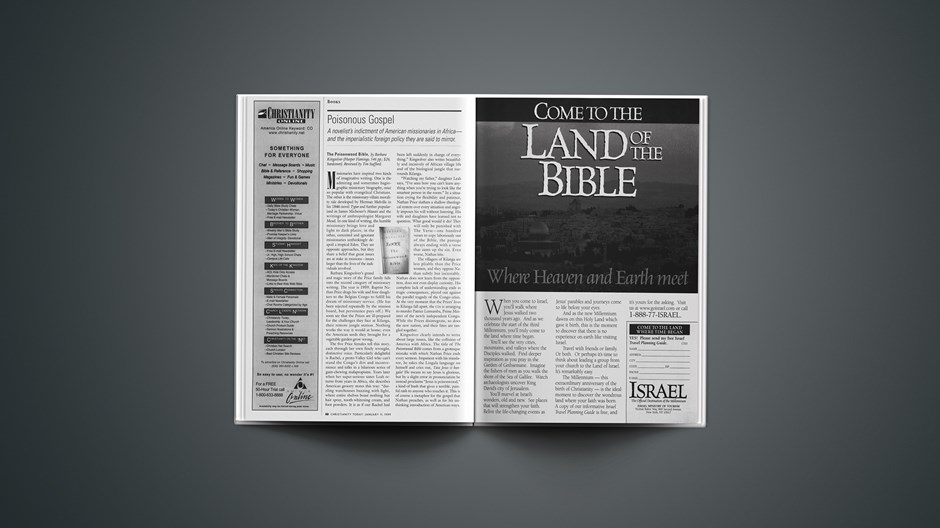
The Poisonwood Bible, by Barbara Kingsolver (Harper Flamingo, 546 pp.; $26, hardcover). Reviewed by Tim Stafford.
Missionaries have inspired two kinds of imaginative writing. One is the admiring and sometimes hagiographic missionary biography, once so popular with evangelical Christians. The other is the missionary-villain morality tale developed by Herman Melville in his 1846 novel Typee and further popularized in James Michener's Hawaii and the writings of anthropologist Margaret Mead. In one kind of writing, the humble missionary brings love and light to dark places; in the other, conceited and ignorant missionaries unthinkingly despoil a tropical Eden. They are opposite approaches, but they share a belief that great issues are at stake in missions-issues larger than the lives of the individuals involved.
Barbara Kingsolver's grand and tragic story of the Price family falls into the second category of missionary writing. The year is 1959. Baptist Nathan Price drags his wife and four daughters to the Belgian Congo to fulfill his dream of missionary service. (He has been rejected repeatedly by the mission board, but persistence pays off.) We soon see that the Prices are ill-prepared for the challenges they face at Kilanga, their remote jungle station. Nothing works the way it would at home; even the American seeds they brought for a vegetable garden grow wrong.
The five Price females tell this story, each through her own finely wrought, distinctive voice. Particularly delightful is Rachel, a proto-Valley Girl who can't stand the Congo's dirt and inconvenience and talks in a hilarious series of gum-chewing malapropisms. Years later when her super-serious sister Leah returns from years in Africa, she describes American grocery stores this way: "dazzling warehouses buzzing with light, where entire shelves boast nothing but hair spray, tooth-whitening cream, and foot powders. It is as if our Rachel had been left suddenly in charge of everything." Kingsolver also writes beautifully and incisively of African village life and of the biological jungle that surrounds Kilanga.
"Watching my father," daughter Leah says, "I've seen how you can't learn anything when you're trying to look like the smartest person in the room." In a situation crying for flexibility and patience, Nathan Price slathers a shallow theological system over every situation and angrily imposes his will without listening. His wife and daughters have learned not to question. What good would it do? They will only be punished with The Verse-one hundred verses to copy laboriously out of the Bible, the passage always ending with a verse that sums up the sin. Even worse, Nathan hits.
The villagers of Kilanga are less pliable than the Price women, and they oppose Nathan subtly but inexorably. Nathan does not learn from the opposition, does not even display curiosity. His complete lack of understanding ends in tragic consequences, played out against the parallel tragedy of the Congo crisis. At the very moment that the Prices' lives in Kilanga fall apart, the CIA is arranging to murder Patrice Lumumba, Prime Minister of the newly independent Congo. While the Prices disintegrate, so does the new nation, and their fates are tangled together.
Kingsolver clearly intends to write about large issues, like the collision of America with Africa. The title of The Poisonwood Bible comes from a grotesque mistake with which Nathan Price ends every sermon. Impatient with his translator, he takes the Lingala language on himself and cries out, Tata Jesus is bangala! He means to say Jesus is glorious, but by a slight error in pronunciation he instead proclaims "Jesus is poisonwood," a kind of bush that gives a terrible, painful rash to anyone who touches it. This is of course a metaphor for the gospel that Nathan preaches, as well as for his unthinking introduction of American ways.
Through arrogance and ignorance, glory gets turned into poison.
Unfortunately, there is a hole at the center of the book. Nine-tenths of the Prices' troubles start with Nathan, but he is incomprehensible-such a brute it is difficult to imagine what he can be thinking, or even that he is actually capable of thinking. No doubt his wife and daughters experience him as an unfathomable force of nature, but we readers expect more insight. Kingsolver has made a stick-figure male the hub of her gorgeously articulated females. She doesn't seem to have a clue what makes him tick.
There is another problem central to the novel. Since Kingsolver chose missionaries for her subject, you would think that religion was a main interest. Yet neither Orleanna Price nor her girls seem to have anything more than superficial belief, which is quickly blown away by tragedy. Neither faith nor doubt has any punch in The Poisonwood Bible. This makes me wonder whether Kingsolver has ever known a fundamentalist missionary.
Kingsolver sheds no light on the nature of single-minded, imperious missionaries. She is no better at showing how Nathan's preaching might actually work to poison African culture, or how American greed and power poisoned African politics. Such topics beg for a novelist's insight. Kingsolver, however, offers a cartoonish story of idiot missionaries and shady CIA operatives destroying the delicate fabric of the Congo, like bulldozers scraping their way through the forest jungle.
Article continues below
The tale seems oddly hollow in its telling, and Kingsolver seems to lose interest. She lets Nathan wander away and disappear as soon as she decently can, while her attention follows subjects far more personal and individual. African society and missionary culture are only a colorful backdrop for Kingsolver's detailed rendering of five lives absorbing a hammer's blow.
The telling of those lives almost absolves the book of its shortcomings. Kingsolver writes luminously of these women who flex and cling to life, surviving, absorbing blows, still hoping. Their voices are unforgettable-as distinctive and as indomitable as the African vegetation Kingsolver, a trained biologist, so intricately describes.
Have something to add about this? See something we missed? Share your feedback here.
Our digital archives are a work in progress. Let us know if corrections need to be made.
















 While we pray for peace, we need moral clarity about this war.
 We’ve got little information on Jesus’ appearance and personality. But that’s the way God designed it.españolFrançais
 After lobbying from fellow Southern Baptists and Christians affected by the war, the House speaker moves a package forward.






